Contact
 Help






Gold Hallmarks: A Guide to Marks, Stamps, and Standards
 Gold & Silver 101


A gold hallmark is the quickest way to find out what a piece of gold really is: how pure it is, where it was verified, and sometimes when and by whom it was made. In many countries, hallmarks are more than tradition. They’re a legal requirement, enforced by independent assay offices that test gold and stamp it before it can be sold. The UK requires a hallmark on almost every gold item over one gram, and India made hallmarking compulsory for gold jewellery in 2021.
The difficulty is that there’s no single system to learn. Hallmarking has been practised for more than 700 years, and almost every country has its own marks, symbols and rules. Some rely on government assay offices, some leave it to the maker, and some don’t require marks at all. A stamp that guarantees purity in one country may be little more than a maker’s claim in another.
This guide won’t catalogue every gold hallmark ever struck. That would take a book, not a page, but it will give you the tools to make sense of what you’re looking at. We cover what a hallmark is, how to read one, the main systems used around the world, and how to spot stamps that aren’t what they seem.
If you’re unsure whether a piece is genuine, our guide on how to test gold explains the checks that can confirm it. And if you’ve identified your gold and are thinking of selling, BullionStar buys gold jewellery at prices based on its gold content, including broken and unwanted pieces down to 8K, at prices based on its gold content.
What Is a Gold Hallmark?
A gold hallmark is an official mark struck into gold by an independent assay office to certify that the metal has been tested and meets a stated standard of purity. The term is often used loosely for any stamp on gold, but a true hallmark is applied by an authorised testing body, not by the maker or retailer marking their own work. A jeweller’s “18K” stamp is a claim. A hallmark is an independent guarantee.
Hallmarking exists because gold is easy to dilute and hard to check by eye. Before assay offices, buyers had no reliable way to know whether a piece was as pure as the seller said. Assay offices solved this by testing the metal and certifying the result with a mark. That certification is backed by law, so forging a hallmark, or selling gold that falls short of its stated purity, is a criminal offence in hallmarking countries rather than just bad practice.
In India, hallmark gold has a specific everyday meaning: jewellery carrying the Bureau of Indian Standards (BIS) hallmark, as opposed to unmarked or self-stamped pieces. Since hallmarking became compulsory there, buyers increasingly ask for hallmarked gold by name, and it typically resells more easily as a result.
Whatever the country, gold hallmarks exist for the same reason: to give buyers confidence that the gold they are paying for is the gold they are getting.
What Do Gold Stamps Mean?
A full gold hallmark is usually a small group of marks struck together, each answering a different question:
- Fineness (purity) mark: how pure the gold is, usually as a number such as 750 or 916, sometimes with a karat mark such as 18K.
- Assay office mark: where the gold was tested and certified.
- Sponsor’s or maker’s mark: who made the piece or submitted it for testing, usually as initials.
- Date letter: in some countries, such as the UK, a letter showing the year the piece was hallmarked.
Not every country uses all four, and some add their own. India’s BIS hallmark, for example, includes a unique six-digit code identifying the individual piece. The exact combination you see depends on where and when the gold was made.
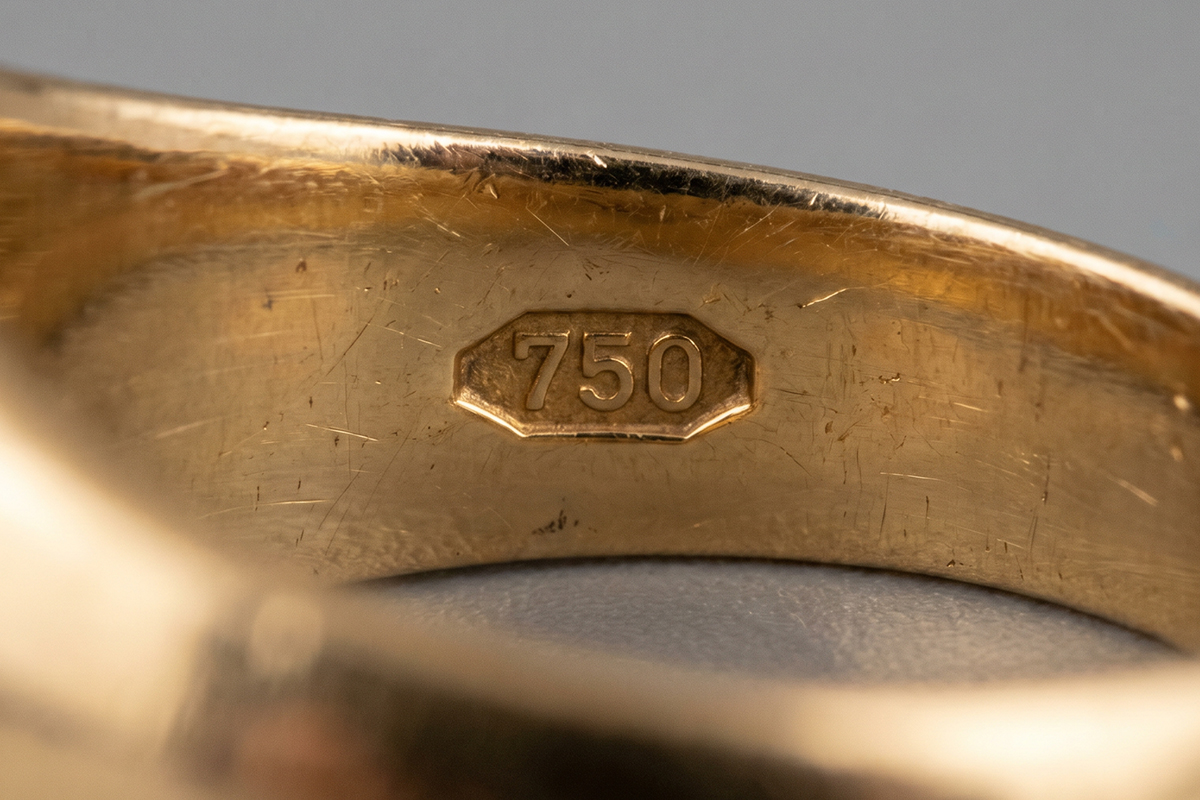
Many stamps you’ll find on gold are not full hallmarks at all. A ring stamped only “18K” or “750” carries a purity stamp, which is the maker’s own statement of what the gold is, with no independent testing behind it. That’s normal in countries without compulsory hallmarking, and the piece may well be genuine, but the stamp alone proves less than a full hallmark would. Some stamps don’t indicate solid gold at all, and the next section covers how to tell the difference.
How to Read a Gold Hallmark
Reading a gold hallmark isn’t about memorising thousands of stamps. It’s about knowing where to look, what each part of the mark represents, and where to check once you’ve noted it down.
Where to Find the Marks
Hallmarks are normally struck where they won’t spoil the design:
- Rings: inside the band.
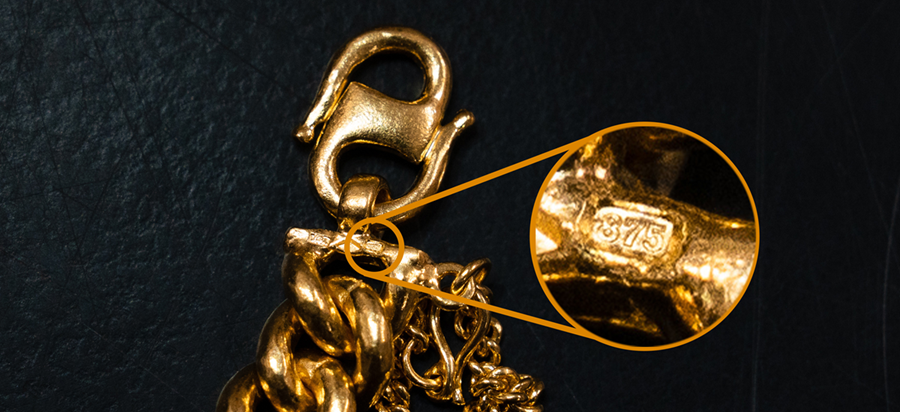
- Necklaces and bracelets: on the clasp, the jump ring next to it, or a small tag.
- Earrings: on the post or the back of the hook.
- Watches: inside the case back.
- Larger items: on the base or near a join.
Gold hallmarks are tiny, often only a millimetre or two high, and wear down with use. A jeweller’s loupe or magnifying glass makes a real difference. Many misread marks are simply marks read with the naked eye.
The table below uses a UK hallmark as an example of what each mark means:
| Mark | What it shows | Example |
|---|---|---|
| Sponsor’s or maker’s mark | Who submitted the item for hallmarking | Two or three initials inside a shield |
| Fineness mark | Purity of the gold, in parts per thousand | 750 (18 karat), set inside a shape reserved for gold |
| Assay office mark | Which assay office tested the item | Leopard’s head (London), anchor (Birmingham), rose (Sheffield) or castle (Edinburgh) |
| Date letter | The year the item was hallmarked | A single letter whose style indicates the year |
| Traditional mark (optional) | Gold, with a karat equivalent | A crown, often with “18" beside it |
From these marks you can usually tell who made a piece, where it was tested, how pure it is and when it was hallmarked. Date letters and sponsor’s marks can then be checked against published reference charts. Note exactly what you see, including the shape of the shield around each mark, since the outline often matters as much as the symbol inside it. Having a clear photo available to quickly compare can also be helpful.
Hallmarks on Gold Bars and Coins
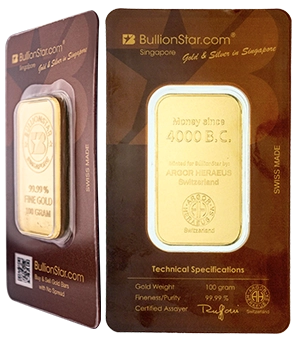
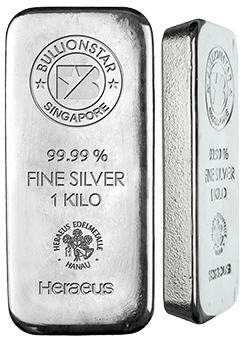
Gold bars and gold coins are a special case. Coins are typically exempt from hallmarking because the issuing mint or government already guarantees their content, and investment bars are treated as raw material rather than finished items. You won’t find a multi-part hallmark on either.
They’re still clearly marked, though. A reputable gold bar carries the refiner’s name or logo, its weight, its fineness (usually 999.9) and often a unique serial number. Bullion coins show their weight and fineness as part of the design. These aren’t hallmarks in the legal sense, but they serve the same purpose: they identify who stands behind the product. That’s why buying bullion from an LBMA-accredited refiner or a recognised national mint matters.

Pseudo Hallmarks and Gold-Plated Marks
Not every mark that looks official is one. Some stamps are designed to look like hallmarks without ever passing through an assay office, and others are outright forgeries. Look closely at the size, sharpness and detail of every mark before assuming it’s genuine.
The most common source of confusion is gold plating. Marks such as GP (gold plated), GEP (gold electroplated), HGE (heavy gold electroplate), GF (gold filled) and RGP (rolled gold plate) show that a piece is only coated in gold over a base metal. A stamp like “18K GP” means a thin layer of 18K gold, not an 18K piece. For a full list of purity and plating marks, see our guide to gold purity.
Gold Hallmarks by Country
Gold hallmarking developed differently almost everywhere it was adopted. Some countries require every piece to be tested by a government assay office, some leave it to the maker’s own stamp, and some don’t require marks at all. These are the systems you’re most likely to come across.
British Gold Hallmarks
Britain has one of the oldest hallmarking systems in the world. It dates back to a statute of 1300 and is still enforced today under the Hallmarking Act 1973. Any gold item weighing more than one gram must be hallmarked before it can be described or sold as gold, and items below that weight are exempt.
A UK gold hallmark has three compulsory marks:
- Sponsor’s mark: the initials of the maker or the business that submitted the piece.
- Fineness mark: the purity in parts per thousand (375, 585, 750, 916, 990 or 999).
- Assay office mark: a leopard’s head for London, an anchor for Birmingham, a rose for Sheffield or a castle for Edinburgh.
Two further marks are optional: a date letter showing the year of hallmarking, and the traditional mark for gold, a crown, often shown with the karat (such as “18”). Because the system is so standardised, British hallmarks are some of the easiest to start learning about.
Indian Gold Hallmarks (BIS)
India is the world’s second-largest market for gold jewellery, and since 2021 hallmarking has been compulsory there. The scheme is run by the Bureau of Indian Standards (BIS) and rolled out district by district, reaching 380 districts by 2026. Small items under 2 grams are exempt.
Since July 2021 a BIS hallmark has had three parts:
- The BIS logo: a triangle-shaped mark.
- The purity grade: shown as karat and fineness together, such as 22K916 or 18K750.
- A six-digit HUID (Hallmark Unique Identification): an alphanumeric code unique to each piece.
Since 1 April 2023, hallmarked jewellery can only be sold in India if it carries a HUID. Buyers can check a HUID using the BIS CARE app, which shows the piece’s purity and the jeweller who registered it. The permitted gold grades are 14K, 18K, 20K, 22K, 23K and 24K.
Swiss Gold Hallmarks
Switzerland’s system is run by the Central Office for Precious Metals Control, part of the Swiss customs authority. Official hallmarking is compulsory for gold, silver, platinum and palladium watch cases sold in Switzerland, which carry the official mark of a St Bernard dog’s head. For other articles, including jewellery, official testing is optional, but every piece must carry the maker’s registered responsibility mark alongside its fineness.
Swiss law also tightly regulates gold bars. Only licensed refiners can produce them, and each bar must carry the refiner’s mark. This is one reason Swiss-made bars from refiners such as PAMP, Valcambi and Argor-Heraeus are trusted around the world.
Italian Gold Hallmarks
Italy has no assay office. Instead, Italian law requires gold to carry two marks: the fineness (most often 750 for 18 karat) and a maker’s identification mark. This mark is a lozenge-shaped stamp containing a number registered to the manufacturer and the code of its home province, such as AR for Arezzo or VI for Vicenza. With the two marks together, any Italian piece can be traced back to its maker.
US Gold Marks
The United States has no government hallmarking at all. There’s no assay office, and no legal requirement to mark gold in the first place. Under the National Gold and Silver Stamping Act of 1906, if a maker does stamp a karat, such as “14K”, the gold must meet that standard, and the stamp must be accompanied by the maker’s registered trademark. The Federal Trade Commission also sets 10 karat as the minimum that can be sold as “gold”. In practice, American gold almost always carries a karat stamp and a maker’s mark, but nothing like a multi-part assay hallmark.
Gold Hallmarks in Singapore and Asia
Hallmarking is voluntary in Singapore. Jewellers who want independent certification can send their gold to the Singapore Assay Office, part of Singapore Test Services (ST Engineering). Its hallmark has three marks: the jeweller’s mark, a lion’s head for the assay office, and a standard mark showing purity, such as 916 or 999. Much of the gold sold in Singapore carries only a purity stamp, such as 916, with no assay mark.
Elsewhere in Asia, practice varies. Hong Kong and mainland China require gold to be marked with its fineness, using terms such as 足金 (990) and 千足金 (999). Thailand has its own compulsory standard for 96.5% Thai gold.
The Common Control Mark
Some countries also recognise each other’s hallmarks through the international Hallmarking Convention, signed in Vienna in 1972. Its Common Control Mark shows a pair of balance scales with the fineness number. Gold carrying it can be sold in any member country, including the UK and Switzerland, without being re-tested.
Gold Purity Marks
Most gold hallmarks and purity stamps use a three-digit number rather than a karat. The number shows how many parts per thousand are pure gold, a system called millesimal fineness. So 750 means 750 parts gold out of 1,000, or 75%, which is 18 karat. These are the purity marks you’re most likely to find on gold:
| Purity mark | Karat | Gold content |
|---|---|---|
| 999.9 / 999 | 24K | 99.9%+ |
| 916 | 22K | 91.67% |
| 875 | 21K | 87.5% |
| 750 | 18K | 75% |
| 585 | 14K | 58.33% |
| 417 | 10K | 41.67% |
| 375 | 9K | 37.5% |
Whatever country a piece comes from, the principle is the same: read the number as parts per thousand and you know its purity. Some countries show the karat instead of, or alongside, the fineness, such as “18K”, “18ct” or India’s “18K750”. Our guide to karat vs carat explains the different spellings.
For the full range of purities from 24K down to 8K, regional names such as 足金 and 916 gold, and which purity suits what you’re buying, see our complete guide to gold purity.
Hallmarks and Counterfeits
Because a stamp is the first thing most buyers check, it’s also the first thing counterfeiters copy. Stamping “750” or “18K” onto plated brass or steel costs almost nothing, which is why fake gold stamps are one of the most common signs of counterfeit jewellery.
Is a 750 or 18K Stamp Proof of Gold?
No. On its own, a purity stamp only tells you what the maker claims the piece is. In countries without compulsory hallmarking, a single “750” or “18K” stamp is normal on genuine gold, but it’s just as easy to strike onto fake gold. A full hallmark from an independent assay office, or a BIS hallmark with a HUID you can check, is far harder to fake and carries real legal weight. Even so, hallmarks have been forged too, so any mark is a starting point rather than proof.
Warning Signs of a Fake Gold Stamp
Be cautious if you notice any of the following:
- A purity stamp with no maker’s mark: a lone “18K” with nothing else on a piece from a country where hallmarks or maker’s marks are expected.
- Poor-quality striking: blurred, shallow, uneven or crooked lettering. Genuine marks are usually crisp and sharp, even when tiny.
- Odd placement or combinations: stamps in unusual places, or marks that don’t belong together, such as a UK assay office mark alongside a US-style karat stamp, or a number that doesn’t match a recognised standard.
- Plating marks nearby: letters such as GP, GF or HGE next to the karat, which mean the piece is only plated.
- Wear revealing another colour: gold-coloured surfaces wearing through to silver, grey or reddish metal on edges and clasps.
- The wrong weight or a magnetic pull: gold is very dense, so a fake often feels too light for its size. Pure gold isn’t magnetic, so a strong pull from a magnet is a clear red flag.
- A price that’s too good: gold jewellery sold well below its gold value almost never contains the gold its stamp claims.
None of these signs is conclusive of fake gold on its own, but together they tell you whether a piece needs a closer look. The only way to be certain is to test the metal itself. Our guide on how to test gold explains the methods, from simple density checks to professional XRF analysis.
Frequently Asked Questions
What is a gold hallmark?
A gold hallmark is an official mark, or more often a small group of marks, showing that a piece of gold has been tested and certified by an independent assay office. Together, the marks usually confirm the gold’s purity, where it was tested, who made it and sometimes when. A maker’s own stamp, such as “18K”, is a purity claim rather than a true hallmark.
How do I read a gold hallmark?
Use a magnifying glass to read each mark separately. The fineness number, such as 750 or 916, shows the gold’s purity in parts per thousand. The assay office mark shows where it was tested, and the sponsor’s mark shows who made or submitted it. A date letter, if there is one, shows the year. Reference charts can confirm each element.
Is hallmarking compulsory in India?
Yes. Hallmarking of gold jewellery has been compulsory in India since 2021, covering 380 districts by 2026. Each piece must carry the BIS logo, its purity grade (such as 22K916) and a unique six-digit HUID code. Since April 2023, hallmarked jewellery can only be sold with a HUID, which buyers can verify using the BIS CARE app.
Can a hallmark be faked?
Yes. Simple purity stamps such as “750” or “18K” are easy to fake, and full hallmarks have been forged too, although forging a hallmark is a criminal offence in hallmarking countries. Warning signs include blurred or uneven marks, a purity stamp with no maker’s mark, and plating marks such as GP. The only way to be certain is to test the gold itself.
Do gold bars have hallmarks?
Not in the legal sense. Gold bars and bullion coins are generally exempt from hallmarking laws, but reputable refiners and mints stamp them with their name or logo, weight and fineness, usually 999.9, and larger bars with a serial number. These marks serve the same purpose as a hallmark, which is why buying from recognised refiners matters.
Is unmarked gold worth anything?
Yes. Plenty of genuine gold carries no mark at all: older pieces, very small items below a country’s hallmarking weight, or gold from countries with no marking requirement. A missing stamp isn’t proof that a piece is fake. It just means you’ll need to test the metal to confirm its purity before you can value it.
Verifying What You Own
Hallmarks are one of the richest sources of information a piece of gold can carry, but reading them well takes practice. With different national systems, worn or missing marks, plain purity stamps and the occasional forgery, it’s normal to work out some of a mark without being able to pin down every detail.
When a hallmark only gets you partway, or a piece carries no mark at all, testing the metal is the next step. Our guide on how to test gold covers the checks that you can carry out, whatever is stamped on the surface. Once you know the weight and purity of a piece, you can work out the value of the gold it contains.
If you’ve identified your gold and don’t want to keep it, BullionStar buys gold jewellery at prices based on its gold content, including broken and scrap pieces down to 8 karat.
If you’re buying gold, the simplest way to avoid doubts about marks altogether is to buy investment bars and coins from recognised refiners and mints. Every product BullionStar sells comes from an established source, and you can read how we ensure the authenticity of our products before you buy gold online or at our Bullion Center in Singapore.
Popular Blog Posts by Gold & Silver 101
 An Introduction to Gold & Silver Investing
 Should I Invest in Gold, Silver, or Platinum Bullion?
 Gold Coins vs Gold Bars: Which Is Better?
 How Is Gold Taxed in Singapore? The IPM GST Exemption Explained
 Storing Precious Metals, Gold, and Silver Bullion
 Gold & Silver Bullion Investing FAQs
 Gold Hallmarks: A Guide to Marks, Stamps, and Standards
 Karat vs Carat: What’s the Difference?
 Gold Purity: The Complete Guide
 How Much Gold Is There in the World?