 Contact
 Help







India Gold Reserves: How Much Gold Does India Have?


India holds 880.52 tonnes of gold in its official reserves, according to the Reserve Bank of India (RBI). That puts it eighth among the world’s official gold holders, according to World Gold Council figures for the end of 2025. Gold now makes up about 16.7% of India’s foreign exchange reserves, its highest share in many years, after years of steady buying by the RBI and a sharp rise in the gold price.
India’s official reserve is also changing in where it is kept. Two years ago, less than half of the RBI’s gold was held in India, with most of the rest in the Bank of England gold vaults in London. After a series of transfers home, more than three-quarters is now stored in India. For a country that once had to fly its gold to London as security for an emergency loan, that shift carries real weight.
Yet the RBI’s gold is only a small part of the story. Indian households are estimated to own 25,000 tonnes of gold or more, in the form of 22K gold wedding jewellery, coins and bars handed down through generations. That is around three times America’s gold reserve.
This guide covers how much gold the RBI holds and where it is stored, how India’s reserve was built, and the place of gold in Indian households.
Highlights
- India’s official gold reserves stand at 880.52 tonnes, held by the Reserve Bank of India, making India the eighth-largest official gold holder in the world.
- The RBI has moved almost 380 tonnes of gold home since 2023, and about 77% of its reserve is now stored in India rather than at the Bank of England.
- In 1991, India pledged 46.91 tonnes of gold to secure emergency loans during a balance of payments crisis, and it bought 200 tonnes from the IMF in 2009.
- Indian households are estimated to own around 25,000 tonnes of gold or more, almost 30 times the RBI’s official reserve.
How Much Gold Does India Have?
India’s official gold reserves stand at 880.52 tonnes, or about 28.3 million fine troy ounces. That figure comes from the Reserve Bank of India’s half-yearly report on its foreign exchange reserves, for the end of March 2026. In June 2026, the RBI said that figure had not changed.
| India’s gold reserves | Figure |
|---|---|
| Tonnes | 880.52 |
| Fine troy ounces (approx.) | 28.3 million |
| Value (approx., end of March 2026) | US$113.5 billion |
| Share of foreign exchange reserves | 16.7% |
| Held in India | 680.05 tonnes (77%) |
| World ranking | 8th |
Sources: Reserve Bank of India, end-March 2026; World Gold Council, end-2025 ranking.
The RBI holds its gold in two parts of its balance sheet. About 312 tonnes sit in its Issue Department as part of the assets backing India’s banknotes. The remaining 568 tonnes are held in its Banking Department as part of the country’s foreign exchange reserves.
Gold has become a much bigger part of India’s reserves in recent years. Its share rose from 13.9% at the end of September 2025 to 16.7% by the end of March 2026. That rise came almost entirely from the higher gold price rather than new buying. The RBI added less than one tonne in the year to March 2026, after several years of heavy purchases.
India’s reserve is large by world standards. It ranks eighth, just behind Switzerland and ahead of Japan. It is still well short of US gold reserves at 8,133.5 tonnes and China’s gold reserves at more than 2,300 tonnes. Spread across a population of around 1.45 billion, it also comes to only about 0.6 grams per person, a tiny fraction of the gold held privately by Indian households. For the full rankings, see our guide to gold reserves by country.
Where Is India’s Gold Stored?
For decades, much of India’s gold sat abroad, mostly at the Bank of England in London. That has changed quickly. Since 2023, the RBI has repatriated almost 380 tonnes of gold. More than three-quarters of the reserve is now stored within India.
| Date | Held in India | Share of total |
|---|---|---|
| March 2024 | Less than half | Under 50% |
| March 2025 | 511.99 tonnes | 58% |
| September 2025 | 575.82 tonnes | 65% |
| March 2026 | 680.05 tonnes | 77% |
Source: Reserve Bank of India, Half Yearly Reports on Management of Foreign Exchange Reserves.
At the end of March 2026, the RBI’s 880.52 tonnes were held in three ways:
| Location | Tonnes |
|---|---|
| Held in India | 680.05 |
| Held abroad with the Bank of England and the Bank for International Settlements | 197.67 |
| Gold deposits | 2.80 |
| Total | 880.52 |
Source: Reserve Bank of India, end-March 2026.
The transfers came in stages. The RBI moved 107.21 tonnes to India in the financial year to March 2024, 103.68 tonnes the following year and 168.06 tonnes in the year to March 2026. The gold held in India is kept in the RBI’s own vaults. These are widely reported to be in Mumbai and Nagpur, but the RBI does not publish their locations.
The RBI has given few official reasons for the move beyond having enough storage capacity at home. Two factors are widely seen as behind it. Storing gold in India avoids custody fees paid to foreign central banks. It also follows the freezing of Russia’s foreign reserves in 2022, after which many central banks reconsidered how safe it is to keep reserves abroad.
India’s remaining overseas gold is held in the Bank of England gold vaults in London and with the Bank for International Settlements. That still leaves the RBI with gold in a major trading centre, where it can be used or sold quickly if needed.
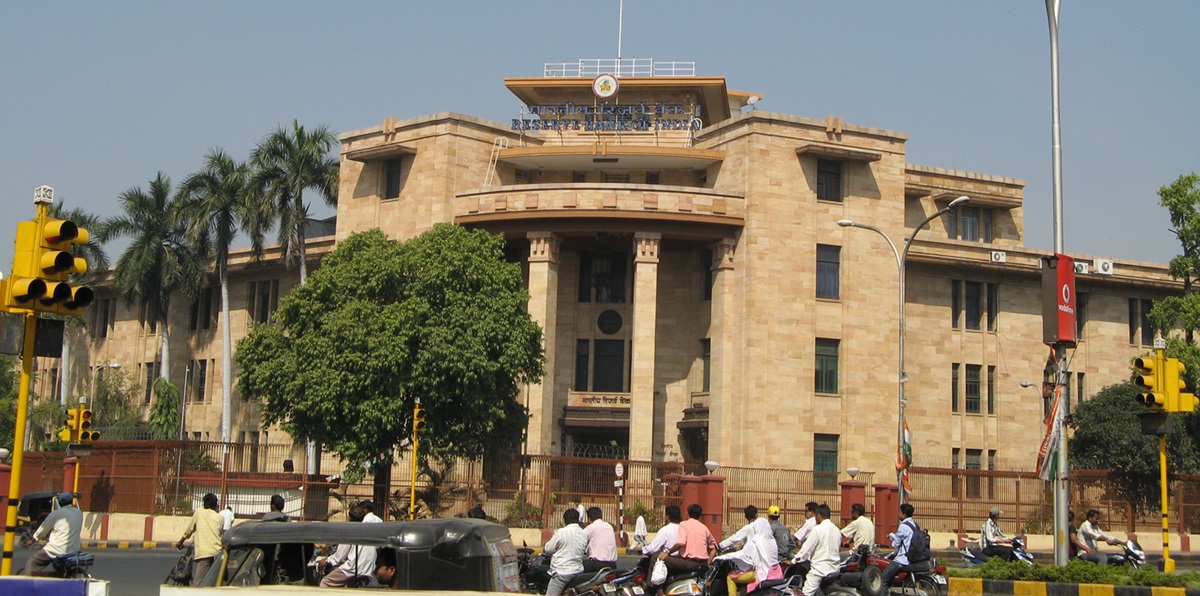
The Nagpur Reserve Bank is believed to be one of the main deposits for India’s gold reserves. Gppande, CC BY-SA 3.0, via Wikimedia Commons.

History of India’s Gold Reserves
India’s gold reserve has been shaped by three key episodes. In 1991, a debt crisis forced India to pledge its gold. In 2009, it made a landmark purchase from the IMF. Then came a decade of steady buying that more than made up for both.
The 1991 Gold Pledge
By June 1991, India was close to defaulting on its foreign debts. Its foreign exchange reserves were enough to pay for only a few weeks of imports. To raise emergency funds, the government turned to its gold. In May 1991, it sold 20 tonnes of gold seized from smugglers to Union Bank of Switzerland, with an agreement to buy it back, raising about US$200 million. In July, the RBI pledged 46.91 tonnes of its own gold as security for around US$405 million in loans. That gold was taken under armed guard from the RBI’s vaults in Mumbai and flown to the Bank of England in London and the Bank of Japan in four consignments.
The pledge bought India time to push through the economic reforms announced in that year’s budget, and the loans were later repaid. But the image of a nation flying its gold abroad to raise money stuck in the public mind. It is one reason the RBI’s recent decision to bring its gold home has attracted so much attention in India.
Buying 200 Tonnes from the IMF
In 2009, the IMF put 403 tonnes of its gold up for sale, and India bought nearly half of it. Between 19 and 30 October 2009, the RBI bought 200 tonnes at market prices for about US$6.7 billion, an average of around US$1,040 an ounce. The purchase increased India’s gold reserves by more than half, from 357 tonnes to 557 tonnes. It was seen as a strong vote of confidence in gold at a time when many central banks were still selling.
A Decade of Buying
After the IMF purchase, the RBI barely added any gold for almost a decade. From around 2017, it changed course and became one of the world’s most active central bank buyers. It added an average of more than 45 tonnes a year, and its 244 tonnes between 2020 and 2024 were second only to China among all central banks, according to the World Gold Council. Gold rose from less than 6% of India’s reserves to a double-digit share in 2024.
The buying slowed sharply as the gold price climbed. The RBI added just under one tonne in the year to March 2026, taking its reserve to the current 880.52 tonnes.
India’s Private Gold Holdings
The RBI’s 880 tonnes are only a small part of India’s gold. Indian households are thought to hold far more gold than any central bank in the world. The most widely cited estimate puts private holdings at around 25,000 tonnes. In 2025, Morgan Stanley put the figure as high as 34,600 tonnes, worth about US$3.8 trillion at the time, or almost 90% of India’s GDP. Even the lower estimate is around three times the US government’s entire reserve, and almost 30 times the RBI’s own holdings.
Gold in Indian Culture
In India, gold is not just an investment. It is part of family life. Much of it is held as 22 karat gold jewellery, given at weddings and passed down through generations, and gold is a traditional part of a bride’s wealth. Demand rises each year around festivals such as Akshaya Tritiya in the spring and Dhanteras, which marks the start of Diwali, when buying gold is considered auspicious.
Temples also hold large amounts of donated gold. For many families, especially in rural areas, gold has long been a store of savings that sits outside the banking system and can be sold or borrowed against when needed. India is consistently one of the two largest consumers of gold in the world, alongside China, and accounted for about a quarter of global consumer demand in the year to June 2025, according to the World Gold Council.

Sovereign Gold Bonds
To reduce gold imports, the Indian government launched Sovereign Gold Bonds (SGBs) in 2015. Issued by the RBI on behalf of the government, these bonds track the price of gold and pay 2.5% interest a year, and are redeemed in rupees after eight years. They proved popular, with about 132 tonnes’ worth still outstanding. In 2025, the government said it had no plans to issue more, with officials describing the scheme as a costly way to borrow. Existing bonds can still be traded on Indian stock exchanges or held to maturity.
SGBs give exposure to the gold price, but they are not gold. They are a promise by the government to pay rupees, and the holder never owns any metal. That is the key difference between paper gold and physical gold, and it is why many investors prefer to own gold outright.
Bringing Gold into India
Many Indians buy gold abroad, especially in Dubai, where 21K and 22K gold jewellery is widely sold. Indian customs rules allow returning travellers who have lived abroad for more than a year to bring in a limited amount of gold jewellery duty-free. Under the 2026 baggage rules, the allowance is set by weight, with a higher limit for women than for men. Gold bars and coins do not qualify for the allowance. Any gold above the limit must be declared, and import duty paid on it. The rules change often, so anyone planning to bring gold into India should check the latest guidance from the Central Board of Indirect Taxes and Customs (CBIC) before travelling.
Frequently Asked Questions
How much gold does India have in reserves?
India’s official gold reserves stand at 880.52 tonnes, held by the Reserve Bank of India, according to its report for the end of March 2026. That makes India the world’s eighth-largest official gold holder. Gold makes up about 16.7% of India’s foreign exchange reserves.
Did India bring its gold back from London?
Yes, most of it. Since 2023, the Reserve Bank of India has moved almost 380 tonnes of gold from overseas, mainly from the Bank of England, to vaults in India. At the end of March 2026, 680.05 tonnes, about 77% of the reserve, was held in India, with 197.67 tonnes still abroad with the Bank of England and the Bank for International Settlements.
Why did India pledge its gold in 1991?
In 1991, India faced a severe balance of payments crisis, with foreign exchange reserves enough for only a few weeks of imports. To raise emergency loans, the Reserve Bank of India pledged 46.91 tonnes of gold with the Bank of England and the Bank of Japan, after the government had sold 20 tonnes to Union Bank of Switzerland with an agreement to buy it back. The loans were later repaid.
What is a Sovereign Gold Bond?
A Sovereign Gold Bond (SGB) is an Indian government bond, issued by the RBI, whose value tracks the price of gold. SGBs pay 2.5% interest a year and are redeemed in rupees after eight years. No new SGBs have been issued since February 2024, but existing bonds can still be held or traded on Indian stock exchanges. SGB holders do not own any physical gold.
How much gold can I bring into India from Dubai?
Indian customs rules allow eligible travellers who have lived abroad for more than a year to bring in a limited amount of gold jewellery duty-free, with a higher allowance for women than for men. Gold bars and coins are not covered by the allowance, and any gold above the limit must be declared, with import duty paid on it. The rules change often, so check the latest guidance from India’s Central Board of Indirect Taxes and Customs before travelling.
How much gold do Indian households own?
Indian households are estimated to own around 25,000 tonnes of gold, with some estimates going higher. Morgan Stanley put the figure at 34,600 tonnes in 2025. Even the lower estimate is almost 30 times the Reserve Bank of India’s official reserve, and around three times the entire US government gold reserve.
From the RBI’s Vaults to Your Own
The RBI’s recent choices say a lot about how it sees gold. It spent most of the past decade buying it. It has kept every ounce, even as prices hit record highs. And over the last three years it has brought so much of its reserve home that more than three-quarters now sits in vaults it controls directly. The lesson of 1991, when India had to send its gold abroad to borrow money, appears to have stayed with the central bank: what matters is holding real gold, and knowing exactly where it is.
Indian families have understood this for generations, which is why so much of the country’s wealth is held in physical gold rather than paper claims. Instruments like Sovereign Gold Bonds offer exposure to the gold price, but no new SGBs are being issued, and they were only ever a promise to pay rupees. Physical gold involves no such promise. It belongs outright to whoever holds it.
BullionStar offers a wide range of gold bars and gold coins, available with secure, fully allocated vault storage at Le Freeport in Singapore. Like the RBI with its own reserve, BullionStar customers know exactly where their gold is held. They can see photos of their own bars, review independent audits, and visit the vault in person. Customers outside Singapore should check the rules in their own country on buying and holding precious metals abroad.
Subscribe to Gold University Articles
Copyright Information: BullionStar permits you to copy and publicize articles or information from the BullionStar Gold University provided that a link to the article's URL or to https://bullionstar.com is included in your introduction of the article or blog post together with the name BullionStar. The link must be target="_blank" without re="nofollow". All other rights are reserved. BullionStar reserves the right to withdraw the permission to copy content for any or all websites at any time.