 Contact
 Help
Help








Gold Reserves by Country: Rankings and Analysis



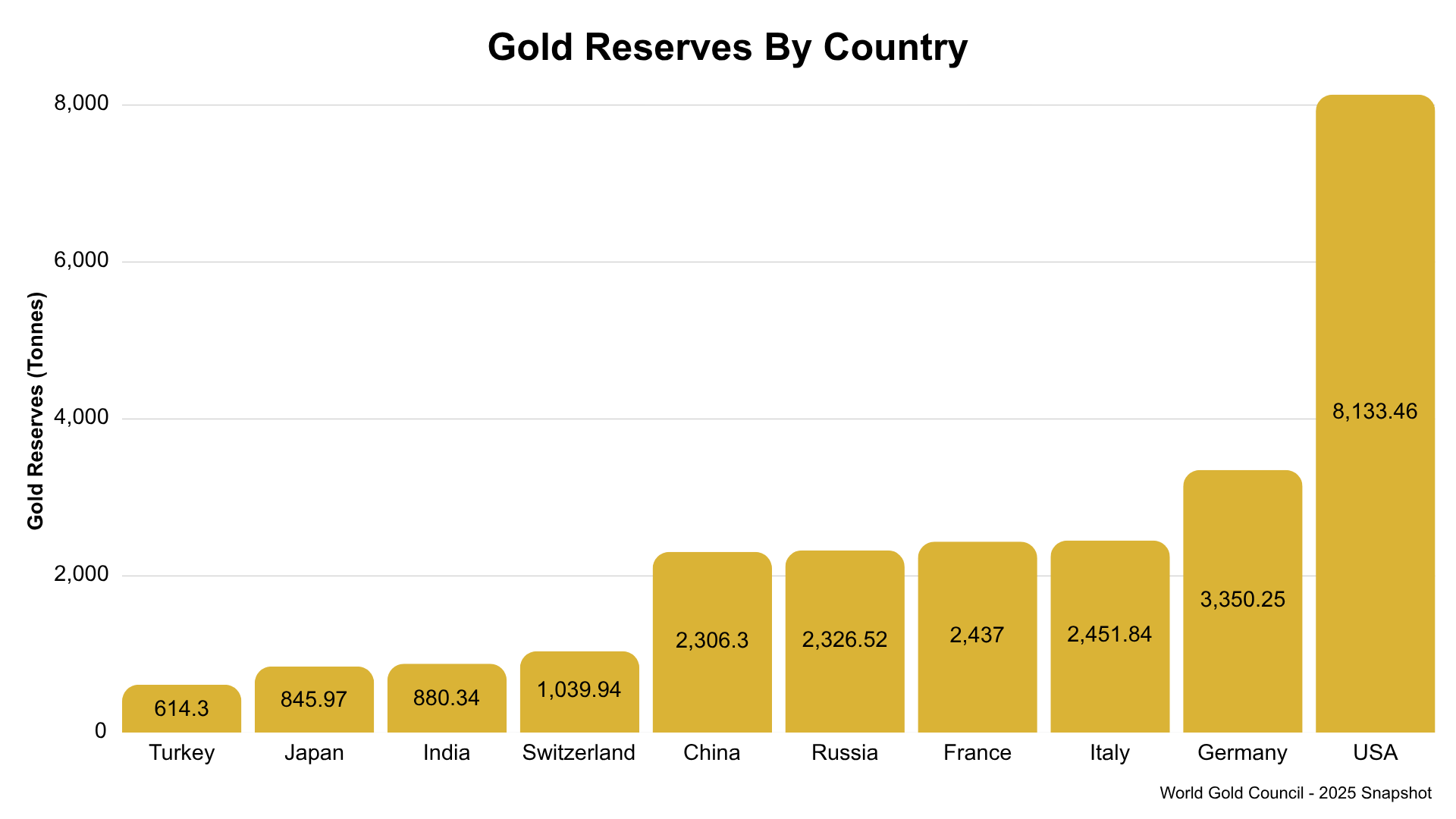
Central banks currently hold just over 36,000 tonnes of gold in official reserves, roughly a fifth of all the gold ever mined. That gold isn’t spread evenly: the top 10 holders alone account for close to 70% of the global total. This is led by the United States with over 8,100 tonnes, more than double the amount that second-placed Germany holds.
Gold’s place in a central bank vault isn’t just a leftover from the gold standard era, it still earns its keep. Unlike a country’s currency, it can’t be printed, defaulted on, or sanctioned, which is exactly why governments lean on it during periods of inflation, currency swings, or geopolitical tension. That’s also why the picture keeps shifting: central banks, especially in emerging markets, have been on a gold-buying spree unlike anything in decades, adding over 1,000 tonnes a year through much of 2022–2025 as countries look to diversify away from the US dollar.
This guide covers why central banks hold gold in the first place, looks at the top 10 gold holders, and how national reserves fit into the broader picture of the roughly 222,600 tonnes of gold that exist above ground today.
Highlights
- Central banks hold just over 36,000 tonnes of gold in official reserves, roughly a fifth of all the gold ever mined, with the top 10 holders alone accounting for close to 70% of the global total.
- The United States holds more gold than any other country by a wide margin, 8,133.46 tonnes, more than double second-placed Germany’s 3,350.25 tonnes.
- Central banks have added more than 1,000 tonnes of gold a year in almost every year since 2022, the strongest sustained buying spree on record, led by emerging markets diversifying away from the US dollar.
- Despite the scale of these holdings, physical audits are rare: the US hasn’t had a full independent audit of its gold since the 1950s, and several other major holders rely on internal checks or paper certificates rather than physical verification.
- Beyond national rankings, the IMF holds 2,814.1 tonnes of gold in its own right, enough to rank third if it were a country, while stablecoin issuer Tether’s physical gold reserves now rival many sovereign central banks.
Why Countries Hold Gold
Central banks hold physical gold for largely the same reasons individual investors do, just at a vastly larger scale and with a longer time horizon. Central bank gold reserves carry no counterparty risk: gold isn’t a promise from another government or institution to pay, it’s a physical asset sitting in a vault, with a value that doesn’t depend on any country’s creditworthiness or another central bank staying solvent. That’s a meaningful difference from the US Treasuries, euros, or other currency holdings that make up the rest of a country’s foreign reserves.
So why do countries hold gold reserves in particular, rather than just more currency? Recent history has provided a blunt answer. When Russia’s foreign currency reserves were frozen by Western sanctions in 2022, it was a wake-up call for central banks everywhere: dollar and euro reserves can be rendered useless overnight by a political decision, but gold held domestically can’t. It’s a big part of why “de-dollarization” has become such a live topic in central banking circles, and why gold holdings by central banks in emerging markets (China, India, Turkey, and Poland among the most active recently) have grown so sharply since.
Gold: An Anchor of Trust
That instinct comes through clearly in how central banks describe their own holdings. De Nederlandsche Bank, the Dutch central bank, puts it simply: its gold stock “mainly functions as a reserve asset and as an anchor of trust.” The gold standard itself was abandoned decades ago, but as DNB notes, the gold sitting in its vaults still does that same job today.
Gold also does the one job reserves are really meant to do during a crisis: hold its value when everything else is wobbling. That’s central to how gold reserves affect currency, since gold has historically held up well through high inflation, currency devaluations, and bouts of financial or geopolitical stress, exactly when a country most needs its reserves to actually be worth something. That mix of stability, liquidity, and independence from any single government’s decisions is why central banks hold gold reserves at all, and why they’ve kept doing so long after the gold standard that once anchored the practice was abandoned.
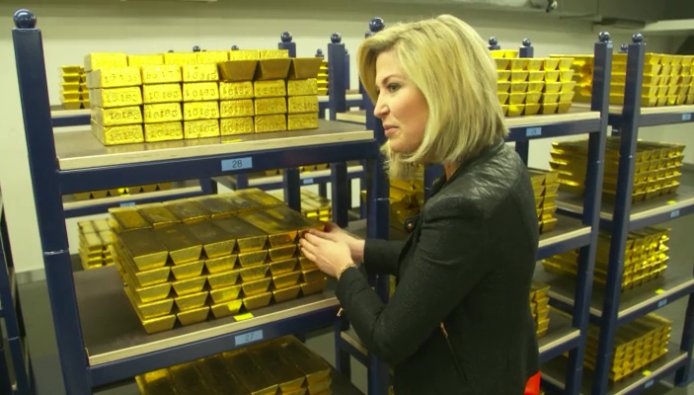
Top Countries by Gold Reserves
So who has the most gold? The table below lays out the current country gold reserves ranking, using annual data from the World Gold Council. These are the countries with the most gold reserves on the planet, and together the top 10 account for roughly 70% of all official gold held by central banks worldwide, more than every other country combined.
Who owns the most gold in absolute terms hasn’t changed in decades: the United States, sitting on more than 8,100 tonnes, more than double second-placed Germany. Beyond the top few, the list of countries with the most gold has shifted noticeably over the past decade, as emerging-market central banks climb the largest gold reserves rankings through years of sustained buying.
| Rank | Country | Gold Reserves (tonnes) | Gold as % of Total Reserves | Recent Trend |
|---|---|---|---|---|
| 1 | United States | 8,133.46 | 82.44% | Unchanged for decades |
| 2 | Germany | 3,350.25 | 82.22% | Unchanged since completing repatriation in 2017 |
| 3 | Italy | 2,451.84 | 79.33% | Unchanged |
| 4 | France | 2,437.00 | 79.92% | Unchanged |
| 5 | Russia | 2,326.52 | Not reported (IMF data awaited) | Net seller since Nov 2025, funding the budget deficit |
| 6 | China | 2,306.30 | 8.64% | Adding almost every month since 2022 |
| 7 | Switzerland | 1,039.94 | 13.58% | Unchanged since early-2000s sales |
| 8 | India | 880.34 | 17.66% | Among the most active buyers; +73t in 2024 |
| 9 | Japan | 845.97 | 8.66% | Unchanged for decades |
| 10 | Turkey | 614.30 | 54.64% | Volatile, swings between buying and selling |
There are a few honourable mentions which don’t make the country table above, but deserve discussion.
The International Monetary Fund holds 2,814.1 tonnes of gold in its own right, enough to rank as the world’s third-largest holder if it were a country. As an international institution rather than a nation, it’s excluded from official country rankings entirely.
More surprising is Tether: the stablecoin issuer’s physical gold reserves, built up to back USDT and its own gold token XAUT, have grown to somewhere between 130 and 150 tonnes, putting a private company ahead of many sovereign central banks and rivalling mid-sized nations for gold holdings.
Lastly, while the Bank of England doesn’t own much gold of its own (only around 310 tonnes belongs to the UK Treasury), its vaults beneath Threadneedle Street are the second-largest gold depository on Earth. They store more than 5,000 tonnes on behalf of roughly 60 other central banks and institutions, second only to the Federal Reserve Bank of New York.
The Top 10 Gold Holding Countries
Numbers only tell part of the story. Here’s a closer look at each of the ten countries with the most gold reserves, how they built up their holdings, and what’s driving their strategy today.
United States
How much gold does the US have? More than anyone else by a wide margin, 8,133.46 tonnes, more than the next two countries on this list, Germany and Italy, combined. Nearly all of it sits in the custody of the US Mint rather than the Federal Reserve, split across three vaults: Fort Knox in Kentucky, West Point in New York, and a facility in Denver, with a small remainder held at the Federal Reserve Bank of New York.
The size of the stockpile isn’t really what makes it interesting, though. It’s the fact that none of it has ever been independently, physically audited. Partial internal audits took place through the 1970s and 80s, and detailed gold bar weight lists have been published, but no outside body has ever verified that the gold sitting in Fort Knox actually matches what’s on the books. That gap is a big part of why Fort Knox has become one of the most persistent subjects of monetary conspiracy theory anywhere in the world, something we cover in more detail in our full breakdown of US Treasury gold policy.
If reading about Fort Knox has you wanting a piece of American gold of your own, the 1 oz American Gold Buffalo is one of the most popular ways to do it, minted by the US Mint in .9999 fine gold, the purest gold coin the US government produces.
Germany
Germany holds the second-largest gold reserves in the world at 3,350.25 tonnes, and for a few years in the 2010s, getting that gold home was Europe’s slowest-moving saga. After German auditors criticised the Bundesbank for never physically checking on the gold it stored abroad, the bank announced a repatriation plan to bring hundreds of tonnes back to Frankfurt from New York and Paris, then somehow managed only 5 tonnes in the entire first year, some of which had to be melted down and recast because it wasn’t even proper Good Delivery gold.
The rest eventually came home by 2017, years ahead of its own famously unambitious schedule. More on the full saga, and Germany’s gold policy generally, is in our full profile of the Bundesbank’s gold reserves.
Italy
Italy holds 2,451.84 tonnes of gold, and unlike almost every other country on this list, that gold technically belongs to the central bank itself rather than the Italian state, an unusual ownership quirk that’s occasionally made it a political football. In 2014, senators from Italy’s Five Star Movement called for the gold to be nationalised and brought home from storage in New York, London, and Switzerland, but Banca d’Italia has never acted on it, and roughly half the country’s reserves remain stored abroad to this day. More detail is in our full profile of Banca d’Italia’s gold policy.
For a piece of Italy’s own gold history, the Italian 20 Lire, nicknamed the “Marengo,” is a classic 90%-pure gold coin first struck under the House of Savoy and still in demand today.
France
France holds 2,437 tonnes of gold, the fourth-largest reserve in the world, and unlike most of its neighbours has never needed a repatriation drama: over 90% of it already sits in the Banque de France’s vaults beneath its Paris headquarters. France used to hold even more, over 3,000 tonnes in the early 2000s, before selling nearly 600 tonnes between 2004 and 2009 under an EU-wide gold sales agreement. Its holdings have stayed unchanged ever since, and the Paris vaults do double duty as storage for other central banks’ gold, including a chunk of what’s left of Germany’s holdings still waiting to come home.
That hasn’t stopped the odd political flare-up: in 2014, Marine Le Pen wrote an open letter demanding the Banque de France repatriate any gold held abroad and open its vaults to a full independent audit, a request the bank has never acted on. More detail is in our full profile of Banque de France’s gold policy.
For a piece of French gold history, the French 20 Franc “Rooster”, also known as the Napoléon, is a classic 90%-pure gold coin minted from the early 1800s and still popular with investors today.
Russia
Russia holds 2,326.52 tonnes of gold, and got there through one of the most deliberate accumulation drives of any central bank: from just 400 tonnes in 2007 to over 1,600 tonnes within a decade, a buying spree officials were candid about at the time. As deputy governor Dmitry Tulin put it, gold is “free from legal and political risks,” a rationale that’s aged well given Russia’s own currency reserves have been frozen by Western sanctions since 2022.
That accumulation story has recently gone into reverse. As covered earlier, Russia’s central bank has been selling gold since late 2025 to help cover its war-driven budget deficit, a sharp turn for a bank that spent nearly two decades buying almost without pause. Our full profile of Bank of Russia gold policy covers the accumulation years in more detail.
For a piece of Russia’s pre-Soviet gold history, the Russian 5 Roubles, struck under the Tsars from 1897, is a 90%-pure gold coin featuring the imperial double-headed eagle.
China
China’s official gold reserves stand at 2,306.30 tonnes, but almost nobody in the gold market takes that number entirely at face value. The People’s Bank of China only started publishing regular updates in 2015, and even then the increases came in suspiciously large, multi-year jumps, 400 tonnes in 2001, 1,054 tonnes by 2009, then straight to 1,658 tonnes in 2015, with years of silence in between. The PBoC has also gone out of its way to buy quietly, reportedly using proxy banks and monetising bullion before it enters the country specifically so the purchases don’t show up in customs data.
Given how vast China’s overall reserves are (over US$3 trillion), even 2,306 tonnes only accounts for a small slice of the total, which has led plenty of analysts to float the obvious theory: that China’s actual gold holdings are considerably larger than what it discloses, and that the PBoC is simply pacing its official updates to avoid spooking the market. More on the accumulation pattern, and the case for undisclosed reserves, is in our full profile of PBoC gold policy.
For a piece of China’s own gold production, the Chinese Gold Panda is the country’s flagship bullion coin, struck in 99.9% pure gold and backed by the PBoC itself.
Switzerland
Switzerland holds 1,039.94 tonnes of gold today, a fraction of what the country used to have. Before 2000, Switzerland held 2,590 tonnes, enough to be the world’s 4th largest official holder, before the Swiss National Bank sold off 1,550 tonnes between 2000 and 2008, timing that looks especially rough in hindsight given how much the gold price has climbed since.
In 2014, a campaign called the Swiss Gold Initiative put a referendum to voters demanding the SNB repatriate all its gold, stop selling it entirely, and hold at least 20% of its assets in gold going forward. It failed, but the campaign did force the notoriously secretive SNB to reveal, for the first time, where any of its gold was actually stored. More detail is in our full profile of Switzerland’s gold policy.
Switzerland’s gold connection today is less about the vault and more about the workshop: refiners like PAMP, Valcambi, Argor-Heraeus, and Metalor are all Swiss, and between them they produce a huge share of the world’s LBMA-accredited gold bars.
India
India holds 880.34 tonnes of gold, and in recent years the Reserve Bank of India has been doing something unusual for a major holder: bringing gold home. Since September 2022, the RBI has repatriated 214 tonnes of gold from the vaults of the Bank of England back to storage facilities in India, including a headline-grabbing 102-tonne shipment timed to land just before Diwali’s Dhanteras festival in 2024. Around 320 tonnes still sits in London and with the Bank for International Settlements, but the direction of travel is clear.
The move echoes the same rationale that’s come up elsewhere on this page: officials have pointed to the freezing of Russian reserves as a reminder that gold held on someone else’s soil isn’t fully in your own control.
India’s MMTC-PAMP is a joint venture between Swiss refiner PAMP and India’s state-owned MMTC, and produces LBMA-accredited gold bars domestically in India.
Japan
Japan holds 845.97 tonnes of gold, and unlike most countries on this list, that gold isn’t managed by the central bank at all: Japan’s reserves sit with the Ministry of Finance rather than the Bank of Japan, another ownership quirk to add alongside Italy’s earlier on this page.
The holdings have barely moved in decades. The one notable change, an 81-tonne jump in early 2021, wasn’t even a market purchase. It turned out to be simply an internal transfer of gold between two divisions of the Ministry of Finance, not any new buying. Beyond that one accounting shuffle, Japan has stayed almost entirely out of the gold-buying wave sweeping other central banks in recent years.
Turkey
Turkey holds 614.30 tonnes of gold, and more than half of that (around 55%) counts toward its total reserves, one of the highest ratios of any country on this list. A lot of that comes down to a uniquely Turkish mechanism: the Reserve Option Mechanism, introduced in 2011, lets Turkish commercial banks meet part of their central bank reserve requirements in gold instead of lira, which has quietly funnelled hundreds of tonnes onto the CBRT’s books over the past decade.
That gold also gets used when things get rough. In 2026, Turkey’s central bank became the world’s largest official gold seller, offloading a large chunk of reserves as a shock absorber to defend the lira during the market turmoil following the outbreak of war between the US, Israel, and Iran. It’s a pattern with precedent: the CBRT built up over 300 tonnes between 2017 and 2020, then sold more than 100 tonnes in a matter of months once conditions turned.
Total World Gold Reserves and Recent Trends
Central banks collectively hold just over 36,000 tonnes of gold, roughly a fifth of all the gold ever mined. That’s only part of the answer to how much gold is in the world, though: total above-ground gold runs to around 222,600 tonnes, with the rest held as jewellery, private investment gold bars and coins, and industrial stock, dwarfing what sits in official vaults.
World gold reserves held by central banks have been climbing fast in recent years. Emerging-market buying drove net purchases above 1,000 tonnes a year from 2022 to 2024, and 2025 added a further 863 tonnes, the strongest sustained stretch of central bank buying on record. This is due to countries looking to diversify away from the US dollar and insulate their reserves from the kind of political risk covered earlier on this page.
Whether that pace holds, or whether recent sellers like Russia and Turkey mark the start of a wider reversal, is likely to shape this ranking for years to come. The signs point to more buying ahead either way: in the World Gold Council’s 2026 survey of central bank reserve managers, a record 45% said they expect to add to their own gold holdings over the next year, the highest reading since the survey began in 2018, with 89% expecting global central bank reserves to grow overall.
Frequently Asked Questions
Which country has the most gold?
The United States has the most gold of any country in the world, with 8,133.46 tonnes in official reserves, more than double second-placed Germany’s 3,350.25 tonnes.
Why do countries keep gold reserves?
Countries keep gold reserves for the same reason as private investors, just on a national scale. Gold carries no counterparty risk, can’t be sanctioned or defaulted on in the way a currency holding can, and holds its value through exactly the kind of financial and political crises that make countries want to keep gold reserves in the first place.
Which country bought the most gold in 2025?
Poland bought the most gold in 2025. The National Bank of Poland added 101.98 tonnes in 2025, more than any other central bank globally, as it continues its push toward a top-10 position. Kazakhstan was second, adding 56.99 tonnes to its reserves.
Why is China buying so much gold?
Mainly diversification: gold is still a tiny sliver of China’s $3 trillion-plus foreign reserves, which are otherwise dominated by US dollar assets. Many analysts also suspect the PBoC’s official 2,306-tonne figure understates what it actually holds, given its history of buying quietly and reporting in large, delayed jumps.
How much gold is in Fort Knox?
There are around 4,582 tonnes of gold reported to be in Fort Knox, the largest single holding among the US Treasury’s storage sites. That figure has never been confirmed by an independent physical audit, however, and there have been doubts for many years over how much gold is truly in Fort Knox.
Are gold reserves audited?
Gold reserves are rarely audited to any meaningful degree, and it’s one of the most persistent criticisms of the entire central bank gold sector. The US hasn’t had a full independent physical audit since the 1950s, Germany’s gold has mainly been checked through internal joint-seal procedures, and countries like Italy and Switzerland largely rely on paper certificates from foreign custodians rather than physical verification.
The Gold Rankings Are Still Moving
Every name on this list got there through decades of decisions, crises, and quiet accumulation, and none of it is fixed in stone. Germany only recently finished a repatriation saga a decade in the making, Russia and Turkey have swapped from buyers to sellers within the space of a year, India and Poland are climbing fast, and China’s true position is in doubt. If the last few years are any guide, and if central banks’ own surveys are to be believed, this ranking will look different again before too long.
None of that changes what gold has represented for centuries: a way to hold value that doesn’t depend on any single government’s promises. If this deep dive into central bank vaults has left you curious about holding a small piece of that story yourself, BullionStar offers a straightforward way to buy physical gold and silver bullion, including several of the historic coins featured throughout this guide.
Subscribe to Gold University Articles
Copyright Information: BullionStar permits you to copy and publicize articles or information from the BullionStar Gold University provided that a link to the article's URL or to https://bullionstar.com is included in your introduction of the article or blog post together with the name BullionStar. The link must be target="_blank" without re="nofollow". All other rights are reserved. BullionStar reserves the right to withdraw the permission to copy content for any or all websites at any time.