 Contact
 Help
Help







Heraeus Precious Metals: The German Gold and Silver Refinery



Heraeus is a German precious metals and technology group based in Hanau, around 25 kilometres east of Frankfurt. Its precious metals business is among the largest refining and processing operations of its kind anywhere. It refines and trades gold, silver, platinum, palladium and the rarer platinum group metals, and produces investment bars in all four of the main ones. The group is still privately held by the Heraeus family, which makes it one of the largest privately owned companies in Germany, and it reported revenue of €43.2 billion in 2025 with just over 15,000 employees.
The name causes more confusion than most, for two reasons. The first is that Heraeus is far larger than its bullion arm. The group organises itself around four areas, precious metals alongside healthcare, semiconductors and electronics, and industrials, so a search for the name turns up medical components and specialist lighting as readily as gold bars. The second is Argor-Heraeus, the Swiss refinery at Mendrisio that Heraeus has owned outright since 2017. The two are separate refineries with separate bar stamps under a single owner, and their bars are not interchangeable.
That 2017 acquisition also changed where the group’s gold comes from. After Heraeus fully acquired Argor-Heraeus, the majority of its gold refining activities transferred to Switzerland, and Hanau’s gold Good Delivery accreditation, first granted in 1958, now sits on the LBMA’s former list. Hanau’s silver accreditation remains current, while Good Delivery gold within the group runs through the Heraeus refinery in Hong Kong and through Argor-Heraeus in Switzerland. For a buyer that is the practical difference: the Heraeus-branded silver range is broad, running from one ounce up to fifteen kilograms, while the Heraeus-branded gold range at retail is narrow.
This guide covers who Heraeus is and where the precious metals business sits within the wider group, what it is accredited for and in which metals, what it produces, how to check that a Heraeus bar is genuine, how its premiums compare with the Swiss refiners, and what buying and selling its bars involves.
Highlights
- A German precious metals and technology group based in Hanau, family-owned since 1851, with a precious metals business dating from Wilhelm Carl Heraeus’s platinum melting breakthrough in 1856.
- Among the largest precious metals refiners and processors in the world, refining, recycling and trading gold, silver, platinum, palladium and the minor platinum group metals.
- A Full Member of the London Bullion Market Association since May 2024, with current Good Delivery accreditation for silver at both Hanau and Hong Kong, and for gold at Hong Kong.
- Owner of the Swiss refinery Argor-Heraeus outright since April 2017, after which the majority of the group’s gold refining transferred to Switzerland.
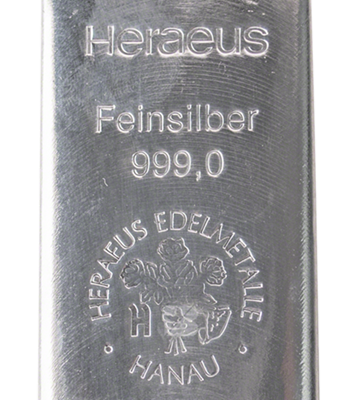
- Bars carry the hand-with-roses motif from the Heraeus family crest and German markings such as Feinsilber 999, with a silver range running from one ounce up to fifteen kilograms.
Who Is Heraeus? (Precious Metals Division)
Heraeus Precious Metals is the arm of the Heraeus group that refines, recycles, trades and fabricates gold, silver, platinum, palladium and the minor platinum group metals. It is an unusual business to sit behind a retail bullion bar, because investment bars are a small part of what it does. The same operation supplies precious metal in industrial forms to the electronics, chemical, automotive and medical sectors, recovers metal from spent catalysts and industrial residues, and runs trading desks that hedge and finance metal for other companies. Investment bars are the consumer-facing edge of a business built mainly around industry.
The scale of that industrial side explains the group’s revenue figure. Most of the €43.2 billion reported for 2025 is precious metals trading turnover rather than product sales, so the number reflects the value of metal passing through the business rather than what the group earns from making things. It is why Heraeus can report revenue in the tens of billions with a workforce of around 15,000 people, and why the precious metals arm dominates group revenue even though the group also makes bone cement, bonding wire and quartz glass.
From a Hanau Pharmacy to a Precious Metals Group
The Heraeus family’s pharmacy in Hanau, the Einhorn, traces back to 1660, when Isaac Heraeus took over what was then the Faucque Pharmacy. Wilhelm Carl Heraeus took over that pharmacy in 1851, which is the date the company treats as its founding. And in 1856 he melted two kilograms of platinum in an oxyhydrogen blowpipe he had built himself, at a time when platinum was worked cold because nobody could get it hot enough to melt. That is the beginning of the precious metals business, and everything the group does today descends from it.
The precious metals business was split, merged and renamed several times across the 2010s, and older sources refer to W. C. Heraeus, Heraeus Precious Metals and Heraeus Metal Management as though they were different companies. They are stages of the same business, which today trades as Heraeus Precious Metals.
The change that matters most to a bullion buyer came in 2017, when Heraeus bought out its partners in Argor-Heraeus and took full ownership of the Swiss refinery at Mendrisio. The group is still controlled by the Heraeus family, and remains one of the largest privately held companies in Germany.
LBMA Accreditation and Good Delivery
Heraeus Precious Metals has been a Full Member of the London Bullion Market Association since May 2024, having previously held associate status. Its Good Delivery accreditation is split across metals and sites.
| Accreditation | Status |
|---|---|
| LBMA Good Delivery, silver | Current, Hanau and Hong Kong |
| LBMA Good Delivery, gold | Current for Hong Kong. Hanau’s listing, first granted in 1958, is now on the former list |
| LPPM good delivery, platinum and palladium | Current, Germany, Hong Kong, South Africa and the United States |
The gold entry is the one that surprises people. The LBMA’s own note against the Hanau listing records that after Heraeus fully acquired Argor-Heraeus in 2017, the majority of its gold refining activities transferred to Switzerland. Good Delivery accreditation covers the 400 ounce wholesale bar rather than retail sizes, so this does not mean Hanau stopped producing gold, and Heraeus-branded gold bars are still stamped and sold as German. It does mean that within the group, wholesale gold accreditation now sits with Hong Kong and with Argor-Heraeus in Switzerland.
Platinum and palladium are the reverse case. Five group entities appear on the London Platinum and Palladium Market’s good delivery lists, in Germany, Hong Kong, South Africa, the United States and Switzerland, which is more than any of the Swiss refiners can claim and reflects how much of the business is platinum group metals recycling rather than gold.
The group’s seat on the LBMA’s panel of Good Delivery referees belongs to Argor-Heraeus, not to Heraeus itself. Heraeus has never held it.
What the Heraeus Refinery Produces
Heraeus output divides into two halves, and the investment bar range is the smaller one. Most of what the refinery makes goes to industry: gold and silver grain for the jewellery trade, platinum and palladium sponge, powders, bonding wire, catalysts and semi-finished alloys, all of it sold by specification rather than by brand. The investment bars are the same metal, refined to the same standards, put into a form a private buyer can hold. Gold runs to 99.99% purity, silver to 99.9%, and platinum and palladium to 99.95%.
Where Heraeus differs from the Swiss refiners is the balance between the metals. Gold is the narrow part of the range and silver and platinum are the broad parts, which is the direct consequence of the 2017 transfer of gold refining to Switzerland covered above.
| Metal | Heraeus-branded bars stocked at BullionStar |
|---|---|
| Gold | 50 g cast, 100 g cast, 100 g minted, and the 400 oz Good Delivery bar |
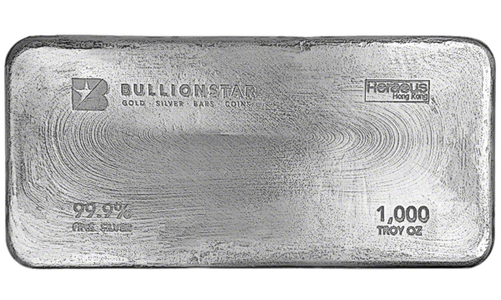
| Silver | 1 oz, 5 oz, 10 oz, 100 oz, 1 kg, 15 kg, and a 1,000 oz bar |
| Platinum | 100 g, 500 g, 1 kg, and individually weighed bars of roughly 95 to 151 oz |
The Heraeus Gold Range
The gold range is short but it covers the two ends of the market. At the retail end are the Heraeus 100 gram minted bar and its cast equivalent, with a Heraeus 50 gram cast bar below them, all supplied in a transparent tamper-evident blister pack that doubles as the assay certificate.
At the other end is the Heraeus 400 ounce Good Delivery bar, the wholesale unit that trades between banks and central banks, refined at Heraeus in Hong Kong and weighing a little over twelve kilograms. Very few dealers offer one at all.
One product commonly attributed to Heraeus is not really its own. Heraeus-branded Kinebars, the gold bars with a hologram embossed into the metal, were manufactured by Argor-Heraeus on Heraeus’s behalf. Older Heraeus Kinebars do still circulate on the second-hand market, and they are genuine, but the Kinebar range you can buy new today is stamped Argor-Heraeus rather than Heraeus.
The Heraeus Silver Range
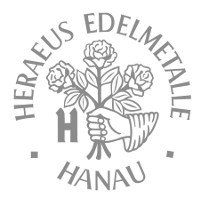
Silver is where the range opens out. It runs from a single ounce up to a fifteen kilogram bar, minted at the small sizes and cast at the large, and the Heraeus one kilogram silver bar is the one you will see most often. It is worth looking at closely, because it carries the refinery’s oldest piece of design: a hand holding roses, taken from the Heraeus family crest, embossed in the centre of the bar and ringed with the words Heraeus Edelmetalle Hanau. The German lettering runs through the range, and Heraeus silver is stamped Feinsilber 999 rather than the English equivalent.
Above the kilogram sit a 100 ounce bar, the 15 kilogram bar, and a Heraeus 1,000 ounce bar produced for BullionStar, which is the wholesale silver unit and the cheapest silver per ounce we sell. Not all of it is plain, either. Heraeus has issued design-led kilogram silver bars, including a Lunar stacker series, which carry a premium over the plain bar in the same way any design does.
The Heraeus Platinum Range
Platinum is the quiet surprise. Alongside conventional Heraeus 100 gram platinum bar, 500 gram and 1 kilogram bars, Heraeus produces large bars that are individually weighed rather than made to a round weight, so a single bar might be 94.996 ounces or 150.993 ounces and is priced on its exact content.
These are LPPM good delivery platinum, the wholesale form of the metal, and they exist because so much of the business is platinum group metals refining and recycling rather than gold.
How to Identify a Genuine Heraeus Bar
Heraeus has no verification app, no scannable code and no serial number database a buyer can query. Checking a Heraeus bar means reading the bar itself and then doing the ordinary physical checks, which is the position with most refiners and is not a mark against the brand.
That puts more weight on the markings than on any technology, and the markings are distinctive enough to be useful. Heraeus stamps its bars in German, which is the quickest way to tell that you are looking at the German refinery rather than its Swiss sister company.
What the Markings Should Show
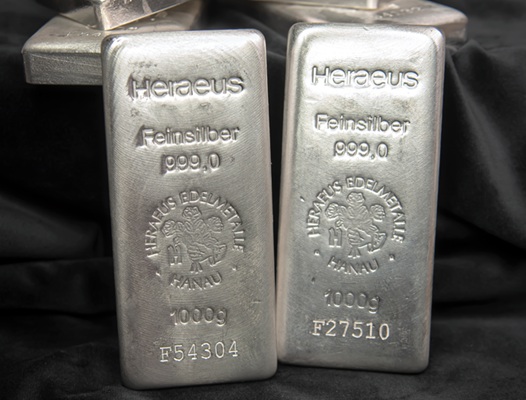
– The hand with roses. Heraeus bars carry a hand holding roses, taken from the family crest, embossed on the face of the bar and ringed with the words Heraeus Edelmetalle Hanau. On the cast silver bars it sits in the centre of the front surface.
– German fineness wording. Silver bars are stamped Feinsilber 999 rather than the English equivalent, and gold bars carry 999.9. If a bar is marked in English throughout, question it.
– The weight, stamped on the face. A 100 gram gold bar reads 100g, a kilogram silver bar reads 1000 g.
– A unique serial number. Every bar carries one, stamped on the same face as the other markings.
– The packaging, where there is any. The 50 and 100 gram gold bars come in a transparent tamper-evident blister pack that doubles as the assay certificate. Check the serial number on the bar against the one on the pack, and look at the pack itself for signs of opening or resealing. The large cast silver bars are supplied loose, as cast bars generally are.
– Weight and dimensions. The 100 gram minted gold bar is listed at 44 mm by 26 mm by 4.5 mm, and the kilogram cast silver bar at 108 mm by 50 mm by 20 mm, although cast bars vary a little by their nature. A counterfeit that copies the design convincingly is usually wrong on weight, dimensions or both.
Where any doubt remains, have the bar tested. Our guides on how to test gold and how to test silver cover the physical methods, from density and dimensions through to ultrasound and X-ray fluorescence.
Heraeus Prices and Premiums
A Heraeus bar is priced from the live spot price of the metal it contains plus a premium covering refining, fabrication, packaging and distribution. Silver is where that premium does the most work, because fabricating a bar costs roughly the same whether it holds gold or silver, and silver is far cheaper per gram. The same work spread over cheaper metal means a much larger premium as a percentage.
What the Silver Costs Against the Other Refiners
The table below compares one kilogram cast silver bars from some of the refiners we stock, priced at the same moment in single quantities.
| 1 kg cast silver bar | Premium over spot |
|---|---|
| Perth Mint | 6.0% |
| Heraeus | 6.7% |
| Argor-Heraeus | 6.7% |
| Metalor | 6.7% |
| PAMP | 7.8% |
Heraeus sits comfortably among peers, with a competitive premium against similar LBMA-accredited refiners.
The BullionStar No-Spread 1 kg silver bar is itself produced by Heraeus, or by Nadir, on our specification. It carries a higher premium in small quantities, but at a hundred bars or more the buy price and the sell price are the same, subject to a minimum holding period of seven days.
Why Size Matters Far More Than Brand
When buying silver, it is the size of the bar that has the greater impact on premium, rather than the brand stamped on the metal.
| Heraeus silver bar | Premium over spot |
|---|---|
| 1 oz | 18.2% |
| 5 oz | 14.8% |
| 10 oz | 9.6% |
| 1 kg | 6.7% |
| 100 oz | 5.7% |
| 15 kg | 5.1% |
| 1,000 oz | 3.0% |
A one ounce silver bar costs six times as much in premium terms as a 1,000 ounce bar holding the same metal, because the cost of making, packaging and handling a bar barely changes with its size while the amount of silver inside it changes enormously. If your aim is to own cost-effective silver rather than to own small units, the large bars are where the value is, and the 1,000 ounce bar Heraeus makes for us is the cheapest silver per ounce we sell.
The trade-off is that large bars are hard to sell in parts. A 1,000 ounce bar is around 31 kilograms and you sell all of it or none of it, while a stack of ten ounce bars can be sold a few at a time. Format has a smaller effect in the same direction: the cast ten ounce bar priced at 8.7% against 9.6% for the minted version, casting being the simpler process. Design also costs money, as it always does. The 2018 Lunar stacker bar carried a premium about one percentage point above the plain kilogram bar of the same weight and purity.
You can check today’s prices on our gold price and silver price pages, and current buy-back rates for every product on our sell gold and silver page.
Frequently Asked Questions
Is Heraeus a good gold brand?
Yes, Heraeus gold is sound and liquid, with competitive pricing. Its gold range narrowed after 2017, because most of the group’s gold refining moved to Switzerland after it bought Argor-Heraeus outright that year. If you want a wide ladder of small gold bars from this group, they are stamped Argor-Heraeus rather than Heraeus.
What is the difference between Heraeus and Argor-Heraeus?
They are two separate refineries with one owner. Heraeus refines in Hanau, Germany, and stamps its bars Heraeus with a hand-holding-roses motif and German wording such as Feinsilber 999. Argor-Heraeus refines in Mendrisio, Switzerland, and stamps its bars with an AH mark and the word Switzerland. Heraeus has owned Argor-Heraeus outright since April 2017, but the two remain distinct products on a dealer’s shelf.
Is Heraeus LBMA accredited?
Yes. Heraeus Precious Metals has been a Full Member of the London Bullion Market Association since May 2024, and holds current Good Delivery accreditation for silver at both Hanau and Hong Kong. For gold, current accreditation sits with the Hong Kong refinery, while Hanau’s gold listing from 1958 has passed to the LBMA’s former list following the transfer of gold refining to Switzerland.
Where are Heraeus gold bars made?
The retail gold bars are German. The 50 and 100 gram bars are stamped Heraeus Edelmetalle Hanau and listed with Germany as their country of origin, while the 400 ounce Good Delivery bar is produced at the group’s Hong Kong refinery and listed as Hong Kong. Separately, the majority of the group’s overall gold refining now happens in Switzerland at Argor-Heraeus.
Are Heraeus silver bars a good buy?
They are a sound choice, and the brand is close to irrelevant to what you pay. What actually determines your cost is size: a 1 oz bar carries an 18.2% premium against 6.7% at a kilogram and 3.0% on the 1,000 ounce bar. Buy the largest bar you are comfortable selling as a single unit and the brand can be whichever you prefer.
How do I check a Heraeus bar is genuine?
Heraeus has no verification app or serial number database for buyers. Look for the hand-with-roses motif ringed by the words Heraeus Edelmetalle Hanau, the German fineness marking, Feinsilber 999 on silver or 999.9 on gold, the stamped weight and a unique serial number. On the small gold bars, check that the serial number matches the transparent blister pack and that the pack has not been opened. Then weigh and measure the bar, since a convincing copy of the design is usually wrong on one or the other, and have it tested by a dealer if any doubt remains.
Buying and Selling Heraeus Bullion
Heraeus does not sell to the public. It refines and fabricates for industry, institutions and the trade, and its bars reach private buyers through dealers.
At BullionStar the Heraeus range is led by silver, from a single ounce up to the 15 kilogram bar, along with the 1,000 ounce bar the refinery produces for us. Alongside it sit the 50 and 100 gram gold bars and the 400 ounce Good Delivery bar, and a platinum bars range running from 100 grams to the large individually weighed bars. Every product page shows the live buy price, the sell price and the premium over spot at the same moment, so the round trip is visible before you buy rather than afterwards.
Bars can be collected in person at our Bullion Center in Singapore, shipped to most countries, or left in vault storage in Singapore, where they are held as your allocated property and can be audited or withdrawn at any time. Singapore charges no GST on investment precious metals and no capital gains tax, and that matters more for silver than for anything else. Investment gold is tax-free in most jurisdictions, but investment silver commonly is not, so a German silver bar bought and held in Singapore can avoid a sales tax charge that the same bar would attract in Europe.
When you come to sell, we buy Heraeus bars back by weight and metal at a live quoted price, whether you bought them from us or elsewhere. You can track what your holding is worth against the live gold price and silver price at any time.
Subscribe to Gold University Articles
Copyright Information: BullionStar permits you to copy and publicize articles or information from the BullionStar Gold University provided that a link to the article's URL or to https://bullionstar.com is included in your introduction of the article or blog post together with the name BullionStar. The link must be target="_blank" without re="nofollow". All other rights are reserved. BullionStar reserves the right to withdraw the permission to copy content for any or all websites at any time.