 Contact
 Help
Help







Valcambi: The World’s Largest Precious Metals Refinery



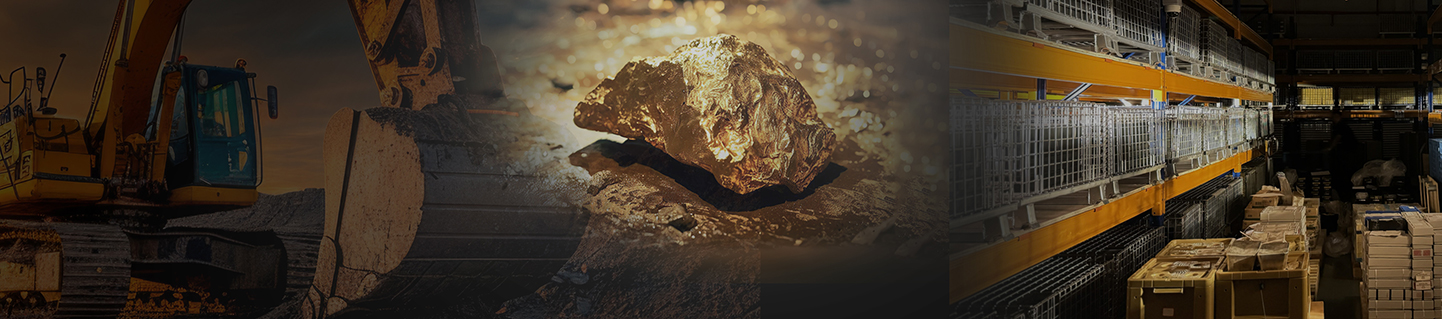
Valcambi is a precious metals refinery at Balerna, in the southern tip of Swiss Ticino a few minutes from the Italian border. By refining capacity it is the largest refinery in the world. It can process around 2,000 tonnes of precious metal a year, and in 2025 it was running at about 5.1 tonnes a day. Almost everything it sells passes through that one site.
Valcambi describes itself as operating a single boutique refinery, and the whole operation occupies 3.3 hectares and employs around 175 people. The world’s largest precious metals refinery is one site in a small Swiss town, and it sits within a few kilometres of two of its largest competitors, PAMP and Argor-Heraeus, in a corner of Ticino that refines a significant share of the world’s gold.
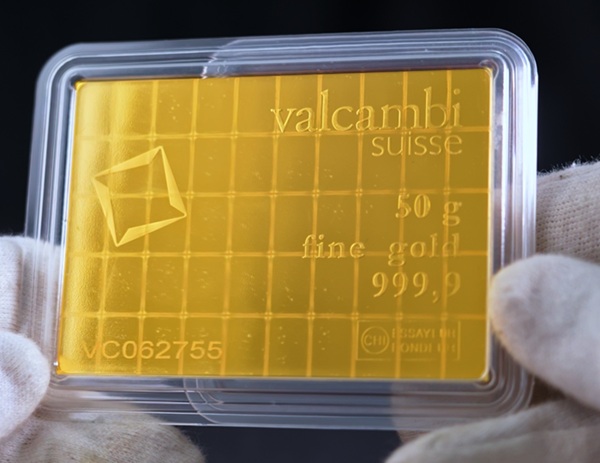
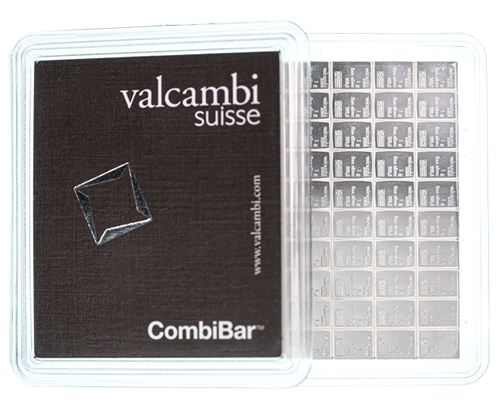
At retail, Valcambi is best known for one product it invented the market for: the CombiBar, a larger bar divided into small pieces that can be snapped apart one at a time. It is the most divisible form of bullion in wide circulation, but as the prices section below sets out, that flexibility is not free.
Highlights
- Founded in 1961 in Balerna, Ticino, as Valori & Cambi, renamed Valcambi in 1967, and owned by Rajesh Exports through Global Gold Refineries since July 2015.
- Around 2,000 tonnes of combined annual refining capacity across gold, silver and the platinum group metals, on a 3.3 hectare site with around 175 employees.
- LBMA Good Delivery for gold and silver since 1968, and an LPPM Good Delivery referee since 2013.
- The CombiBar, launched in April 2011, is a bar split into detachable pieces, letting you sell a fraction of your holding without breaking the whole bar.
- Bars in gold, silver, platinum and palladium, in cast, minted, CombiBar and round bar formats, from 1 gram up to kilobar sizes.
Who Is Valcambi?
Valcambi SA is a precious metals refinery, assayer and fabricator at Balerna in southern Ticino, fifteen minutes from Lugano and half an hour from Milan. It refines gold, silver, platinum and palladium, fabricates them into bars, coins, medals, grain and semi-finished components for the Swiss watch industry, and offers high-security storage on site, though that service is aimed at institutions rather than individuals and carries a high minimum.
It is the largest precious metals refinery in the world by capacity, and the figure is worth stating carefully because two different numbers circulate. Valcambi publishes a single combined capacity of approximately 2,000 tonnes of precious metals a year. The 1,600 tonne figure you will find quoted elsewhere is a gold-only capacity from its 2013 sustainability report, and the company no longer publishes a separate gold number. Valcambi also publishes throughput figures for 2025. Refining throughput was 5.1 tonnes a day. Product throughput, which is metal leaving as finished bars and coins, was 7.1 tonnes of gold and 2.6 tonnes of silver a day. The second pair is larger than the first because Valcambi fabricates metal it has not refined itself, so the two are not the same measure.
The refinery also has a decent claim on two firsts in the bar business. By its own account it produced the world’s first 1 oz minted gold ingot and the first minted 1,000 gram bar, and minted bars remain what it is best known for.
From Valori & Cambi to Rajesh Exports
Valcambi was founded in Balerna in 1961 by five Swiss businessmen from nearby Mendrisio, under the name Valori & Cambi, meaning dealers in valuables and exchange. It received its Swiss melter’s licence, the Patente di Fonditore, the same year, completed its first refinery building in 1962, and gained the Essayeur Fondeur assayer’s licence in 1965. The name was shortened to Valcambi in June 1967.
Ownership since then has moved three times, and each owner left something behind.
| Period | Owner |
|---|---|
| 1961 to 1967 | The five founding Swiss investors |
| 1967 to 2003 | Credit Suisse, rising from 50% to 100% by 1980 |
| 2003 to 2015 | European Gold Refineries, a venture of Newmont and Swiss investors |
| 2015 to date | Rajesh Exports of India |
Credit Suisse bought half the company in 1967, took 80% the following year and the remainder in 1980, and by 1997 it sat inside Credit Suisse First Boston. That is why gold bars stamped Credit Suisse are a Valcambi product, a point worth remembering for anyone holding one now that the bank itself no longer exists. The bank withdrew from most of its bullion business in 2001 and sold the refinery in December 2003 to European Gold Refineries, a vehicle formed by the American miner Newmont and a group of Swiss investors, in which Newmont’s stake rose to 60% by the end of 2008.
In July 2015 the Indian group Rajesh Exports, the world’s largest manufacturer of gold jewellery, bought European Gold Refineries outright for around $400 million through a Swiss acquisition vehicle, Global Gold Refineries. European Gold Refineries was absorbed into that company in July 2017, so the structure today is simpler than most sources describe: Valcambi SA is wholly owned by Global Gold Refineries, which is 95% owned by REL Singapore and 5% by Rajesh Exports directly, with REL Singapore itself wholly owned by Rajesh Exports. The refinery continues to be run from Switzerland by Swiss management.
LBMA Accreditation and Good Delivery
Valcambi’s gold and silver have been accredited for London Bullion Market Association Good Delivery since 1968, which puts it among the longer-standing entries on the list, and its platinum and palladium have held London Platinum and Palladium Market good delivery status since 1997. Its bars are accepted on COMEX, where the Credit Suisse brand was approved in 1974, on TOCOM, and in Dubai since 2005, and it became a member of the Shanghai Gold Exchange in 2021.
Its laboratory was the first refinery laboratory in the world to gain Swiss METAS accreditation, in 1995, and in 2024 it added ISO 17034, which allows it to produce certified reference materials.
Valcambi has also taken a notably independent line on sourcing. In October 2023 it resigned from the Swiss precious metals trade association after forty years of membership, both sides citing irreconcilable differences. Valcambi’s position was that it disagreed with excluding particular countries of origin outright, arguing that any origin can be assessed properly under OECD-aligned due diligence, and that it had never concealed where its gold came from.
In June 2026 the LBMA opened an incident review concerning Valcambi, following media reports about its Indian parent, Rajesh Exports, which is the subject of an interim order by India’s securities regulator. Valcambi remains an accredited Good Delivery refiner while that review runs, and no outcome had been published at the time of writing.

What Valcambi Produces
Valcambi’s output runs from the very large to the very small, and most of it never reaches a private buyer. It pours Good Delivery bars for the wholesale market, supplies gold and silver grain to jewellers and, at 99.999% purity, to electronics manufacturers making components for phones and computers, and fabricates cases, bezels and back plates for the Swiss luxury watch industry. Investment bars are the visible end of a business that mostly sells metal by specification.
Cast and Minted Bars
| Format | Metals | Weights |
|---|---|---|
| Cast bars | Gold, silver, platinum, palladium | Good Delivery, 15 kg, 5 kg, 100 oz, 1 kg, 500 g, 250 g, 10 oz, 100 g, 50 g, plus 5 and 10 tola sizes for South Asia |
| Minted bars | Gold, silver, platinum, palladium | 1 kg, 500 g, 250 g, 100 oz, 10 oz, 100 g, 50 g, 1 oz, 20 g, 10 g, 5 g, 2.5 g, 1 g |
Not every weight is made in every metal. The tola sizes are gold, the 100 oz bars are silver, and the smallest minted sizes are mostly gold and platinum.
Cast bars are poured molten into a mould, which is why no two are quite alike and why the surface has that slightly irregular look. Minted bars are cut from rolled sheets and then struck, so they come out uniform, flat and sharp-edged. Neither is better metal, and the cast process is simpler, which is generally why cast bars carry the lower premium at the same weight.
Finenesses vary by metal in a way that catches people out. Valcambi produces gold at 999.9 and, for some applications, 999.99. Silver runs at 999 or 999.9, and platinum and palladium at 999.5 rather than four nines. A platinum bar marked 999.5 is not a lesser product, it is the standard for the metal.
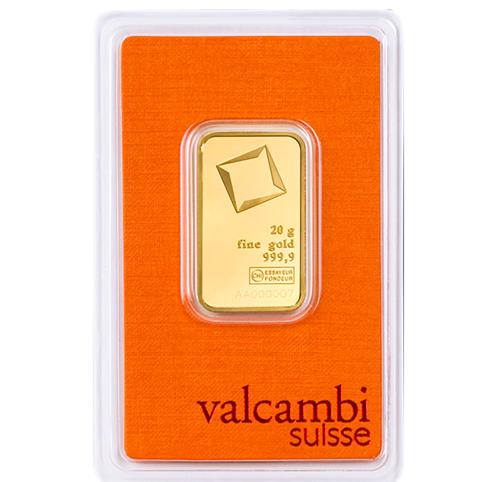
A standard Valcambi minted bar carries the logo, the weight, the metal, the fineness, the words essayeur fondeur and a unique bar number, with “Valcambi Suisse” on the reverse. Older bars carry only the Valcambi name on both faces.
The CombiBar
A CombiBar is a bullion bar divided into a grid of smaller bars, each fully assayed, which can be snapped apart one at a time. Buy one and you own a single bar until the day you want a fraction of it, at which point you have smaller separate pieces without cutting anything or paying anyone to do it.
Valcambi introduced the gold version in April 2011 as a 50 gram bar made of fifty 1 gram pieces, added silver that October and platinum and palladium in September 2012. The current range is:
| Metal | CombiBar formats |
|---|---|
| Gold | 100 g, 50 g, 1 oz, 20 g, and a 5 g star |
| Silver | 100 g, as either 100 × 1 g or 10 × 10 g |
| Platinum | 50 g, as 50 × 1 g |
| Palladium | 50 g, as 50 × 1 g |
Each bar arrives security sealed in a PETG blister with a serial-numbered assay certificate inside, and Valcambi’s position is that every individual piece remains certified and saleable on its own once detached.
The idea was not originally Valcambi’s. The CombiBar was invented and patented by the German refiner ESG Edelmetall-Service, and Valcambi holds the licence to produce it for every market outside Germany and Austria, where Heimerle + Meule makes it instead. What Valcambi did was make it the standard, and the Valcambi CombiBar is the version almost everyone means when they use the word.
Divisibility is not free, and a CombiBar carries a substantially higher premium than a plain bar of the same weight and metal. The prices section below sets out exactly how much, because the gap is large enough that it should decide whether you buy one. Our guide to buying your first gold bar covers the same trade-off between size and cost across the wider bar market.
Round Bars and Other Formats
Valcambi also produces a handful of formats that sit somewhere between bullion and jewellery. Round Bars are the standard minted bars in a disc rather than a rectangle, in gold from 1 gram to 1 oz. The Armillary is stranger and rather good: four quarter-ounce legal tender gold coins, issued for the Cook Islands, held concentrically so they twist apart into an armillary sphere or separate into four coins. The sBEad coin is a pierced gold sphere of 2 or 5 grams, also Cook Islands legal tender, sold sealed in a blister with its certificate.
None of these are efficient ways to buy gold, and they are not sold as such. They exist because Valcambi is a minting house as much as a refinery.
How to Identify a Genuine Valcambi Bar
Valcambi has no verification app, no QR code and no serial number database a buyer can query. For the largest refinery in the world that may seem surprising, but it is the ordinary position across the industry, and what does the work instead is a consistent set of stamped markings, a sealed blister and the physical properties of the metal.
What the Markings Should Show
– The Valcambi Assay Mark. Valcambi’s own position is that the fineness, weight and authenticity of its bars are guaranteed by the assay mark struck on each individual bar. Its presence means the bar was assayed and produced at Balerna.
– The essayeur fondeur marking. The LBMA describes Valcambi’s official stamp as a rectangle enclosing CHI in a circle together with the words ESSAYEUR FONDEUR, with the brand mark a diamond made up of four scalene triangles. Essayeur fondeur is the Swiss assayer-melter designation and it should be present.
– “Valcambi Suisse” on the reverse. Standard minted bars carry the logo, weight, metal, fineness, the essayeur fondeur marking and a unique bar number on the face, with Valcambi Suisse on the back. Older bars carry only the Valcambi name on both sides, which is normal for their age rather than a warning sign.
– A unique serial number, on cast and minted bars alike, which should match the number on the certificate.
– The right fineness for the metal. Valcambi gold is 999.9, sometimes 999.99. Silver is 999.0 or 999.9. Platinum and palladium are 999.5, not four nines, because that is the standard for those metals. A Valcambi platinum bar claiming 999.9 is worth a second look.
– An intact seal. Minted bars and CombiBars are sealed in PETG blisters or capsules, which Valcambi says are designed to resist tampering rather than simply to look tidy. A blister that has been opened and reclosed is reason enough to stop.
Why the Certificate Is Unsigned
Valcambi certificates carry no signature, deliberately. The company’s explanation is that it holds both the assayer’s and the melter’s licence, and that those licences are issued to Valcambi as a company rather than to a named individual, so no assayer’s signature is legally required on a certificate it issues. What the certificate does carry is the product’s fineness, its weight in grams, its serial number and Valcambi’s certified assayer hallmark.
So an unsigned Valcambi certificate is normal. A certificate whose serial number does not match the bar is not.
On a CombiBar the certificate sits inside the sealed blister with the bar, which means a genuine, unopened CombiBar cannot have had its certificate swapped. Once you break the seal to separate the pieces, that link is gone, which is one more reason to think about when you actually want to divide one.
How Valcambi’s Verification Compares
| Refinery | Who can verify, and how |
|---|---|
| Rand Refinery | The owner, by QR code or image recognition, on RandSure minted bars |
| PAMP | The owner, using the Veriscan app on a compatible bar |
| Argor-Heraeus | The owner, by eye, on a Kinebar |
| Royal Canadian Mint | A dealer only, using Bullion DNA equipment |
| Heraeus | Markings and physical checks |
| Valcambi | Markings and physical checks |
If being able to authenticate a bar yourself matters to you, PAMP’s Veriscan range and the Argor-Heraeus Kinebar are the two options among the Swiss refiners, and both cost more than a plain bar for that reason. If it does not, a Valcambi bar buys the same recognition at the point of sale without paying for a feature you will not use.
Whatever the brand, weigh and measure the piece. A counterfeit that reproduces the design convincingly is usually wrong on weight, dimensions or both, and that remains the most reliable cheap check available. Our guides on how to test gold and how to test silver cover the methods, from density and dimensions through to ultrasound and X-ray fluorescence.
Valcambi Prices and Premiums
Every bar is priced from the live metal price plus a premium covering refining, fabrication and distribution. For Valcambi the interesting question is not how it compares with PAMP or Argor-Heraeus, since Swiss plain bars are priced within a rounding error of each other, but what the CombiBar’s divisibility actually costs.
| Gold product | Premium over spot | Spread |
|---|---|---|
| Plain 100 g cast bar (Argor-Heraeus) | 2.3% | 3.7% |
| Valcambi CombiBar, 100 g | 8.0% | 8.8% |
| Plain 1 oz minted bar (Argor-Heraeus) | 3.9% | 5.1% |
| Valcambi CombiBar, 1 oz | 11.0% | 11.1% |
At 100 grams the CombiBar costs roughly three and a half times the premium of a plain bar holding the same gold, and at one ounce close to three times. Within the CombiBar range the premium falls as the bar gets larger, from 25.8% on the 5 gram star down to 11.7% at 20 g, 11.0% at 1 oz, 8.2% at 50 g and 8.0% at 100 g.
The fair way to read those numbers is not against a plain bar of the same weight, though, because a CombiBar is not one bar. A 100 gram gold CombiBar is a hundred separately assayed one gram bars in a single sealed package, and the alternative route to owning a hundred one gram pieces is to buy a hundred one gram bars. At the same moment a plain 1 gram Argor-Heraeus gold bar carried a 36.8% premium, and the PAMP equivalent 46.1%. Against that, the CombiBar’s 8.0% is not expensive at all. It sits far closer to a plain 100 gram bar than to the grams it divides into, which is precisely the point of the product. The question is only whether you will ever want to divide it. If you know you will not, a plain bar does the same job for a quarter of the premium.
Silver is the more extreme case. The 100 gram silver CombiBar carried a 72.3% premium, against 13% for a plain 100 gram silver bar from Nadir Refinery, and 5.2% for Valcambi’s own plain 100 oz bar. Silver’s low value per gram means fabrication dominates the price, and dividing it into a hundred pieces multiplies that effect. As a way of owning silver it is very expensive. As a way of holding small, recognisable, individually certified units of silver, it is the cheapest form of that there is.
Platinum follows the same size ladder without the CombiBar effect: Valcambi’s 5 gram bar came in at 41.6%, the 1 oz at 13.2% and the kilogram at 8.4%, with spreads from 32% down to 9%. Platinum is a thinner market than gold or silver, and both the premium and the buy-back reflect that.
You can check today’s prices on our gold price and silver price pages, and current buy-back rates for every product on our sell gold and silver page.
Frequently Asked Questions
Is Valcambi the largest gold refinery in the world?
Yes, by refining capacity. Valcambi can process around 2,000 tonnes of precious metals a year, more than any other single refinery. That figure covers gold, silver, platinum and palladium combined, and Valcambi no longer publishes a separate gold-only capacity.
What is a Valcambi CombiBar?
A CombiBar is a bullion bar divided into a grid of smaller bars, each separately assayed, that can be snapped apart by hand one piece at a time. It offers the flexibility of smaller units, with some of the cost-efficiency of a larger bar. Each arrives sealed in a blister with a serial-numbered assay certificate.
Is Valcambi LBMA accredited?
Yes. Valcambi’s gold and silver have been accredited for London Good Delivery since 1968, and its platinum and palladium have held London Platinum and Palladium Market good delivery status since 1997. It is not one of the LBMA’s seven Good Delivery referees, which surprises people given its size, but it has been an LPPM Good Delivery referee for platinum and palladium since 2013.
Where are Valcambi bars made?
All of them at Balerna, in the Swiss canton of Ticino, on a single 3.3 hectare site near the Italian border. Refining, assaying, casting, minting and packaging all happen there, which is unusual for a refinery of this size. It is also where gold bars stamped Credit Suisse were made, during the bank’s ownership of Valcambi from 1967 to 2003.
Are Valcambi bars a good investment?
A Valcambi bar tracks the metal price in exactly the same way as a bar from any other accredited refiner, because the value is in the metal rather than the name struck on it. On plain bars Valcambi sits with the other Swiss refiners, whose premiums differ by a rounding error. Where the choice actually matters is the CombiBar, which carries a substantially higher premium than a plain bar of the same weight in exchange for being divisible, so it is worth deciding whether you will use that flexibility before paying for it.
Can I break a CombiBar into single grams?
Yes, by hand and without tools. Each piece is individually assayed and carries its own markings, and Valcambi’s position is that every separated piece remains certified and saleable on its own. The one thing to understand is that the assay certificate is sealed in the blister with the intact bar, so once you break the seal the bar and its certificate are no longer packaged together, which is a reason to divide one only when you actually need to.
Buying and Selling Valcambi Bullion
Valcambi does not sell to the public. It refines and fabricates for banks, mints, industry and the trade, so its bars reach a private buyer through a dealer.
At BullionStar the Valcambi range is led by the CombiBar, in gold and silver. Alongside it sit plain Valcambi silver bars in 1 kg and 100 oz, the broadest part of the range in platinum bars from 5 grams to a kilogram, a 1 oz palladium bar, and pre-owned Credit Suisse gold bars in 5 and 10 gram sizes, made at Balerna during the bank’s ownership. Every product page shows the live buy price, the sell price and the premium over spot at the same moment.
A CombiBar costs more than a plain bar of the same weight and much less than the individual grams it divides into, so it is a good buy if you genuinely want the option to sell or give away a part of your holding, and a poor one if you simply want to own gold. Decide that before you choose the format, not afterwards.
One Singapore detail worth knowing: Valcambi’s gold, silver and platinum all qualify as Investment Precious Metals and carry no GST, but palladium does not qualify at all, so normal GST applies to the palladium bar on Singapore deliveries. Singapore levies no capital gains tax on any of it.
Bullion bought from us can be collected at our Bullion Center in Singapore, shipped to most countries, or held in vault storage as your allocated property. When you come to sell we buy Valcambi bars back at a live quoted price whether or not you bought them from us, by weight and metal.
Subscribe to Gold University Articles
Copyright Information: BullionStar permits you to copy and publicize articles or information from the BullionStar Gold University provided that a link to the article's URL or to https://bullionstar.com is included in your introduction of the article or blog post together with the name BullionStar. The link must be target="_blank" without re="nofollow". All other rights are reserved. BullionStar reserves the right to withdraw the permission to copy content for any or all websites at any time.