 Contact
 Help
Help






Argor-Heraeus: The Swiss Precious Metals Refinery Explained



Argor-Heraeus is one of the largest precious metals refineries in the world, and one of three that sit within a few kilometres of each other at the southern tip of Switzerland in Ticino. Its refinery and headquarters are in Mendrisio, in the canton of Ticino close to the Italian border, near enough to PAMP and Valcambi that the three together account for a significant share of all the gold refined globally. It processes gold, silver, platinum and palladium, and produces investment bars for both the wholesale and retail markets.
The business began as Argor SA in 1951, Ticino’s first precious metals refinery, and has changed hands more than once since. UBS owned it outright through the 1970s, then sold a quarter of it to the German group Heraeus in 1986, which is when the refinery took the name it still carries. Commerzbank bought in from 1999 and the Austrian Mint from 2002, both holding their stakes until 2017, when Heraeus Precious Metals acquired the rest of the company outright. Argor-Heraeus has been wholly owned by Heraeus ever since, while continuing to operate as a distinct refinery under its own name.
Two things set an Argor-Heraeus bar apart for a buyer. The refinery holds London Good Delivery accreditation and sits on the LBMA’s small panel of Good Delivery referees, the handful of refiners trusted to assay everyone else’s work. And its minted bars can carry the Kinebar, a diffractive hologram struck into the surface of the metal that is among the most difficult security features in the industry to reproduce.
This guide covers who owns Argor-Heraeus and how it got there, what the refinery produces and in which sizes, how to identify a genuine bar and how the Kinebar works, how its premiums compare with the other Swiss refiners, and what buying and selling its bars involves.
Highlights
- Founded in 1951 in Chiasso as Ticino’s first precious metals refinery, and based in Mendrisio, Switzerland, since 1986.
- Wholly owned by Heraeus Precious Metals since April 2017, though its bars are still stamped and traded as Argor-Heraeus.
- An LBMA full member with Good Delivery accreditation for gold since 1961, and one of only seven Good Delivery referees worldwide.
- Refines gold to 99.99% and 99.999% purity and supplies customers in more than 50 countries.
- Creator of the Kinebar, a gold bar with a diffractive hologram embossed into the metal that you can verify by eye, with no app or database needed.
Who Is Argor-Heraeus?
Argor-Heraeus SA is a precious metals refinery in Mendrisio, in the Swiss canton of Ticino. It is one of a small number of refineries worldwide operating at the scale where it serves mining companies, bullion banks, central banks and mints from the same site. It refines gold, silver, platinum and palladium, taking in doré from mine sites, recycled and industrial scrap, and existing wholesale bars for re-forming into smaller sizes. Its gold output runs to 99.99% and, for specialist applications, as high as 99.999%. Its customers are spread across more than fifty countries.
It also has a decent claim to being the origin of Ticino’s gold industry. Argor SA opened in Chiasso in 1951 as the canton’s first precious metals refinery, some years before Valcambi and PAMP established themselves a few kilometres away.
From Argor SA to Heraeus Ownership
The company’s ownership has changed hands several times.
UBS bought 80% of Argor SA in 1960 and took full ownership in 1973. In 1986 it sold a quarter of the business to the German precious metals and technology group Heraeus, and the two formed a joint venture named Argor-Heraeus SA, at which point the headquarters moved from Chiasso to nearby Mendrisio. UBS exited in 1999 following its merger with Swiss Bank Corporation, and Commerzbank bought a stake the same year. The Austrian Mint followed in 2002.
That left an unusual arrangement for a refinery: three corporate shareholders across Germany and Austria, plus a holding owned by the refinery’s own Swiss management, with each bringing something different. Heraeus contributed its research and industrial capacity, Commerzbank its bullion banking network, and the Austrian Mint its distribution.
It ended in April 2017, when Heraeus acquired the remaining 67% from Commerzbank, the Austrian Mint and Argor-Heraeus management, taking full control. German press reporting at the time put the valuation of the whole business at around half a billion Swiss francs.
Argor-Heraeus has been wholly owned by Heraeus Precious Metals since. What did not change is the refinery itself. It still operates from Mendrisio under its own name, and its bars still carry the Argor-Heraeus stamp rather than the Heraeus one, which is why the two appear as separate brands on a dealer’s shelf despite sharing an owner.
LBMA Accreditation and Good Delivery
Argor-Heraeus is a full member of the London Bullion Market Association and holds Good Delivery accreditation for both gold and silver, its gold accreditation dating back to 1961.
It also sits on the LBMA’s panel of Good Delivery referees, the small group of refiners that assess applicants to the list, provide technical guidance, and assay sample bars submitted by other refineries. That panel held five members for decades before the LBMA expanded it to seven in March 2025. The others are PAMP, the Perth Mint, Metalor, Rand Refinery, Tanaka and Germany’s Agosi.
Beyond London, the refinery’s platinum and palladium bars are accepted as good delivery by the London Platinum and Palladium Market, and its gold bars are approved for delivery against COMEX and TOCOM gold futures contracts. It is a member of the Swiss precious metals trade body, the Association Suisse des Fabricants et Commerçants de Métaux Précieux, and like every Swiss refinery it works with licensed assayers accredited by the Swiss Central Office for Precious Metals Control, whose standards sit behind the assay on every bar it produces.
What the Argor-Heraeus Refinery Produces
Argor-Heraeus output splits into two halves that rarely sit under one roof. One is investment bullion: cast and minted bars in gold, silver, platinum and palladium for the wholesale and retail markets. The other is industrial, supplying finished and semi-finished alloys and high-precision components to the electronics, chemical, watchmaking and jewellery sectors. That second half is a real difference from a pure bullion producer, and it is part of why the refinery’s purity range extends to 99.999% gold for specialist applications rather than stopping at the 99.99% that investment bars require.
On the bullion side, the gold range is the broadest.
| Gold bar format | Weights produced |
|---|---|
| Minted | 1 g, 2 g, 5 g, 10 g, 20 g, 50 g, 100 g, and 1 troy oz |
| Cast | 50 g, 100 g, 250 g, 500 g, 1 kg, 10 tola, and 400 oz Good Delivery |
The 50 gram and 100 gram sizes are made both ways, which is why you will find cast and minted versions of the same weight sitting side by side, the cast bar usually a little cheaper because the process is simpler. Two entries in the cast column say something about who the refinery sells to: the 400 oz bar is the wholesale unit traded between banks and central banks rather than anything an individual buys, and the 10 tola bar, at roughly 116 grams, is made for South Asia and the Gulf where the tola remains the customary unit.
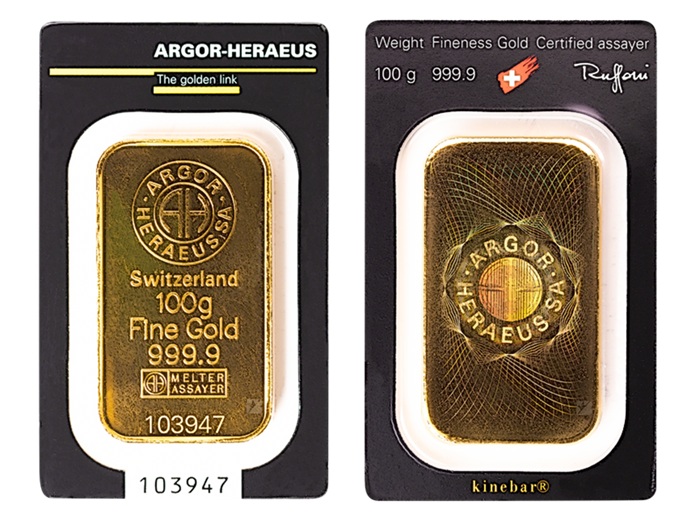
Minted bars up to 100 grams are supplied in a laminated assay card that doubles as the certificate of authenticity, carrying the bar’s weight, purity and serial number.
Argor-Heraeus platinum is unusually complete for a bullion range, running from 1 gram to 1 kilogram, which makes it one of the few practical routes into physical platinum at retail sizes. Silver from the refinery arrives mostly as large cast bars, including an uncommon 15 kilogram size.
Not everything the refinery makes is a plain bar. Its Lunar Series follows the animals of the Chinese zodiac with a new design each year, struck in gold from 1 gram up to 1 troy oz, alongside other design-led minted issues. As with any product bought partly for its design, these carry a premium above a plain bar of the same weight, which the prices section below covers.
Argor-Heraeus produces bars under other companies’ brands as well as its own, and BullionStar’s 100 gram no-spread gold bar is one of them, manufactured by Argor-Heraeus to our specification. Beyond that, we stock Argor-Heraeus gold bars from 1 gram to 1 kilogram in both minted and cast form, the full Kinebar range, the Lunar Series, platinum bars from 1 gram upwards, and large cast silver bars.
The Kinebar Hologram
The Kinebar is Argor-Heraeus’s signature product and the most distinctive security feature on any bar in the Swiss range. On the reverse of the bar sits a kinegram: a diffractive optically variable image, closely related to the security holograms used on banknotes, passports and identity documents. The technology comes from OVD Kinegram AG, a Swiss company whose main business is exactly that kind of government security printing.
The important part is how it gets there. The kinegram is not a foil or a label stuck to the surface. It is embossed directly into the gold, so it forms part of the bar itself. Tilt a Kinebar under a light and the image shifts and moves; the effect is in the metal, not on it.
Argor-Heraeus first applied kinegrams to bar reverses in December 1993 and launched the gold Kinebar range in 1994, in 1 gram, 2 gram, 5 gram, 10 gram, 20 gram and 1 troy ounce sizes. The 50 gram and 100 gram versions followed in 2012. The product dates from the period when UBS owned the refinery, which is why UBS-branded Kinebars also exist from that era.
Why the Kinebar Is Hard to Fake
Three things make it a strong deterrent. Because the image is embossed rather than applied, it cannot be peeled from a genuine bar and transferred to a fake, which is the usual weakness of any applied security label. Reproducing it requires the original embossing tooling and the diffractive master behind it, which is not something a counterfeit operation improvises. And the optical behaviour is difficult to imitate convincingly: a printed or stickered approximation looks flat and static next to the real thing, and the difference is obvious once you have seen a genuine one move.
That the same technology guards banknotes and passports is the useful shorthand for how seriously it is engineered. Argor-Heraeus produces Kinebars from 1 gram up to 100 grams, including the 1 oz Kinebar.
How to Identify a Genuine Argor-Heraeus Bar
Most Argor-Heraeus bars are plain minted or cast bars, and the checks on them are the ordinary ones. The Kinebar is the exception, and it has one practical advantage over every other authentication system in the industry.
There is no app to download, no serial number to look up and no database to query. Verifying a Kinebar means looking at it. Compare that with PAMP, where Veriscan requires the app and a compatible product, or the Royal Canadian Mint, where Bullion DNA verification is a dealer procedure a buyer cannot run at all. If you are looking at a bar in your own hands, in a private sale, the Kinebar is the only one of the three you can check unaided.
In practice:
– On a Kinebar, tilt it under a light and watch the image move. A flat or static pattern is a bad sign.
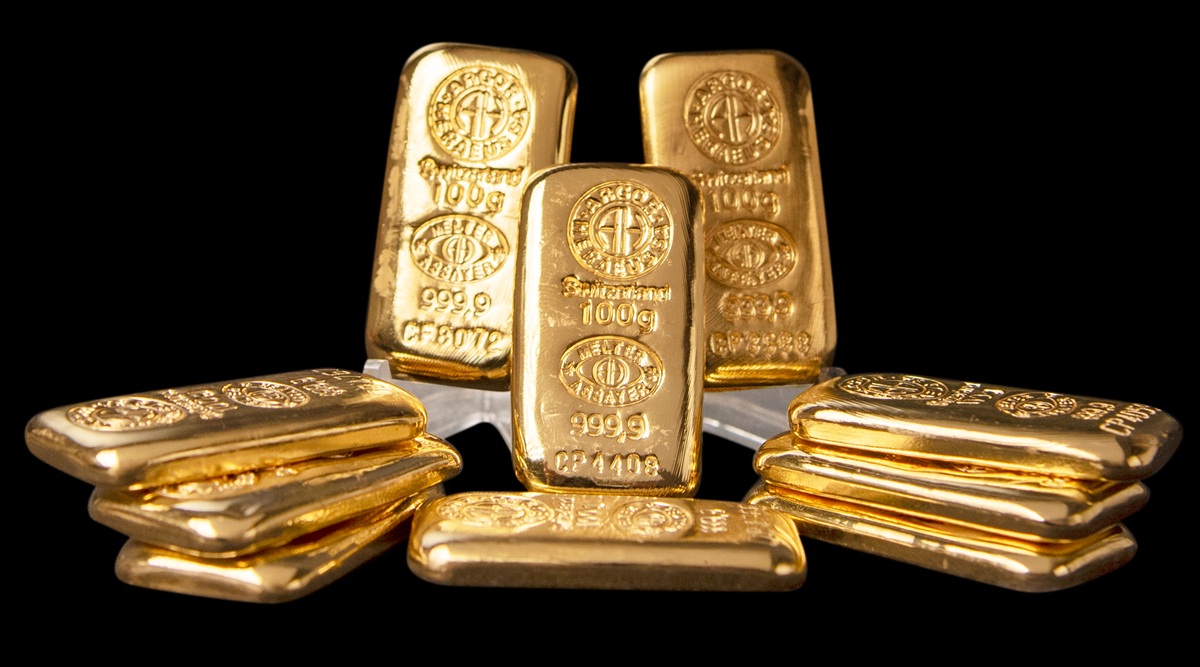
– Check the obverse markings: the Argor-Heraeus logo, the weight, the purity, and “Switzerland” engraved beneath the logo.
– Match the serial number stamped on the bar against the number printed on its assay card. The two should be identical, and a mismatch is reason enough to stop. – A match confirms that the bar and the card belong together rather than proving authenticity on its own.
– On minted bars up to 100 grams, check the laminated assay card, which doubles as the certificate of authenticity, for signs of opening or resealing, and look closely at print quality.
– Weigh and measure the bar. A counterfeit that reproduces the design convincingly is usually wrong on weight, dimensions or both.
– Where any doubt remains, have it tested by a dealer.
Our guide on how to test gold covers the physical methods, from density and ultrasound through to X-ray fluorescence, in more detail.
Argor-Heraeus Prices and Premiums
An Argor-Heraeus bar is priced from the live spot price of the metal it contains, plus a premium covering refining, minting, packaging and distribution. The table below compares 1 oz minted gold bars from the three Swiss refiners in our range, priced at the same moment at the time of writing.
| 1 oz minted gold bar | Premium over spot |
|---|---|
| PAMP | 3.9% |
| Argor-Heraeus | 4.0% |
| Metalor | 4.0% |
| Argor-Heraeus Kinebar | 5.9% |
The first three sit within a tenth of a percentage point of one another, which is narrower than the rounding. If you have been trying to work out which Swiss refiner offers better value, that is the answer. On price it barely matters. All three hold LBMA Good Delivery accreditation, all three produce 99.99% bars, and a dealer buying any of them back is buying the same gold.
The exception in the table is the Kinebar, and the gap is the price of the hologram: roughly 1.9 percentage points over a plain Argor-Heraeus bar of the same weight. Whether that is worth paying depends on what you want from it. It buys a bar that is genuinely harder to counterfeit and, as the section above sets out, one you can check by eye without an app or a dealer’s equipment. It does not buy a better exit. A dealer buying it back is buying an ounce of gold; the hologram does not travel with the price. If you are planning to sell privately, however, the Kinebar may offer reassurance to the future buyer that a plain bar would not.
Two other factors move the premium far more than the brand does. Size is the significant one: the same Argor-Heraeus gold carried a premium of about 2.4% at 100 grams against 4.0% at one ounce, because fabrication costs are spread across more metal. Format matters less, though not nothing. The cast versions of the 50 gram and 100 gram bars price slightly below the minted ones, casting being the simpler process. Our guide to buying your first gold bar covers how size and premium interact in more detail.
You can check today’s prices on our gold price page, and current buy-back rates for every product on our sell gold and silver page.
Frequently Asked Questions
Is Argor-Heraeus a good gold brand?
Yes, Argor-Heraeus is one of the four Swiss refineries whose bars are accepted for resale almost anywhere in the world, alongside PAMP, Metalor and Valcambi. Its gold is refined to 99.99% purity, its bars carry LBMA Good Delivery accreditation, and it has been on the Good Delivery List since 1961. In practical terms that means a dealer in Singapore, Zurich or Hong Kong will recognise the stamp and quote you a price without needing to assay the bar first.
What is a Kinebar?
A Kinebar is an Argor-Heraeus gold bar with a diffractive hologram, called a kinegram, embossed directly into the reverse face of the metal. The image shifts and changes colour as you tilt the bar, which makes it one of the few security features you can check by eye without an app, a database or a dealer’s equipment. The pattern is pressed into the gold itself rather than printed on a sticker or a card, so it cannot be transferred to another bar.
Is Argor-Heraeus LBMA accredited?
Yes. Argor-Heraeus is a full member of the London Bullion Market Association and has held Good Delivery accreditation for gold since 1961, with separate accreditation for silver, and LPPM good delivery status for platinum and palladium. It also sits on the LBMA’s panel of Good Delivery referees, the seven refineries that assess applicants to the list and assay sample bars submitted by other refiners. Its bars are additionally approved for delivery against COMEX and TOCOM futures contracts.
Where are Argor-Heraeus bars made?
Argor-Heraeus refines and casts its bars in Mendrisio, in the Swiss canton of Ticino, a few kilometres from the Italian border. The company began in nearby Chiasso in 1951 as Ticino’s first precious metals refinery and moved to the current Mendrisio site in 1986. Bars are stamped “Switzerland” alongside the AH mark, and Swiss production is part of why the brand trades at a globally recognised price. Its parent company, Heraeus, refines separately in Hanau, Germany, and stamps its own bars under its own name, so the two brands are distinct products from one corporate group.
Can I buy directly from Argor-Heraeus?
No, Argor-Heraeus does not sell to the public. It refines and manufactures for banks, institutions, industrial customers and dealers, and its bars reach private buyers through the retail bullion trade. At BullionStar you can buy Argor-Heraeus gold bars and platinum bars from stock, in sizes from 1 gram to 1 kilogram, and take delivery in Singapore, arrange shipping or leave them in vault storage.
Do Argor-Heraeus bars hold resale value?
They hold value as well as any of the major Swiss brands, which is to say the price you get back tracks the gold, not the name. Dealers buy Argor-Heraeus bars readily because the stamp is recognised and the bar does not need testing, and BullionStar quotes a live buy-back price on them. The one thing worth knowing is that the extra you pay for a Kinebar is not recovered on resale, because a dealer buying it back is buying an ounce of gold. If resale value is your main concern, a plain minted or cast bar costs less to enter and returns the same on exit.
Buying and Selling Argor-Heraeus Bars
At BullionStar the Argor-Heraeus range runs from 1 gram to 1 kilogram in gold, in both minted and cast formats, plus the full Kinebar ladder and platinum bars across the same weight range. Every product page shows the live buy price, the sell price and the premium over spot at the same moment, so you can judge the round trip before you buy rather than discovering it later. If you want the cheapest way into 100 grams of Argor-Heraeus gold and expect to sell it back to us, the BullionStar No-Spread bar is refined by Argor-Heraeus to the same standard and carries no spread at all in quantities of ten or more, once past a seven-day holding period.
Bars bought from us can be collected in person at our Bullion Center in Singapore, shipped to most countries, or left in vault storage in Singapore, where they are held as your allocated property and can be audited or withdrawn at any time. Singapore charges no GST on investment precious metals and no capital gains tax, which is the main reason a Swiss bar bought in Asia often works out cheaper to hold than the same bar bought closer to where it was made.
When you come to sell, we buy Argor-Heraeus bars back by weight and metal at a live quoted price, whether you bought them from us or elsewhere. That is the practical value of a Good Delivery brand, the stamp does the work of an assay, and the transaction is a matter of arithmetic rather than negotiation. You can track what your holding is worth against the live gold price at any time.
Subscribe to Gold University Articles
Copyright Information: BullionStar permits you to copy and publicize articles or information from the BullionStar Gold University provided that a link to the article's URL or to https://bullionstar.com is included in your introduction of the article or blog post together with the name BullionStar. The link must be target="_blank" without re="nofollow". All other rights are reserved. BullionStar reserves the right to withdraw the permission to copy content for any or all websites at any time.