 Contact
 Help
Help







The Metalor Refinery: Swiss Precious Metals Since 1852



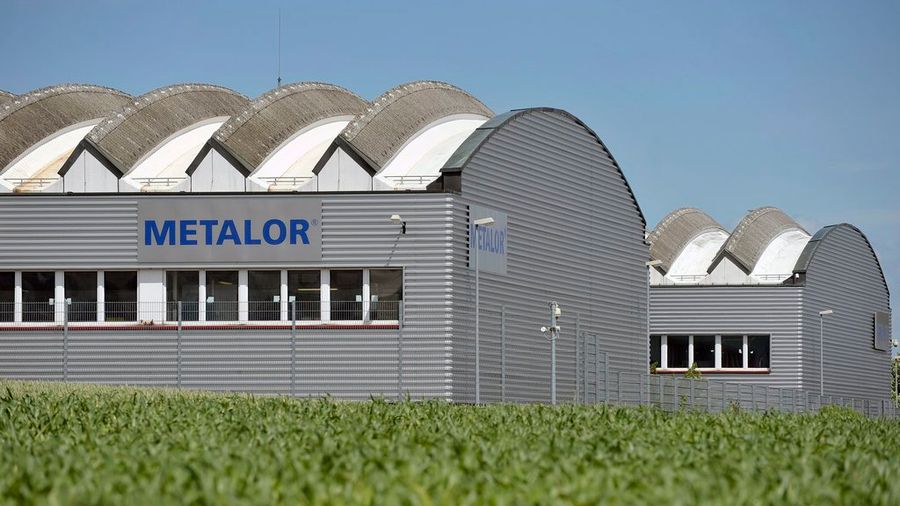
Metalor is a precious metals refiner at Marin-Epagnier, on the shore of Lake Neuchâtel in western Switzerland. It is one of the four large Swiss refineries, alongside PAMP, Valcambi and Argor-Heraeus, and the only one of the four not in the Italian-speaking canton of Ticino. It is also by a wide margin the oldest. The business traces back to 1852, when Martin de Pury & Cie began smelting and rolling gold in Le Locle for the watchmakers of the Jura, more than a century before any of its Swiss rivals existed.
Since September 2016 Metalor has been owned outright by Tanaka, the Japanese precious metals group, although it continues to trade as a Swiss company under its own name and its own accreditations. Two of the world’s best known refining names now sit inside one group, and both still hold their places on the LBMA referee panel.
This page covers who Metalor is and how a bank-owned supplier to Swiss watchmakers ended up in Japanese hands, what the refinery produces and in which sizes, how to check that a Metalor bar is genuine, what its bars cost against the other Swiss refiners, and how buying and selling them works.
Highlights
- Traces back to 1852 in Le Locle, supplying gold to Swiss watchmakers, which makes it the oldest of the four large Swiss refineries. Owned outright by the Japanese group TANAKA since September 2016.
- Five LBMA-accredited refineries across three continents, in Switzerland, the United States, Hong Kong, Singapore and Suzhou, with more than 1,550 employees in fifteen countries.
- The Singapore refinery is the only business approved as a Refiner under the Inland Revenue Authority’s Approved Refiner and Consolidator Scheme, a status it has held since June 2013.
- One of the seven LBMA good delivery referees, the refiners the market uses to settle disputes over a bar’s assay, and a member of the equivalent panel at the London Platinum and Palladium Market.
- Three businesses, not one: refining, electrical contacts for the switchgear industry, and advanced coatings for watches, semiconductors and solar panels, with bullion one output of a large industrial group.
Who Is Metalor?
Metalor Technologies International SA is a precious metals refiner, assayer and fabricator with its head office at Marin-Epagnier, in the canton of Neuchâtel. It refines gold, silver, platinum and palladium, and in smaller volumes rhodium, ruthenium and iridium, drawing its feed from mines, from industrial customers and increasingly from recycled material. It employs more than 1,550 people across fifteen countries, at fifteen industrial sites and thirteen offices.
Five of those sites are refineries accredited for good delivery, which is what puts Metalor bars on the London market and on the futures exchanges.
| Refinery | Location | Good delivery accreditation |
|---|---|---|
| Metalor Technologies SA | Marin-Epagnier, Switzerland | LBMA gold and silver, LPPM platinum, palladium and rhodium |
| Metalor USA Refining Corporation | North Attleboro, Massachusetts | LBMA gold and silver |
| Metalor Precious Metals Hong Kong | Hong Kong | LBMA gold and silver |
| Metalor Technologies Singapore | Singapore | LBMA gold |
| Metalor Precious Metals (Suzhou) | Suzhou, China | LBMA gold, LPPM platinum and palladium |
Two of those entries are recent. Metalor bought a second Hong Kong refinery in March 2023, and the Hong Kong operation was added to the LBMA silver good delivery list in April 2026. In March 2026 Metalor also completed the purchase of Gannon & Scott, an American recycler founded in 1919, adding plants in Rhode Island and Arizona. Those handle recovery from electronic scrap and industrial waste rather than good delivery bar production, but they feed the same refineries.
The Singapore refinery is worth a note if you are buying from us. It opened in 2014 and joined the LBMA gold good delivery list the same year, and it is the only precious metals refinery of any size in the country. It is also the only business Singapore recognises as an Approved Refiner under the Inland Revenue Authority’s Approved Refiner and Consolidator Scheme, a status it has held since June 2013. The scheme suspends GST on the raw material a refiner imports to turn into Investment Precious Metals, which is part of what makes Singapore workable as a bullion market rather than merely a storage location. Some of the Metalor gold in our vault was refined a short drive away.
The Three Sides of Metalor Technologies
Metalor runs three divisions, and refining is only one of them.
Refining takes precious metals from mining output, industrial by-products and scrap, and produces bars, grain and investment products. Gold for the electronics industry is refined to purities as high as 99.999%.
Electrotechnics fabricates silver and other alloys into electrical contacts, the small components inside switches and relays that have to conduct reliably for decades.
Advanced Coatings makes electroplating chemistry for watch and jewellery finishing, coatings for semiconductors, and the precious metal powders and flakes used in solar panels and touchscreens.
For a bullion buyer the practical point is that the bars are one product of a large industrial business, not the whole of it. That breadth is part of why the refining side has survived two centuries of upheaval in the Swiss watch trade.
LBMA Accreditation and Good Delivery
Metalor’s Swiss refinery has been on the London Bullion Market Association gold good delivery list since the 1930s, which makes it one of the oldest entries on it. The US refinery joined in 1987, Hong Kong in 2001 and Singapore in 2014.
Beyond the list itself, Metalor holds two positions that only a handful of refiners do. It is one of the seven LBMA good delivery referees, the refiners the association uses to test applicants and to settle disputes over a bar’s assay, and it sits on the equivalent referee panel at the London Platinum and Palladium Market. It is also a full member of both bodies rather than an associate. Its Swiss bars are deliverable against COMEX gold futures, and it was a founding member of the Shanghai Gold Exchange’s international board.
Each refinery is audited annually against the LBMA’s Responsible Gold Guidance, and the reports are published. The most recent audits of the Swiss, Singapore and Hong Kong refineries were all signed without qualification or adverse findings.
On sourcing, Metalor took a harder line than most of its peers. In June 2019 it announced it would stop processing artisanally mined gold altogether, citing the cost and complexity of assuring those supply chains, a decision that drew criticism from campaigners who argued that walking away pushes small miners towards less scrupulous buyers. It has since reopened a narrow channel, accepting artisanal gold from a single Peruvian mine that participates in the Swiss Better Gold programme, and works otherwise with industrial mines. In Switzerland it remains a member of the Swiss Precious Metals Association.
From Le Locle to Tanaka
The business began in 1852 in Le Locle, in the Jura hills above Neuchâtel, as Martin de Pury & Cie, smelting and rolling gold for the watch case makers who dominated the valley. In 1864 it merged with the local bank, which set the pattern for the next 134 years. When Swiss Bank Corporation took over the Banque du Locle in 1918, the refinery came with it, and Metalor spent the rest of the twentieth century as a bank-owned business. It was renamed Métaux Précieux SA in 1936, and opened a new plant in the Neuchâtel area in 1947.
Bank ownership ended in 1998, when a group of Swiss private investors led by Ernst Thomke bought control, and the company took the name Metalor Technologies in 2001. Expansion followed quickly: Hong Kong had opened in 1982 and the United States in 1986, and Suzhou followed in 2006, the Johnson Matthey refinery in Hong Kong was acquired in 2007, and Singapore came in 2014. The French private equity firm Astorg Partners bought a majority stake in 2009.
Astorg sold in 2016. On 27 September that year, Metalor became a wholly owned subsidiary of TANAKA, the Japanese precious metals group founded in 1885, in a deal that put two of the world’s most recognised refining brands inside one company. The Tanaka group restructured and renamed its own entities in January 2025, and now trades as TANAKA Precious Metals. Metalor kept its name, its Swiss management and its own accreditations, and the head office moved to Marin to sit beside the refinery. Both Metalor and Tanaka remain on the LBMA referee panel.
What the Metalor Refinery Produces
Most of what Metalor makes never reaches a private buyer. It pours Good Delivery bars for the wholesale market, supplies gold, silver, platinum and palladium as grain, powder and sponge to jewellers and to electronics manufacturers, refining gold for that market to as fine as 99.999%, and produces semi-finished alloys for the watch trade it has served since 1852. Investment bars are the visible end of a business that mostly sells metal by specification.
At the retail end, the range divides cleanly into cast and minted.
| Format | Metal | Fineness | Weights |
|---|---|---|---|
| Cast bars | Gold | 999.9 | 1 oz, 50 g, 100 g, 250 g, 500 g, 1 kg, and Good Delivery bars to 12.5 kg |
| Cast bars | Silver | 999 | 100 g, 250 g, 500 g, 1 kg, and Good Delivery bars to 30 kg |
| Minted bars | Gold | 999.9 | 1 g, 2 g, 5 g, 10 g, 20 g, 1 oz, 50 g, 100 g |
| Minted bars | Platinum | 999.5 | 100 g, 1 kg |
Metalor does not mint silver, so every Metalor silver bar is cast, and it publishes no retail palladium bars at all, although it refines palladium to London Platinum and Palladium Market standards for the wholesale market. If you want a small minted silver bar or any palladium bar, Metalor is not the refiner for it.
Cast Bars
A cast bar is poured molten into a mould and left to cool. The process is simple and quick, the surface comes out slightly irregular, and no two bars look quite the same. That irregularity is not a defect. It is the reason cast bars cost less to make, and at the same weight they almost always carry the lower premium, which is why they dominate at the larger sizes where buyers care about metal rather than presentation.
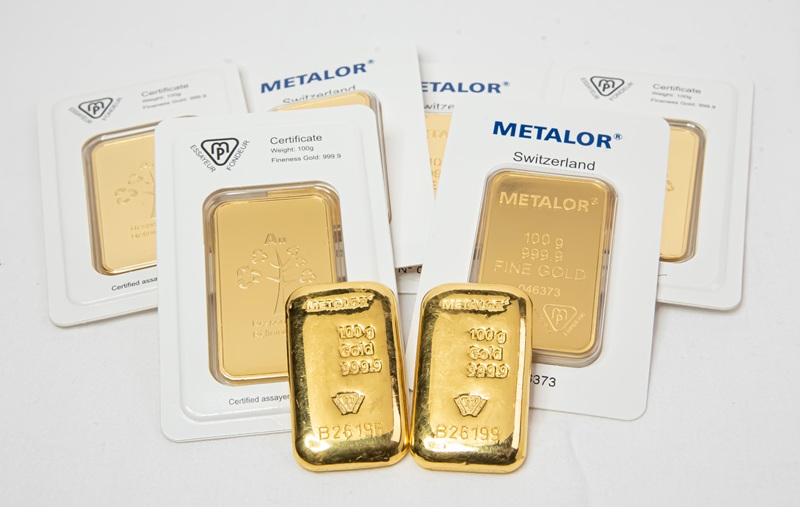
Every Metalor cast bar carries a serial number and is delivered with its own certificate of authenticity.
Minted Bars
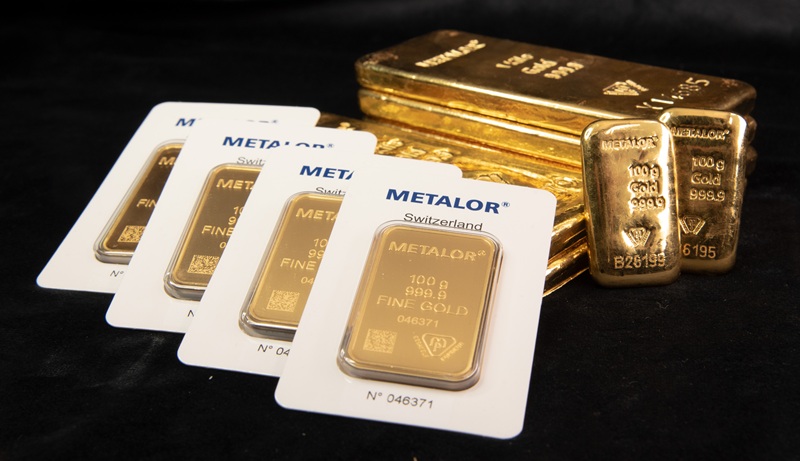
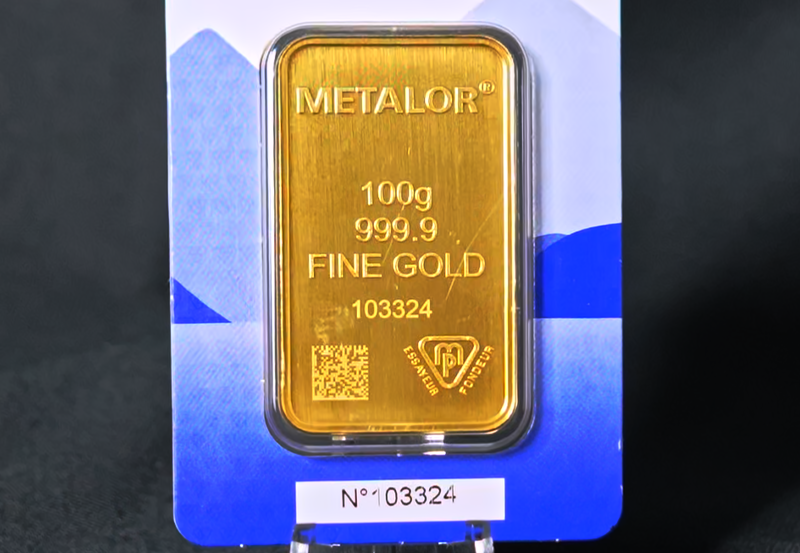
A minted bar is cut from a rolled strip and struck, so it comes out flat, uniform and sharp-edged. Metalor seals its minted bars inside a credit card sized blister with the certificate of authenticity enclosed, so the bar and its paperwork arrive as one sealed unit rather than as a bar and a loose card.
Each minted bar carries a six digit serial number. From 20 grams upward, Metalor also laser engraves a DataMatrix code onto the bar surface, a small square barcode that links to an encrypted page on Metalor’s own system. That matters for checking a bar is genuine, and the next section covers how it works.
Two Bars, Same Weight
At 50 grams and at 100 grams, Metalor produces the bar both ways, cast and minted, at the same fineness and the same gold content. Most refiners pick one method per weight. The result is a straight comparison that is rarely available: two bars holding identical metal, differing only in how they were made and how they look.
Which you should buy comes down to what you want from the bar. The minted version is the more attractive object, arrives sealed with its certificate, and carries the DataMatrix code. The cast version is plainer, arrives with a separate certificate, and is cheaper. We stock both at both weights, and the prices section below sets out exactly what the difference costs.
What We Stock
At BullionStar we carry Metalor gold bars in multiple sizes, from a 5 gram minted bar up to a kilogram, including the minted and cast pairs at 50 grams and 100 grams. Our own 100 gram BullionStar No-Spread gold bar is produced for us by Metalor’s Singapore refinery and by Argor-Heraeus in Switzerland. Silver bars include the 1 kg cast bar, produced by Metalor in either Switzerland or Singapore.
We also list a number of Metalor platinum bars of around 5 kilograms each. These are LPPM plate bars of irregular weight, each sold as a single piece and priced on its actual platinum content, so they are wholesale stock for institutional and high-volume buyers rather than a standard retail product.
If you are choosing a first bar and are unsure what size makes sense, our guide to buying your first gold bar works through the trade-off between size and premium across the wider market.
How to Identify a Genuine Metalor Bar
Metalor is one of the few refiners whose bars you can verify yourself, without specialist equipment and without taking the bar to a dealer. That has not always been true, and it is not true of most of its Swiss neighbours. Before reaching for the app, though, the markings do most of the work.
What the Markings Should Show
The METALOR wordmark. The current stamp was introduced in 2001, when the company took the name Metalor Technologies. It replaced the Métaux Précieux SA stamp that had been in use since 1952, and it is applied group-wide, so a bar refined in Singapore or Suzhou carries the same wordmark as a Swiss one.
An assay mark that tells you which refinery made it. This is the detail most buyers miss. The wordmark is common to the group, but the assay seal is specific to the plant.
| Refinery | Assay mark |
|---|---|
| Switzerland | ESSAYEUR FONDEUR with MP inside a triangle |
| United States | MUS, including the year of production |
| Hong Kong | M above HK inside an inverted triangle, with ASSAYERS and MELTERS along the sloping sides |
| Singapore | MSG |
| Suzhou | MCN |
Essayeur fondeur is the Swiss assayer-melter designation, and it appears only on Swiss-made bars. Its absence on a bar stamped Singapore or Hong Kong is correct, not a warning sign.
Weight, metal and fineness. A cast gold bar reads the weight, the word gold, 999.9 and Switzerland. A minted gold bar reads the weight, 999.9 and FINE GOLD. Metalor gold is always 999.9, silver 999, and platinum 999.5 rather than four nines, because 999.5 is the standard for the metal. A Metalor platinum bar claiming 999.9 is worth a second look.
A unique serial number, on cast and minted bars alike. On minted gold bars it is six digits, and it should match the number on the certificate.
A DataMatrix code, on recently minted bars of 20 grams and above and on kilobars. This is the small square barcode laser engraved onto the bar face, and it is what the app reads.
Checking a Bar with the Metalor Check App
Metalor Check is a free app for iOS and Android. It reads the DataMatrix code on a gold kilobar or on a minted gold bar of 20 grams or more, and returns the bar’s production location, purity and specifications. Where the gold was refined under Metalor’s segregated service, it will also show the origin of the metal, whether that is a named mine, a region, or recycled material.
Above that sits BullionProtect, a security seal Metalor developed with SICPA, the Swiss company behind the inks used in passports and banknotes. It is applied directly to the bar surface, adds under 20 milligrams, and can be checked three ways: by eye, with a card-sized validator that needs neither internet nor good lighting, and by the QR code embedded in the seal, which any smartphone will read. The ink burns off cleanly if the bar is ever melted, leaving no impurity in the gold. It is most often seen on kilobars and Good Delivery bars.
One practical caveat. Not every Metalor bar carries a DataMatrix code. The 1, 2, 5 and 10 gram minted bars do not, so on the smallest bars you are back to markings and physical checks.
Older Metalor Bars
Bars made before 2001 carry the Métaux Précieux SA stamp rather than the METALOR wordmark, and bars from the intervening years may read Métaux Précieux SA Metalor. These are the same refinery and the same Swiss assay lineage, and a 1990s kilobar with a blank reverse and a Métaux Précieux stamp is exactly what it should be. What they will not have is a serial number your phone can read, so they are assessed the way any older bar is, on markings, weight and dimensions.
How Metalor’s Verification Compares
| Refinery | Who can verify, and how |
|---|---|
| Rand Refinery | The owner, by QR code or image recognition, on RandSure minted bars |
| PAMP | The owner, using the Veriscan app on a compatible bar |
| Metalor | The owner, using the Metalor Check app on a kilobar or a minted bar of 20 grams or more |
| Argor-Heraeus | The owner, by eye, on a Kinebar |
| Royal Canadian Mint | A dealer only, using Bullion DNA equipment |
| Heraeus | Markings and physical checks |
| Valcambi | Markings and physical checks |
If being able to check a bar yourself matters to you, Metalor belongs in the first group alongside PAMP and Rand, and unlike the Kinebar it does not charge a premium for the feature. The DataMatrix is on the standard bar.
Whatever the brand, weigh and measure the piece. A counterfeit that reproduces the design convincingly is usually wrong on weight, dimensions or both, and that remains the most reliable cheap check available. Our guides on how to test gold and how to test silver cover the methods, from density and dimensions through to ultrasound and X-ray fluorescence.
Metalor Prices and Premiums
Every bar is priced from the live metal price plus a premium covering refining, fabrication and distribution. Metalor sits at the value end of the Swiss group.
| Metalor gold bar | Premium over spot |
|---|---|
| 5 gram, minted | 12.6% |
| 10 gram, minted | 7.0% |
| 20 gram, minted | 4.5% |
| 1 troy oz, minted | 3.9% |
| 50 gram, minted | 3.2% |
| 50 gram, cast | 2.7% |
| 100 gram, minted | 2.3% |
| 100 gram, cast | 2.3% |
| 1 kilogram, cast | 1.5% |
The size ladder holds no surprises. Premium falls steadily as the bar gets larger, and the 5 gram bar costs more than eight times the premium of the 1 kg bar for the same metal.
The cast against minted comparison is the interesting one, because the answer changes with weight. At 50 grams the minted bar carries about half a percentage point more premium than the cast bar.
At 100 grams, however, the difference is negligible, both rounding to 2.3%. It is close enough to nothing that at 100 grams the choice is not really financial. For slightly more the minted bar gives you a sealed blister with the certificate inside and a DataMatrix code you can check with your phone, and most buyers will take that. At 50 grams the larger gap is real money against a smaller bar, and if you are buying for metal rather than presentation the cast bar is the better purchase.
When selling, it is worth knowing that we pay the same for a cast or a minted bar of the same weight. The entire difference is paid at purchase and never recovered.
Against the other Swiss refiners at 100 grams, Metalor’s cast bar matched Argor-Heraeus and Heraeus exactly at 2.3%, with PAMP the only one above the group at 2.4% cast and 2.6% minted. Swiss plain bars are priced within a rounding error of each other, so the refiner is rarely the thing worth optimising.
You can check today’s prices on our gold price and silver price pages, and current buy-back rates on our sell gold and silver page.
Frequently Asked Questions
What is Metalor?
Metalor is a Swiss precious metals refiner based at Marin-Epagnier in the canton of Neuchâtel. It refines gold, silver, platinum and palladium, produces investment bars, and supplies industrial customers with grain, electrical contacts and coatings. The business traces back to 1852, which makes it the oldest of the four large Swiss refineries, and it has been owned by the Japanese group TANAKA since 2016.
Are Metalor bars a good investment?
A Metalor bar tracks the gold price in exactly the same way as a bar from any other accredited refiner, because the value is in the metal rather than the name struck on it. What a well known refiner buys you is easy resale, since any dealer anywhere will recognise the bar. The decision that actually costs you money is the size of the bar you buy, not whose name is on it.
Is Metalor LBMA accredited?
Yes, and at all five of its refineries. The Swiss refinery has been on the London Bullion Market Association gold good delivery list since the 1930s, with the United States joining in 1987, Hong Kong in 2001, Singapore in 2014 and Suzhou more recently. Metalor is also one of the seven LBMA good delivery referees, the refiners the association uses to test applicants and settle assay disputes, and it sits on the equivalent panel at the London Platinum and Palladium Market.
Where are Metalor bars made?
At five refineries: Marin-Epagnier in Switzerland, North Attleboro in Massachusetts, Hong Kong, Singapore and Suzhou in China. You can tell which one made your bar from the assay mark, since the METALOR wordmark is used group-wide but the assay seal is specific to the plant. Swiss bars carry ESSAYEUR FONDEUR with MP in a triangle, United States bars carry MUS with the year, Singapore carries MSG and Suzhou MCN.
How do Metalor premiums compare to PAMP?
Metalor is slightly cheaper most of the time, though the gap is small. A 100 gram Metalor cast bar carried a 2.3% premium against 2.4% for the PAMP equivalent, and a 100 gram minted bar 2.3% against 2.6%. Both are LBMA accredited Swiss refiners and both resell without difficulty, so the choice between them is not one to agonise over.
Can I sell Metalor bars back easily?
Yes. Metalor is one of the most widely recognised refiner marks in the world, and any dealer will take one. We buy Metalor bars back at a live quoted price whether or not you bought them from us, by weight and metal, and you can see current rates on our sell gold and silver page. One detail worth knowing: we buy the cast and the minted bar back at the same price at any given weight, so the extra you pay for a minted bar is not recovered when you sell.
Buying and Selling Metalor Bullion
Metalor does not sell to the public. It refines and fabricates for banks, mints, industry and the trade, so its bars reach a private buyer through a dealer.
Metalor’s Singapore refinery is the only business the Inland Revenue Authority approves as a Refiner under its Approved Refiner and Consolidator Scheme, so a good deal of the gold that circulates in this market has passed through it. Our own 100 gram BullionStar No-Spread gold bar is made for us by that refinery and by Argor-Heraeus in Switzerland.
On tax, Metalor is straightforward. Its gold at 999.9, silver at 999 and platinum at 999.5 all clear the thresholds to qualify as Investment Precious Metals, so none of it carries GST on Singapore deliveries, and Singapore levies no capital gains tax on any of it when selling.
Bullion bought from us can be collected at our Bullion Center in Singapore, shipped to most countries, or left in vault storage as your allocated property. When you come to sell we buy Metalor bars back at a live quoted price whether or not you bought them from us, by weight and metal, and at the same price for a cast or a minted bar of the same weight.
Subscribe to Gold University Articles
Copyright Information: BullionStar permits you to copy and publicize articles or information from the BullionStar Gold University provided that a link to the article's URL or to https://bullionstar.com is included in your introduction of the article or blog post together with the name BullionStar. The link must be target="_blank" without re="nofollow". All other rights are reserved. BullionStar reserves the right to withdraw the permission to copy content for any or all websites at any time.