 Contact
 Help
Help







How Much Gold Is There in the World?
 Gold & Silver 101



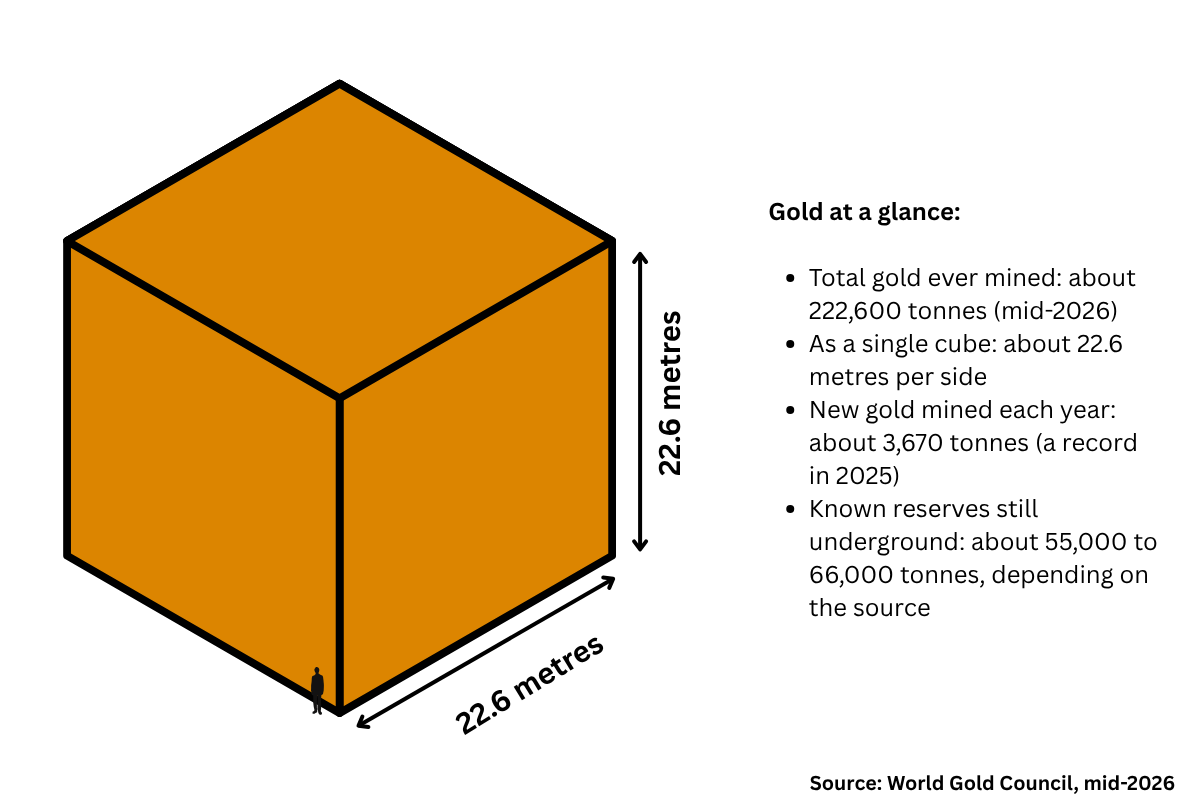
Every gram of gold ever mined adds up to roughly 220,000 tonnes. That includes everything from the treasures of ancient Egypt to the gold bars in central bank vaults today. The best current estimate, from the World Gold Council, puts total above-ground gold stocks at around 222,600 tonnes as of mid-2026.
That sounds like a huge amount until you picture it. Gold is extremely dense, so if all of it were melted down and cast into a single cube, each side would measure only about 22.6 metres. That’s roughly the height of a seven-storey building. All the gold humanity has ever produced would fit comfortably on a single city block.
Almost all of that gold still exists, because gold doesn’t rust, tarnish or get used up. Over thousands of years it has been melted, recast, traded and stored, but very little of it has been lost. This guide covers how the total is estimated, where all that gold sits today, how much is left in the ground, and what such a limited supply means for gold’s value.
How Much Gold Has Ever Been Mined?
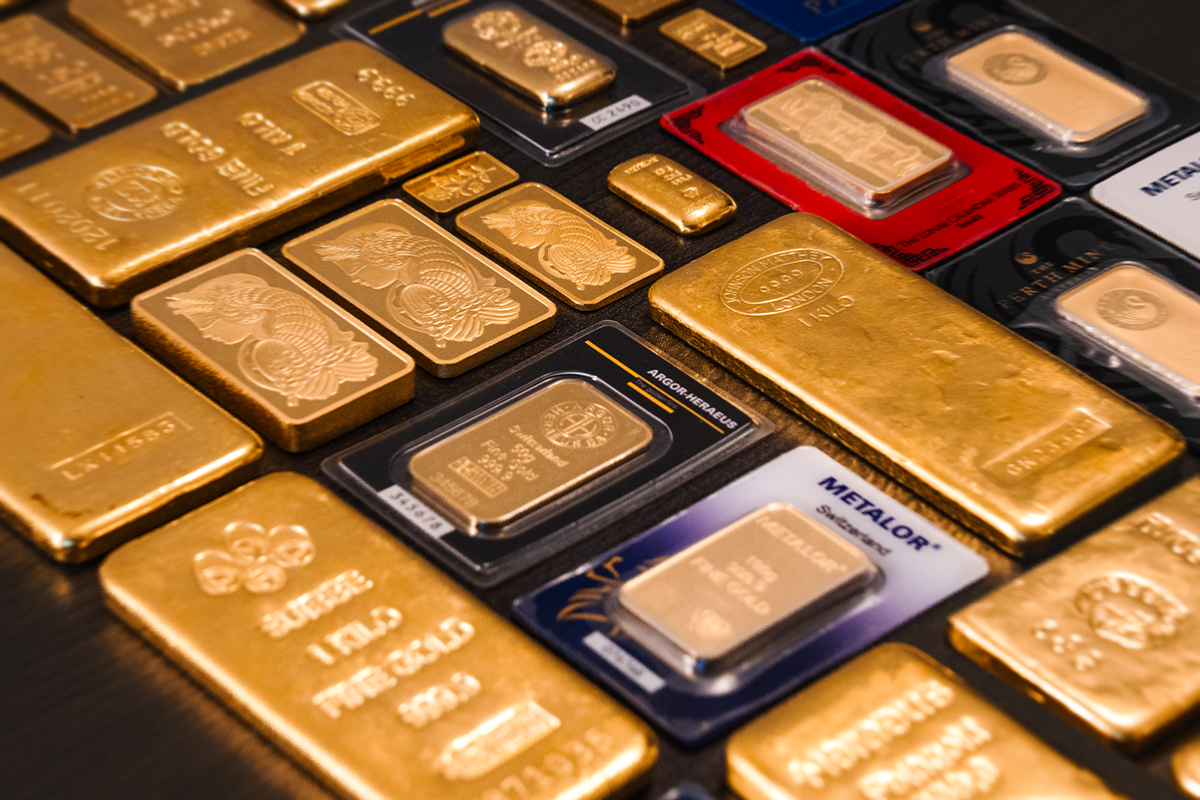
Around 222,600 tonnes of gold have been mined throughout human history, according to the World Gold Council’s mid-2026 estimate. The figure rises by roughly 3,600 tonnes a year as mines around the world add new supply. At mid-2026 prices, all of that gold was worth about US$29 trillion, though the value changes daily with the gold price.
Most of that gold is surprisingly recent. About two-thirds of all gold ever mined has come out of the ground since 1950, thanks to industrial-scale mining, modern extraction chemistry and huge deposits such as South Africa’s Witwatersrand Basin. Thousands of years of ancient and medieval mining, and even the famous 19th-century gold rushes in California, Australia and the Klondike, make up a fairly small share of the total. You can read more about where those deposits lie in our guide to where gold is found.
How Is the Total Estimated?
Nobody has weighed all the world’s gold, so the total is a careful estimate rather than an exact count. Analysts at firms such as Metals Focus and Refinitiv GFMS build it by adding up historical mine production, year by year, then sorting it into the forms it exists in today.
Modern production is well documented through company reports and government statistics, so the figures for the last century or so are fairly reliable. The further back you go, the less certain the numbers become. Records of ancient Egyptian, Roman or pre-Columbian mining are patchy at best. Small-scale and illegal mining still goes partly unrecorded today, and a small amount of gold has been genuinely lost over the centuries in shipwrecks, industrial waste and electronics thrown into landfill. Different researchers therefore arrive at somewhat different totals. The World Gold Council’s figure is the most widely used, but it’s best read as a solid estimate rather than a precise measurement.
Putting 222,600 Tonnes in Perspective
Gold is one of the densest metals there is, at 19.3 tonnes per cubic metre, so even a vast tonnage takes up very little room. Melted down and cast into a single block, all the gold ever mined would form a cube about 22.6 metres along each side.
A few other ways to picture it:
- Swimming pools: it would fill around four and a half Olympic swimming pools.
- Football pitch: the cube’s footprint would cover less than a tenth of a standard football pitch.
- Per person: shared equally among the world’s roughly 8.2 billion people, everyone would get about 27 grams, less than a single one-ounce gold coin each.
That last comparison is perhaps the most striking. All the gold in history, from Tutankhamun’s mask to every central bank reserve, works out at less than an ounce per person on the planet.
Where All the Gold Is
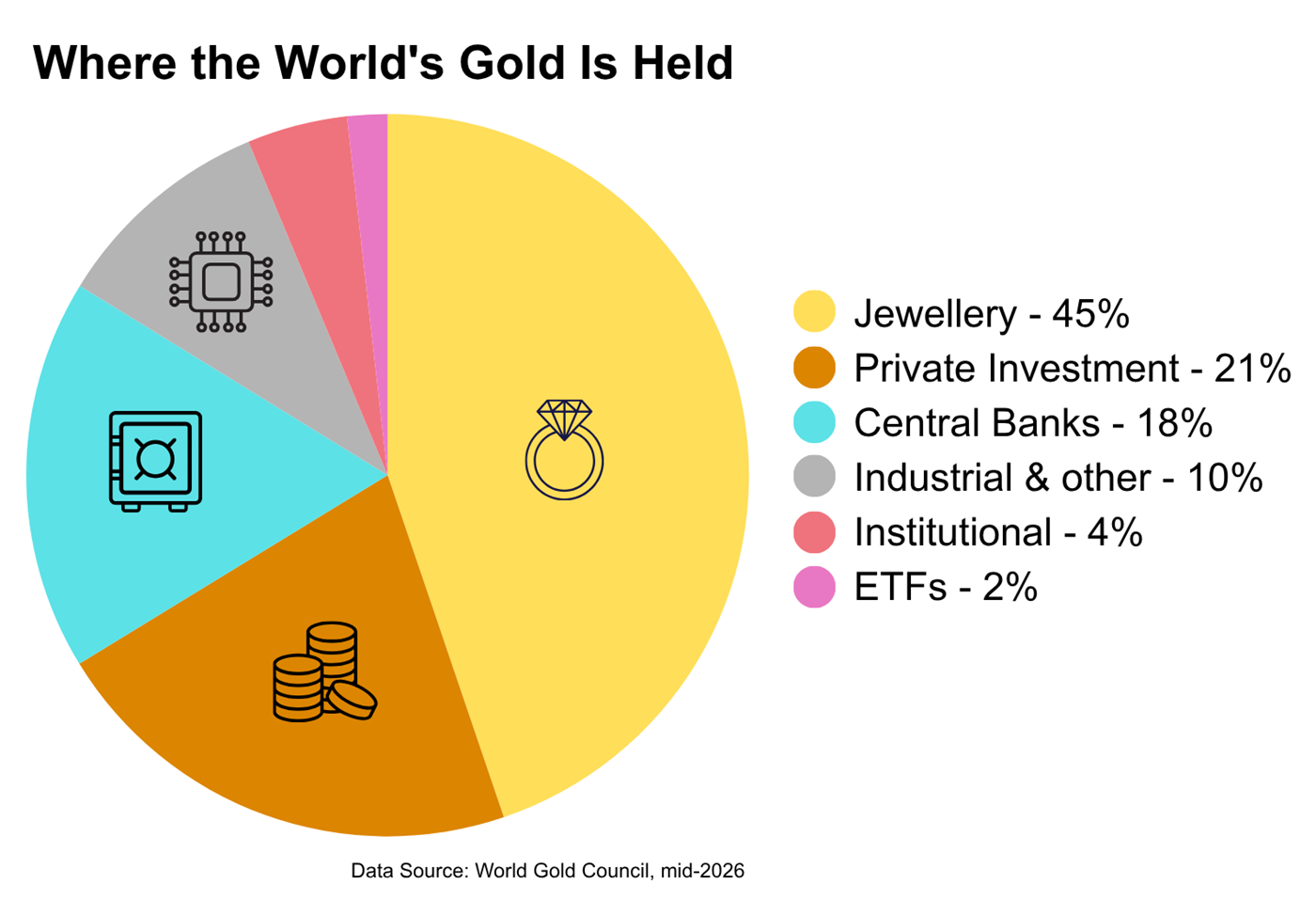
Most of the world’s gold isn’t sitting in vaults. Almost half of it is jewellery, worn or tucked away in homes, and only around a fifth is held as investment bars and coins. Here’s how the World Gold Council breaks the total down as of mid-2026:
| Where it is | Tonnes (approx.) | Share of total |
|---|---|---|
| Jewellery | 99,700 | 45% |
| Private investment: bars and coins | 47,800 | 21% |
| Central banks | 39,000 | 18% |
| Industrial, technology and unaccounted gold | 22,100 | 10% |
| Institutional holdings (OTC) | 10,000 | 4% |
| Gold ETFs | 4,000 | 2% |
| Total | 222,600 | 100% |
Jewellery
Gold jewellery is by far the largest category, and much of it is held in India and China. In those countries gold jewellery is a store of family wealth as much as an adornment, often given at weddings and festivals and passed down through generations. Indian households alone are commonly estimated to hold around 25,000 tonnes, more than the official reserves of the United States, Germany and Italy combined.
Bars, Coins and Other Investment Gold
Private investors hold about 47,800 tonnes in gold bars and gold coins, roughly a fifth of all the gold ever mined. Another 4,000 tonnes or so backs gold exchange-traded funds (ETFs), and around 10,000 tonnes sits in large bars held privately by institutions and wealthy investors, typically in professional vaults in places like London, Zurich and Singapore. Taken together, investment gold accounts for over a quarter of the world’s supply.
Central Banks
Central banks and official institutions such as the International Monetary Fund hold about 39,000 tonnes, close to a fifth of the total. That share has been climbing again in recent years as central banks bought more than 1,000 tonnes a year between 2022 and 2024, the fastest pace in decades. We look at which countries hold the most in the next section.
Industrial, Technology and Unaccounted Gold
The remaining tenth is a mix of gold used in electronics, dentistry and other industrial applications, together with gold that can’t be traced to any of the other categories. Every smartphone and laptop contains a tiny amount of gold, valued for its conductivity and resistance to corrosion. Unlike most gold, a portion of this is genuinely lost when devices are thrown away rather than recycled. It’s one of the few ways gold actually leaves circulation.
How Much Gold Is Left to Mine?
Somewhere between 55,000 and 66,000 tonnes of gold are believed to remain underground that could be mined profitably today. That’s equal to roughly a quarter to a third of all the gold mined so far. The range comes from two leading estimates:
| Estimate | Gold remaining (tonnes) | As of |
|---|---|---|
| Metals Focus (used by the World Gold Council) | 54,770 | End-2025 |
| US Geological Survey (USGS) | 66,000 | Early 2026 |
| Total known resources (Metals Focus) | 132,110 | End-2025 |
At today’s mining rate of around 3,600 tonnes a year, the lower figure would last only about 15 years. That sounds alarming, but the gold industry has been “15 years from running out" for decades.
Reserves vs Resources
The difference comes down to two terms. Reserves are deposits that have been well surveyed and can be mined profitably at current prices with current technology. Resources are a much wider pool of known gold that is less well understood, lower grade, or simply too expensive to extract today. As the gold price rises or mining technology improves, parts of a resource are reclassified as reserves.
That’s why the reserve figure barely moves. At the end of 2019, global gold reserves stood at about 55,460 tonnes. Six years and roughly 21,000 tonnes of mining later, the Metals Focus estimate was almost exactly the same. New gold was added to the reserve count about as fast as it was dug out, through higher prices, exploration around existing mines and better extraction methods.
Why Mine Supply Barely Moves
Even with record gold prices, the amount of gold mined each year has hardly changed. Global output rose from about 2,300 tonnes in 1995 to 3,556 tonnes in 2018, then stayed broadly flat for most of the following decade, reaching a record of 3,672 tonnes in 2025. That was only 1% more than the year before. The USGS puts 2025 production lower, at around 3,300 tonnes. The two use different methods, particularly in how they estimate small-scale and informal mining, which the World Gold Council reckons makes up about a fifth of world output.
Several factors keep a lid on new supply:
- Fewer big discoveries: 278 major gold deposits were found between 1990 and 2019, but only 25 of them in the last decade of that period, and none at all between 2017 and 2019.
- Long lead times: a new discovery typically takes more than ten years to explore, permit, build and bring into full production.
- Falling ore grades: the best deposits are mined first, so miners have to move more rock for every gram of gold. Average gold head grades (the gold content of ore processed) fell by more than 13% between 2010 and 2023.
- Deeper, costlier mines: more production is coming from underground operations, which are slower and more expensive to develop.
Has the World Reached Peak Gold?
“Peak gold" is the idea that annual mine production has hit its high point and will decline from here. Mine output has been on a plateau for nearly a decade, and many analysts expect it to stay flat or fall slowly over the coming years. The World Gold Council argues there’s no structural shortage, though. Higher prices tend to unlock lower-grade deposits, and there is gold deeper in the Earth’s crust and dissolved in the oceans, even if it is far too costly to recover today.
The practical point for investors is that we’re unlikely to run out of gold in the short term, but we’re also unlikely to see much more of it. New mining adds only around 1.6% a year to the world’s above-ground stock, and that pace has stayed remarkably steady regardless of price.
How Much Gold Do Central Banks Hold?
Central banks and official institutions hold around 39,000 tonnes of gold between them, roughly 18% of all the gold ever mined. Most of it is held as part of national reserves, kept as a store of value that no other country can print, freeze or default on.
Holdings are concentrated in a handful of countries. The five largest official holders are:
| Country | Official gold holdings (tonnes) | Share of all gold ever mined |
|---|---|---|
| United States | 8,133 | 3.7% |
| Germany | 3,350 | 1.5% |
| Italy | 2,452 | 1.1% |
| France | 2,437 | 1.1% |
| Russia | 2,327 | 1.0% |
Even the United States, by far the largest holder, has less than 4% of the world’s gold. Together, the top five account for under a tenth of the total, far less than the gold held as jewellery in Indian households alone.
These are officially reported figures, and not every country reports in full. China is the clearest example. China’s declared gold reserves of around 2,300 tonnes are widely believed to understate what the country actually holds. For the full rankings, recent central bank buying and the debate over undeclared gold, see our guide to gold reserves by country.
What Finite Supply Means for Gold’s Value
Gold’s supply grows very slowly and very predictably, and that’s a large part of why it has held its value for thousands of years. Mines add around 3,600 tonnes a year to an above-ground stock of more than 222,000 tonnes, an increase of only about 1.6% a year. That pace barely changes whether the gold price doubles or halves, because new mines take more than a decade to bring into production.
Analysts sometimes describe this with the stock-to-flow ratio: the existing stock divided by annual new supply. For gold it’s about 60, meaning it would take roughly 60 years of mining at today’s rate to double the amount of gold in the world. Few other commodities come close. Oil, copper and most other metals are consumed as they’re used, so their stocks are small compared with annual production. Gold is almost never used up, so the existing stock dwarfs anything the mines can add.
This has an important consequence. Because each year’s new supply is so small, gold’s price is set mainly by the decisions of the people who already hold it: whether jewellery owners, investors and central banks choose to buy, hold or sell. A sudden rush of new supply that could crash the price is almost impossible.
Gold vs Paper Money
Compare that with fiat currency. Paper money has no natural limit on supply. Central banks and commercial banks can create it in whatever quantity policy demands, and over the long run the supply of most major currencies has grown far faster than the supply of gold. The result is a steady loss of purchasing power: the US dollar has lost more than 85% of its value since it was cut loose from gold in 1971.
Gold can’t be expanded by a policy decision or created with a few keystrokes. Every new ounce has to be found, dug out and refined, at real cost. That’s why gold tends to hold its purchasing power over long periods while paper currencies lose theirs, and why central banks, which control their own currencies, still hold gold as a reserve.
Scarcity alone doesn’t make something valuable, though. Gold’s worth also rests on its durability, its long history as money, its beauty and its usefulness, which we cover in more depth in why gold is valuable. What its finite, slow-growing supply does is make sure that value can’t simply be diluted away.
Frequently Asked Questions
How much gold has been mined in total?
Around 222,600 tonnes of gold have been mined throughout history, according to the World Gold Council’s mid-2026 estimate. About two-thirds of it has been mined since 1950. Because gold doesn’t corrode or get used up, almost all of it still exists today as jewellery, bullion, central bank reserves and industrial products.
How much gold is left in the ground?
Known gold reserves that can be mined profitably today are estimated at between 55,000 and 66,000 tonnes, depending on the source. A much larger pool of around 132,000 tonnes of known resources exists, but much of it is lower grade or too costly to extract at current prices and with current technology.
How big would all the world’s gold be as a cube?
All the gold ever mined, melted into a single block, would form a cube about 22.6 metres along each side. That’s roughly the height of a seven-storey building, or enough to fill around four and a half Olympic swimming pools. Gold’s extreme density, at 19.3 tonnes per cubic metre, is why so much fits into so little space.
Who holds the most gold in the world?
Collectively, private individuals hold the most gold: jewellery alone accounts for about 45% of all gold ever mined, and investment bars and coins for another 21%. The largest single holder is the United States government, with 8,133 tonnes of official reserves, which is still less than 4% of the world’s total.
Will we ever run out of gold?
It’s unlikely. Known gold reserves have stayed at roughly the same level for decades, because rising prices and new technology keep turning previously uneconomic deposits into mineable ones. Easy, high-grade gold is becoming harder to find, though, so new supply is likely to stay flat or grow only slowly.
How much gold is mined each year?
About 3,600 tonnes of gold are mined each year. The World Gold Council recorded a record 3,672 tonnes in 2025, only 1% more than in 2024. Annual mine production adds roughly 1.6% to the world’s above-ground gold stock, and it has stayed broadly flat for most of the past decade.
Owning a Share of a Finite Asset
All the gold ever mined would fit in a cube about 22.6 metres wide. Shared equally, it would come to less than a troy ounce for every person on Earth. Mines add only around 1.6% to that total each year, and the world’s best deposits are getting harder to find. Unlike paper money, no central bank can create more of it.
That combination of a small, slow-growing supply and thousands of years of trust is what makes gold such an enduring store of value. Every bar and coin you own is a direct share of that limited global stock, and one that can’t be diluted by policy decisions or printing presses.
If you’d like to own your own piece of the world’s gold, you can buy gold online from BullionStar, in bars and coins from all the major mints and refiners. Choose home delivery or secure storage in our vaults, or visit our Singapore Bullion Center at 45 New Bridge Road to see the range in person.
Popular Blog Posts by Gold & Silver 101
 An Introduction to Gold & Silver Investing
 Should I Invest in Gold, Silver, or Platinum Bullion?
 Gold Coins vs Gold Bars: Which Is Better?
 How Is Gold Taxed in Singapore? The IPM GST Exemption Explained
 Storing Precious Metals, Gold, and Silver Bullion
 Gold & Silver Bullion Investing FAQs
 Karat vs Carat: What’s the Difference?
 Gold Purity: The Complete Guide
 How Much Gold Is There in the World?
 Junk Silver: What It Is and What It’s Worth