 Contact
 Help
Help







How to Invest in Palladium: A Complete Guide
 Gold & Silver 101



If you’re considering how to invest in palladium, it’s worth understanding upfront how different a market this is from gold, silver, or even platinum. Palladium is a platinum-group metal in its own right, driven overwhelmingly by industrial demand from petrol and hybrid vehicle catalytic converters, and supplied almost entirely as a by-product of platinum and nickel mining in Russia and South Africa. Unlike gold, silver, and platinum, palladium bars and coins don’t qualify for Singapore’s Investment Precious Metals (IPM) exemption, so GST applies — a real practical difference worth knowing before you buy.
At BullionStar, we’ve been helping customers invest in precious metals since 2012, including palladium bars from LPPM-accredited refiners. In this guide, we walk through why investors consider palladium, the different ways to invest in it, and how palladium’s smaller, thinner market compares to the other precious metals.
Please note that BullionStar does not provide investment or financial advice. The information below is for informational purposes only. Your individual circumstances and goals will always be the most important factors in any investment decision.
Why Invest in Palladium?
Why invest in palladium at all, given how different a market it is from gold and silver? The case starts with genuine scarcity: global palladium mine supply runs to only around 6 million ounces a year, comparably scarce to platinum and a fraction of gold’s roughly 106 million ounces. Supply is also concentrated overwhelmingly in Russia and South Africa. That scarcity underpins palladium’s critical industrial role: roughly 80% of demand comes from catalytic converters fitted to petrol and hybrid vehicles, a purpose gold and silver play almost no part in.
For investors already holding gold, silver, or platinum, palladium’s appeal is portfolio diversification: its price is driven by the health of the automotive sector rather than inflation, currency, or safe-haven demand, giving it a genuinely different risk profile even in small amounts.
As with platinum, this comes with real trade-offs, including extreme volatility, a smaller and more concentrated market than any other precious metal, and no Investment Precious Metal (IPM) tax exemption in Singapore. For the full case for and against palladium, including how it compares directly to gold, silver, and platinum, see our dedicated Is Palladium a Good Investment? guide.

How to Invest in Palladium
There are three main ways of investing in palladium: physical bullion, exchange-traded funds (ETFs), and mining company shares. The table below covers the key differences between each option, followed by a more detailed look at how they work.
| Physical Bullion (Bars) | Palladium ETFs | Palladium Mining Stocks | |
|---|---|---|---|
| Ownership | Direct, full ownership of the metal | Indirect — a claim on a fund | Indirect — equity in a mining company |
| Counterparty Risk | None | Fund and custodian risk | Company and operational risk |
| Liquidity | Lower — a thinner dealer market than gold, silver, or platinum | Very high, exchange-traded during market hours | High, exchange-traded during market hours |
| Singapore Tax Treatment | GST applies — palladium isn’t IPM-qualifying | Taxed under ordinary securities rules | Taxed under ordinary securities rules |
| Best For | Diversification and physical ownership | Low-friction, liquid price exposure | Leveraged, higher-risk exposure |
Physical Palladium Bullion
Physical palladium bars offer direct ownership with no counterparty risk, the same core appeal as physical gold, silver, or platinum. Unlike those metals, though, palladium bars don’t qualify for Singapore’s Investment Precious Metal (IPM) exemption, so GST applies, and availability of palladium bullion is much more limited compared to the other three precious metals. We cover what’s currently available, and how to buy it, in the next section.
Palladium ETFs
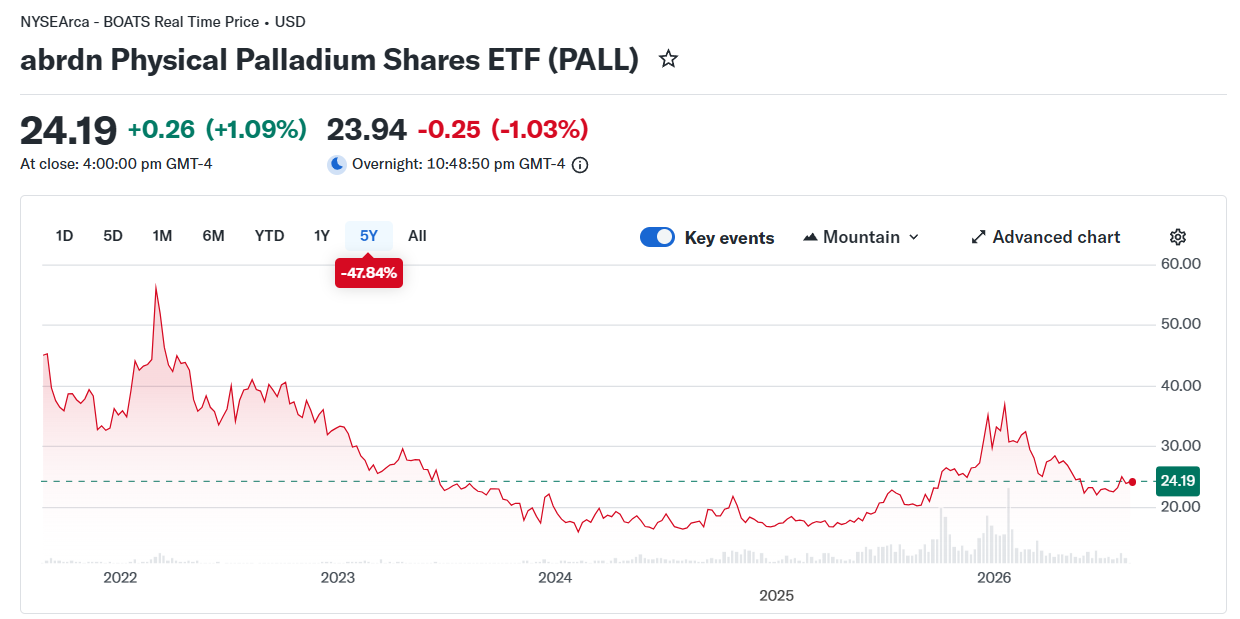
Palladium ETFs are one of the most popular methods of investing in palladium. They offer straightforward exposure to the palladium price through an ordinary brokerage account, with no storage, insurance, or GST to think about. The largest is the abrdn Physical Palladium Shares ETF (PALL), listed on NYSE Arca, which holds physical palladium bars in a London vault and charges a 0.60% expense ratio. For investors with access to European exchanges, the iShares Physical Palladium ETC (IPDM), listed on the London Stock Exchange at a lower 0.20% expense ratio, is a further option.
As with any precious metal ETF, owning shares isn’t the same as owning palladium directly. Shareholders own a claim on the fund, not a specific bar, and in almost all cases cannot redeem shares for physical metal. The fund’s expense ratio is also deducted continuously from its holdings, so the actual amount of palladium backing each share gradually declines over time.
Palladium Mining Stocks
Palladium mining stocks offer a different, more leveraged kind of exposure: you’re investing in the business of mining palladium, not the metal itself. Supply is dominated by just two companies, Russia’s Norilsk Nickel and South Africa’s Sibanye-Stillwater, so mining stocks carry concentrated geopolitical and single-company risk on top of ordinary equity risk. Sanctions and capital controls tied to Russia can directly affect access to Russian-linked mining shares, a risk gold and platinum mining stocks don’t carry in the same way.
Choosing Between Physical, ETFs, and Mining Stocks
For investors who want no counterparty risk and are comfortable accepting GST and a thinner resale market, physical palladium bullion remains an option. Palladium ETFs suit investors who want simple, liquid exposure. Mining stocks suit investors comfortable with equity and geopolitical risk in exchange for leveraged upside.
How to Buy Palladium Bullion
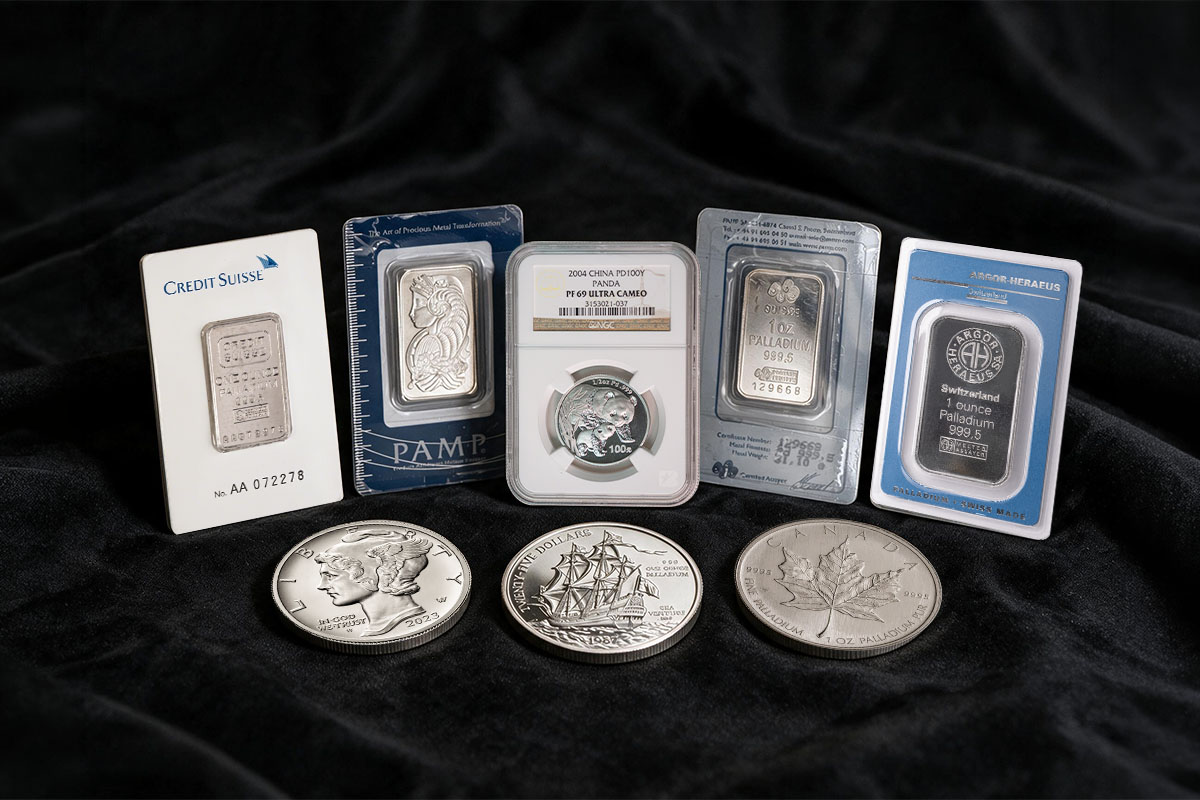
Palladium bullion refers to investment-grade bars and coins, the same category covering gold, silver, and platinum, but the palladium market for both is considerably thinner. The world’s major Swiss and German refiners, Valcambi, PAMP, Argor-Heraeus, Metalor, and Heraeus, all produce palladium bars at 99.95% purity, in sizes from 1 gram up to 1 kilogram, with larger 1–6 kilogram bars produced to LPPM Good Delivery standard for institutional buyers.
Palladium coins are considerably rarer than other metals. The Canadian Palladium Maple Leaf, produced by the Royal Canadian Mint at 99.95% purity, is the only bullion coin in regular ongoing production, issued every year since 2015. The US Mint has released an American Palladium Eagle intermittently since 2017, but production has been sporadic and increasingly focused on collector proof versions rather than a reliable annual bullion release.
Buying Palladium Bars from BullionStar
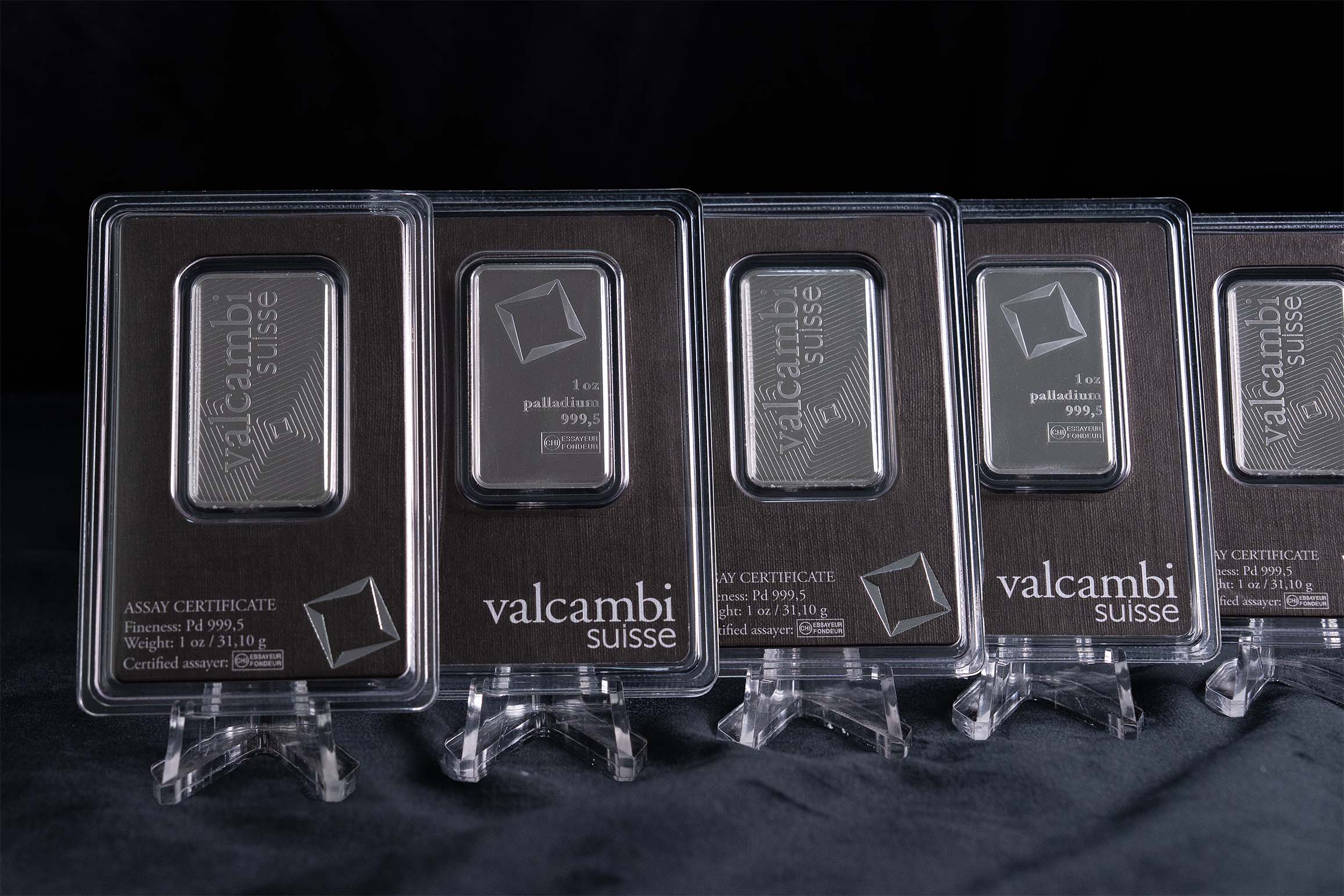
BullionStar currently sells palladium bars from Valcambi and Argor-Heraeus, both LPPM Good Delivery refiners producing bars at 99.95% purity. Availability is limited compared to our gold, silver, and platinum ranges, and stock levels on individual products can be low, so it’s worth checking current availability before planning a purchase.
Frequently Asked Questions
Is palladium GST-free in Singapore?
No. Unlike gold, silver, and platinum, palladium bars and coins aren’t classified as Investment Precious Metals (IPM) by the Inland Revenue Authority of Singapore (IRAS), so ordinary GST applies on purchase. This is one of the clearest practical differences between palladium and the other precious metals available from BullionStar.
Why is the palladium bullion market so much smaller than gold or silver?
Palladium bullion has always been a niche corner of the precious metals market, and that hasn’t changed. Coins are especially limited: the Canadian Palladium Maple Leaf, produced by the Royal Canadian Mint, is currently the only bullion coin in regular ongoing production, while the US Mint’s American Palladium Eagle has been released only intermittently since 2017. Bars are more widely available, but even here, stock levels and product choice are noticeably thinner than for gold, silver, or platinum.
What’s the difference between palladium ETFs and physical palladium?
Palladium ETFs give you a claim on a fund’s holdings rather than ownership of any specific bar, and carry fund and custodian risk that physical bullion doesn’t. Physical palladium, by contrast, means outright ownership with no counterparty risk, but at the cost of arranging storage and paying tax depending on your jurisdiction. ETFs suit investors who want simple, liquid price exposure without those physical considerations; physical bullion suits investors who want to hold the metal itself.
How do I sell palladium?
You can sell palladium bars back to BullionStar at any time, at a transparent, published price. As with buying, palladium’s thinner market means fewer dealers offer this compared to gold, silver, or platinum, so a published buy-back price removes the need to negotiate a sale privately.
Should I add palladium to my precious metals portfolio?
For most investors, palladium can be worth a small, deliberate allocation rather than a core holding, provided you’re comfortable with its volatility, concentrated supply, and tax consideration. It doesn’t offer the same store-of-value case as gold or silver, so it’s better suited to investors specifically seeking exposure to industrial and automotive demand trends. For guidance on how much palladium to hold, see our Is Palladium a Good Investment? guide.
Start Investing in Palladium with BullionStar
Palladium is a genuinely different proposition to gold, silver, or even platinum: a metal whose fortunes are tied overwhelmingly to the automotive industry, supplied almost entirely by two countries, and without the Singapore tax advantages the other three enjoy. That combination means it isn’t a metal to build a core holding around, but it can offer real diversification for investors who understand its volatility and want targeted exposure to industrial demand trends.
How you invest matters more with palladium than with the other metals, given how much thinner the market is. Physical bars remain an option for investors who want no counterparty risk, and direct ownership of the metal, while accepting the lower availability and increased price volatility.
Ready to explore palladium? Browse our range of palladium bars, track live prices with our price charts, or get in touch with our team at support@bullionstar.com — we’re happy to help. If you’re still weighing up whether palladium fits your portfolio at all, our Is Palladium a Good Investment? guide is the place to start.
Popular Blog Posts by Gold & Silver 101
 An Introduction to Gold & Silver Investing
 Should I Invest in Gold, Silver, or Platinum Bullion?
 Gold Coins vs Gold Bars: Which Is Better?
 How Is Gold Taxed in Singapore? The IPM GST Exemption Explained
 Storing Precious Metals, Gold, and Silver Bullion
 Gold & Silver Bullion Investing FAQs
 Gold Purity: The Complete Guide
 How Much Gold Is There in the World?
 Junk Silver: What It Is and What It’s Worth
 999 Fine Silver: Investment-Grade Silver Explained