 Contact
 Help
Help







Is Palladium a Good Investment?
 Gold & Silver 101



Palladium occupies an unusual place among precious metals. For a stretch between 2018 and 2022 it traded at a higher price than even gold, driven almost entirely by its role in catalytic converters for petrol and hybrid vehicles, before falling sharply as the shift towards electric vehicles cast doubt over its industrial demand story.
Unlike gold, silver, and platinum, palladium also doesn’t carry the same tax advantages in many jurisdictions, including Singapore, where it isn’t classed as an Investment Precious Metal.
Is Palladium a Good Investment? The Direct Answer
Yes, palladium can be a good investment, but with meaningfully more caveats than gold or silver. It isn’t a metal that is recommended as a core, standalone holding, or for investors seeking stability. Where palladium earns its place is as a small, deliberate allocation within a diversified portfolio — one that accepts real volatility in exchange for exposure to a metal with a genuinely different demand profile and a supply base that remains structurally tight. Whether palladium is worth buying really depends on your risk tolerance and your reasons for wanting exposure to it in the first place.
Why Invest in Palladium?
Despite the caveats, there are genuine reasons investors consider palladium:
- Portfolio Diversification — Palladium’s price is driven by different forces to gold and silver, principally the health of the automotive industry rather than inflation or currency concerns. That gives it a genuinely different risk profile, which can be valuable in a diversified portfolio, even in small amounts.
- Constrained Supply — Palladium mining is concentrated overwhelmingly in Russia and South Africa, and roughly 80% of demand comes from catalytic converters. That concentration makes the market structurally tight and vulnerable to supply shocks, which can also work in an investor’s favour during periods of disruption.
- Historical Highs Show Its Potential — Palladium traded above US$3,000 per ounce in 2022, at one point commanding a higher price than gold. That run illustrates the scale of upside possible when supply and demand are tightly balanced, even if prices have fallen substantially since.
The Risks of Investing in Palladium
Palladium’s risks are just as important to consider as its potential upside:
- Extreme Volatility — Palladium is one of the most volatile precious metals, capable of large swings in both directions over short periods, driven by its comparatively small and thin market.
- Narrow, Concentrated Market — With supply concentrated in just two countries and demand overwhelmingly reliant on one industry, palladium lacks the broad-based demand that underpins gold and silver.
- Industrial Demand Sensitivity — The continued shift towards electric vehicles, which don’t require catalytic converters, poses a long-term structural risk to palladium’s primary source of demand.
- Fewer Tax Advantages — Unlike gold, silver and platinum, palladium isn’t classed as an Investment Precious Metal (IPM) in Singapore, and in many other countries it attracts VAT, GST, or sales tax on purchase, eroding returns compared to more tax-efficient metals.
Weighed together, palladium is best suited to investors who understand these risks and want targeted exposure to industrial and automotive demand trends, rather than those seeking a straightforward store of value.
Palladium vs Platinum, Gold, and Silver
Palladium doesn’t sit neatly alongside the other precious metals, and understanding how it differs is key to deciding whether it deserves a place in your portfolio. The table below summarises how the four metals compare across the factors that matter most to investors, before we look at each comparison in more depth.
| Metal | Primary Demand Driver | Volatility | Supply Concentration | Singapore Tax Status |
|---|---|---|---|---|
| Palladium | ~80% industrial (catalytic converters) | Very High | Concentrated (Russia, South Africa) | Not IPM — GST applies |
| Platinum | Industrial (diesel converters, hydrogen) + jewellery | High | Concentrated (South Africa, Russia) | IPM — GST-exempt |
| Gold | Monetary/investment, jewellery, central bank reserves | Low–Medium | Globally diversified | IPM — GST-exempt, no CGT |
| Silver | Dual: monetary + industrial (solar, electronics) | Medium–High | Globally diversified | IPM — GST-exempt, no CGT |
Palladium Vs Platinum
Palladium and platinum are often described as sister metals, and it’s easy to see why. Both are heavily used in catalytic converters, both come from the same handful of mining regions, and both trade in far smaller volumes than gold or silver.
The key difference lies in application. Palladium is used almost exclusively in catalytic converters for petrol and hybrid vehicles. Platinum is more common in diesel vehicles and carries a growing role in hydrogen fuel cell technology, giving it a more diversified demand base.
Platinum also holds Investment Precious Metal (IPM) status in Singapore, alongside gold and silver, meaning it can be bought free of GST — a tax advantage palladium doesn’t share. For investors weighing the two, platinum arguably offers a similar industrial-demand thesis with a broader use case and more favourable tax treatment.
Palladium Vs Gold
The comparison between palladium and gold is really a comparison of two different types of asset. Gold is a monetary metal first and foremost, valued for its role as a store of value and safe haven, with relatively modest and stable industrial demand. Palladium is almost the opposite: an industrial metal whose price is dictated by the automotive sector, with none of the safe-haven characteristics that make gold attractive during periods of economic or political stress.
Palladium can, briefly, outperform gold (as it did between 2018 and 2022) but it lacks gold’s long track record as a store of value, its tax advantages in Singapore, and its broad base of demand across investment, central banks, and jewellery.
Palladium Vs Silver
Palladium and silver share a similar industrial dependency, but the comparison stops there. Silver’s industrial demand is spread across solar, electronics, and medical applications, alongside a strong and enduring monetary role;. Palladium’s demand is concentrated almost entirely in one industry that faces a genuine long-term threat from the shift to electric vehicles. Silver also benefits from IPM status in Singapore, unlike palladium.
For investors seeking industrial-demand exposure within precious metals, silver’s broader demand base and tax efficiency make it the more balanced choice, though palladium can offer sharper short-term moves for those willing to accept the added risk.
Palladium Demand, Supply, and Use Cases
Understanding what actually drives palladium’s price is essential context for any investor considering it, since its demand and supply picture looks very different to gold, silver, or even platinum.
Palladium Uses
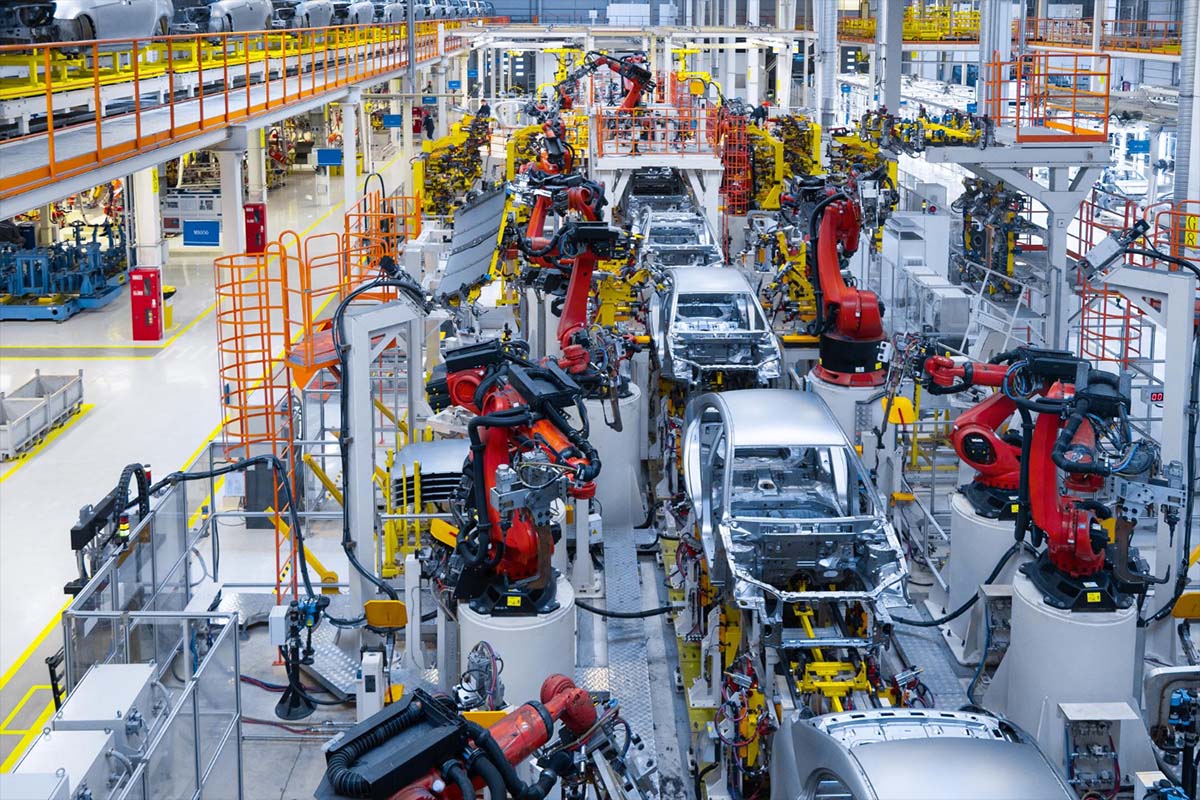
Palladium’s demand is overwhelmingly industrial. Around 80% of global palladium demand comes from catalytic converters, which convert harmful pollutants from petrol and hybrid vehicle exhausts into less harmful emissions. The remainder is split across electronics, where palladium is used in multi-layer ceramic capacitors found in smartphones and computers, as well as dentistry, and a small amount of jewellery.
Unlike gold or silver, investment demand makes up only a small fraction of the total market. This is a key reason palladium’s price behaves so differently to the more monetary-focused metals.
Palladium Supply & Demand
Palladium mining is highly concentrated, with Russia and South Africa together accounting for the large majority of global supply. Much of this output is also a by-product of nickel and platinum mining rather than the primary target, meaning palladium supply doesn’t always respond to palladium’s own price signals. Miners may keep producing it regardless of price if the economics of the primary metal still make sense, or cut back if they don’t. Recycling from scrapped catalytic converters adds a meaningful secondary source of supply, helping to cushion some of the market’s tightness.
The biggest long-term question hanging over palladium demand is the transition to electric vehicles. Fully electric vehicles don’t require catalytic converters at all. As EV adoption grows, palladium’s primary source of demand faces genuine structural pressure. Hybrid vehicles, which still use internal combustion engines alongside electric motors, continue to support demand in the near term, but the long-term trajectory is a real risk factor for anyone considering palladium as a long-term holding.
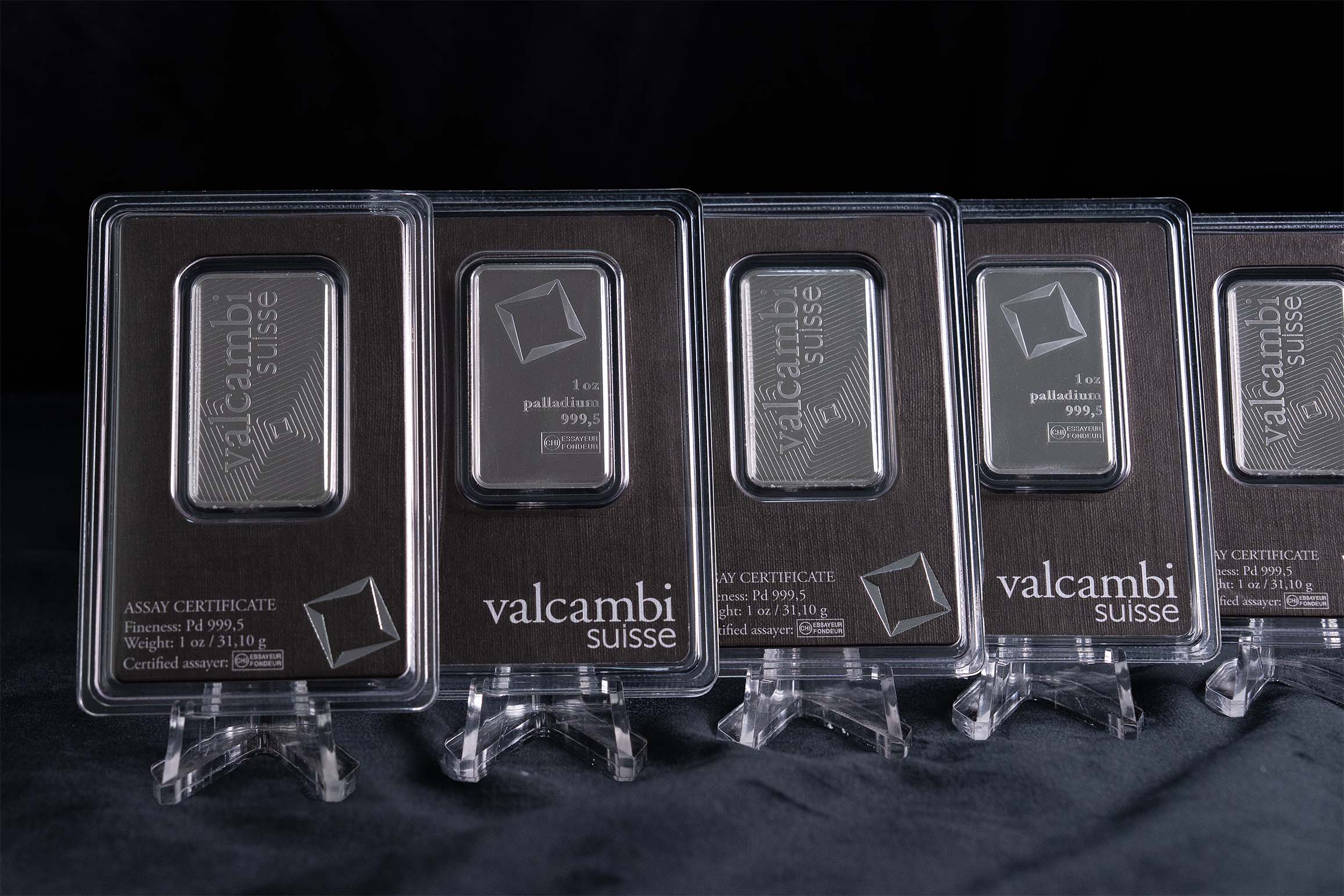
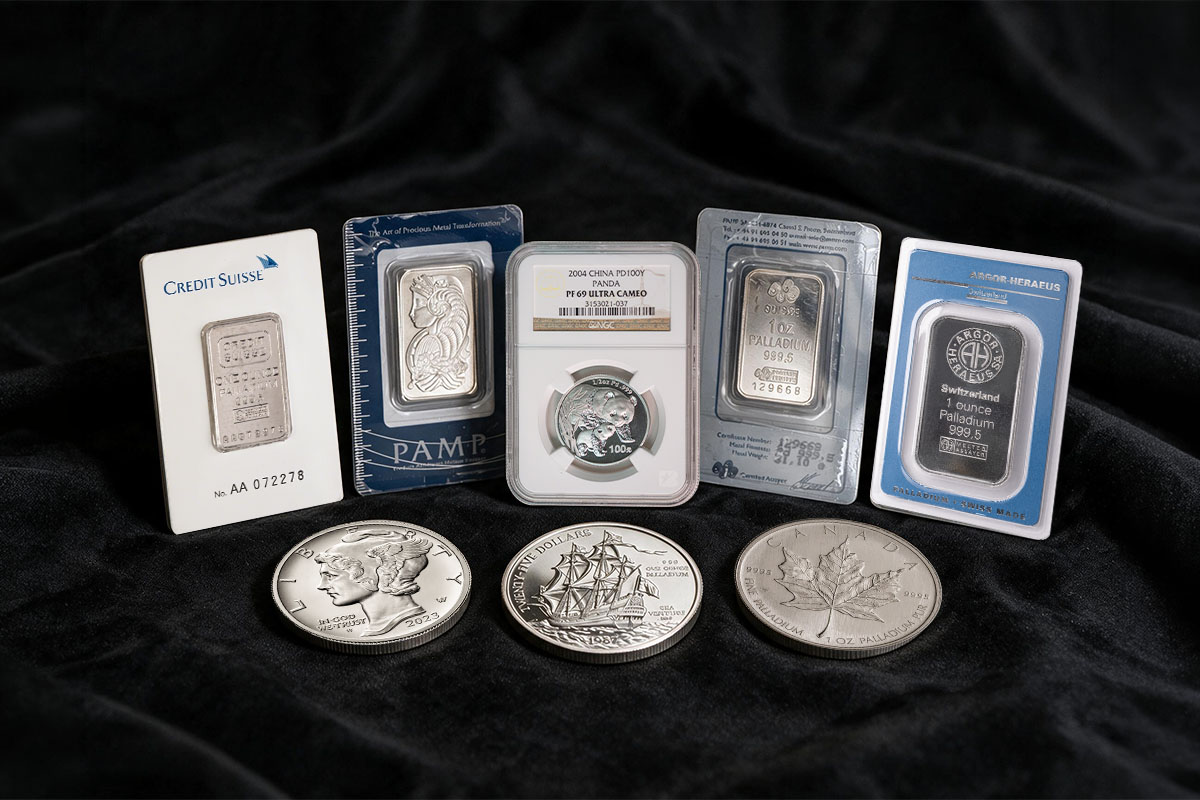
This reduced investment angle is also reflected in the market for palladium bullion itself: far fewer refiners produce palladium bars and coins compared to gold, silver, or platinum, and available product ranges are noticeably smaller. Investors looking to buy physical palladium can browse BullionStar’s palladium range to see what’s currently available.
Palladium Performance and Outlook
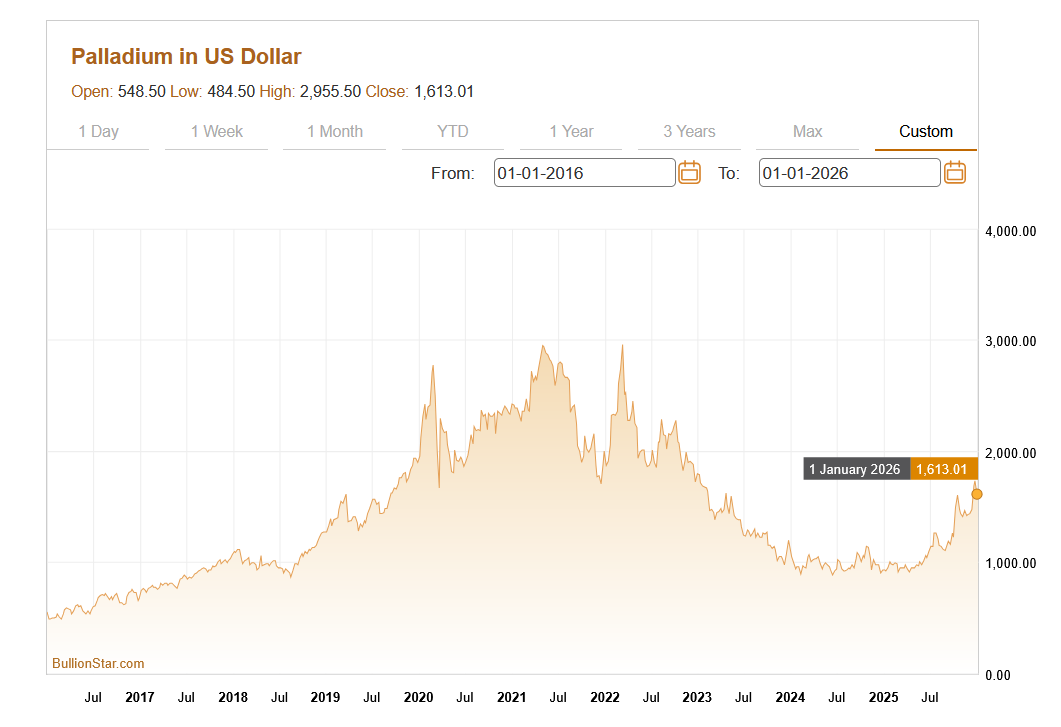
Palladium’s performance over the past few years illustrates just how volatile this metal can be. It hit an all-time high of US$3,429.50 per ounce on 7 March 2022, driven by supply fears following Russia’s invasion of Ukraine (Russia alone accounts for around a third of global primary palladium supply) combined with tightening emissions regulations on petrol vehicles. From that peak, the palladium price fell sharply and has remained well below its record ever since, currently trading around US$1,300 per ounce.
That decline reflects the structural headwinds already covered: automakers substituting to cheaper options where possible, accelerating EV adoption reducing demand for catalytic converters altogether, and a higher-for-longer interest rate environment that weighs on non-yielding assets like precious metals generally. Palladium has staged a partial recovery through 2025 and into 2026, trading modestly higher than a year ago, but it remains far below its 2022 peak — a clear illustration of the boom-and-bust pattern that defines this market.
Palladium Outlook
A full recovery back to 2022 levels looks unlikely in the near term. The conditions that drove that spike haven’t returned, and the long-term shift towards electric vehicles works directly against a sustained recovery in catalytic converter demand. That said, palladium mining remains concentrated in just two countries, leaving supply exposed to sudden shocks, and any disruption to Russian or South African production could still produce a sharp, if temporary, price spike. Investors should treat palladium’s outlook as inherently more uncertain and event-driven than gold’s or silver’s.
For up-to-date pricing, our fully customisable price charts let you track palladium’s spot price alongside the other precious metals, over any timeframe.
Frequently Asked Questions
Will palladium prices recover in 2026?
A full recovery to the 2022 peak of over US$3,400 per ounce is unlikely in 2026. The specific conditions that drove that spike haven’t returned, and the long-term shift to electric vehicles continues to weigh on demand. Palladium has recovered modestly through 2025 and into 2026, but a return to its all-time high isn’t expected in the near-term.
Is palladium more volatile than other metals?
Yes, palladium is generally more volatile than gold, silver, or platinum. Its small, concentrated market means that supply disruptions or shifts in automotive demand can move the price sharply in either direction. This is demonstrated by its rise to over US$3,400 per ounce in 2022 followed by a steep and sustained decline. Investors considering palladium should expect larger and more frequent price swings than they would with the more established precious metals.
Should I buy palladium for industrial demand exposure?
Palladium can offer targeted exposure to industrial and automotive demand trends, but it comes with significant concentration risk given that roughly 80% of demand comes from a single application — catalytic converters. Investors specifically seeking industrial-demand exposure within precious metals may find silver a more balanced option, since its industrial demand is spread across several growing sectors rather than concentrated in one that faces long-term structural pressure from EV adoption.
How much palladium should I hold in my portfolio?
Given its volatility and narrow demand base, palladium is best held as a small, tactical position rather than a core allocation — typically no more than 1–3% of a portfolio, well below the 5–10% often suggested for gold. Investors should treat it as a targeted bet on industrial and automotive trends rather than a foundational holding, and size their position accordingly.
Is palladium taxed like gold and silver?
No. Unlike gold, silver, and platinum, palladium is not classed as an Investment Precious Metal (IPM) in Singapore, meaning it doesn’t benefit from the same GST exemption. In many other countries, palladium also attracts VAT or sales tax on purchase, which can meaningfully erode returns compared to more tax-efficient metals. This is worth weighing carefully before buying, particularly for investors used to the tax treatment of gold and silver.
Palladium or platinum: which should I buy?
For most investors, platinum is the more balanced choice between the two sister metals. It offers a similar industrial-demand thesis, with exposure to catalytic converters and a growing role in hydrogen fuel cell technology, but carries a more diversified demand base and holds IPM status in Singapore, unlike palladium. Palladium may still appeal to investors specifically seeking exposure to the current dynamics of the petrol vehicle market, but platinum is generally the easier metal to justify from a cost and tax perspective.
Is Palladium a Good Investment? The Bottom Line
Palladium is a good investment for a specific type of investor: one who understands its risks and wants targeted, tactical exposure to industrial and automotive demand trends, rather than a straightforward store of value. Its constrained supply and dependence on a concentrated handful of producers mean it can move sharply higher when disruption strikes. But that same concentration, combined with a structural threat from EV adoption and the absence of the tax advantages that gold, silver, and platinum enjoy in Singapore, means palladium demands a level of caution that isn’t necessary with the other precious metals.
For most investors, palladium is best held as a small, deliberate allocation alongside a core position in gold and silver, rather than as the foundation of a portfolio. Approached this way, with realistic expectations about volatility and a clear-eyed view of its risks, palladium can still offer genuine diversification benefits that few other assets provide.
Interested in adding palladium to your portfolio? Browse our palladium range, track live prices with our price charts, or get in touch with our team at support@bullionstar.com — we’re happy to help.
Popular Blog Posts by Gold & Silver 101
 An Introduction to Gold & Silver Investing
 Should I Invest in Gold, Silver, or Platinum Bullion?
 Gold Coins vs Gold Bars: Which Is Better?
 How Is Gold Taxed in Singapore? The IPM GST Exemption Explained
 Storing Precious Metals, Gold, and Silver Bullion
 Gold & Silver Bullion Investing FAQs
 How Much Gold Is There in the World?
 Junk Silver: What It Is and What It’s Worth
 999 Fine Silver: Investment-Grade Silver Explained
 Gold Savings Account vs Bullion Savings