 Contact
 Help
Help







Why Physical Gold & Silver Beats Paper
 Gold & Silver 101



At BullionStar, we believe in physical gold and silver bullion — the real thing, held in your hand or stored in your name in a secure vault. Owning physical bullion means owning an asset outright, with no counterparty, no fund manager, and no institution standing between you and your wealth.
Investors frequently encounter paper alternatives — ETFs, futures contracts, and mining stocks — and understanding what these are, how they work, and where they fall short is genuinely useful. This guide examines each category, so you can make an informed comparison.
For most investors with a medium-to-long time horizon, physical bullion is the superior choice. Paper instruments have their uses, but they come with counterparty risk, management fees, and in many jurisdictions, tax disadvantages that physical bullion avoids entirely. In Singapore, for example, qualifying Investment Precious Metals are fully exempt from GST — a 9% structural advantage over paper alternatives from day one.
Please note that BullionStar does not provide investment or financial advice. The information below is for informational purposes only.
Physical Gold and Silver vs. Paper: What You Actually Own
The fundamental difference between physical and paper precious metals isn’t price exposure — it’s ownership. When you hold a gold bar or silver coin, you own an physical asset outright. When you hold a paper instrument, you hold a claim — essentially an “IOU"— one that depends on the continued solvency and integrity of brokers, fund issuers, and custodians.
The table below makes the contrast clear:
| Factor | Physical Gold & Silver | Paper Gold & Silver |
|---|---|---|
| Ownership | Outright; you own the metal | Claim on price exposure; no physical asset |
| Counterparty Risk | None (if self-stored or allocated) | Broker, issuer, and custodian all required |
| Storage Cost | Low | None (but management fees apply to ETFs) |
| Tax Efficiency | Significant advantages in many jurisdictions (e.g. GST-free in Singapore) | Typically no equivalent exemption |
| Capital Gains | Not taxed in Singapore | Varies by jurisdiction |
| Liquidity | High (bullion dealers) | High (exchange-traded), but no physical backing |
| Leverage | None — you own what you own | Available (futures, CFDs) — amplifies losses too |
Counterparty risk is the decisive issue. With allocated physical bullion, your metal is not part of any institution’s balance sheet. It cannot be lent out, rehypothecated, or frozen in a financial crisis. With ETFs, futures, or mining stocks, your return depends entirely on the financial health of multiple third parties, and history shows those chains can break at the worst possible moments.
Tax treatment reinforces the case for physical. In Singapore, Investment Precious Metals are exempt from 9% GST, an advantage that applies from the moment of purchase. Similar exemptions exist in other jurisdictions. Paper instruments rarely qualify for equivalent treatment. For long-term investors, the compounding effect of buying tax-efficiently from day one is substantial.
Gold and Silver ETFs: Convenient, But Not the Real Thing
Gold and silver ETFs are the most widely marketed form of paper precious metals exposure. They trade on stock exchanges like shares, require no storage or insurance, and track the metal price closely enough for most casual observers. For investors who simply want a number on a screen that moves with gold, they do the job.
But an ETF is not gold. It is a financial product, issued by a fund manager, held through a broker, custodied by a bank, and subject to the terms of a prospectus. When you buy a gold ETF, you are buying exposure to the gold price, not the metal itself. That distinction matters more than most investors realise, particularly in a financial crisis, which is precisely when gold’s protective qualities are most needed.
Major Global Gold and Silver ETFs
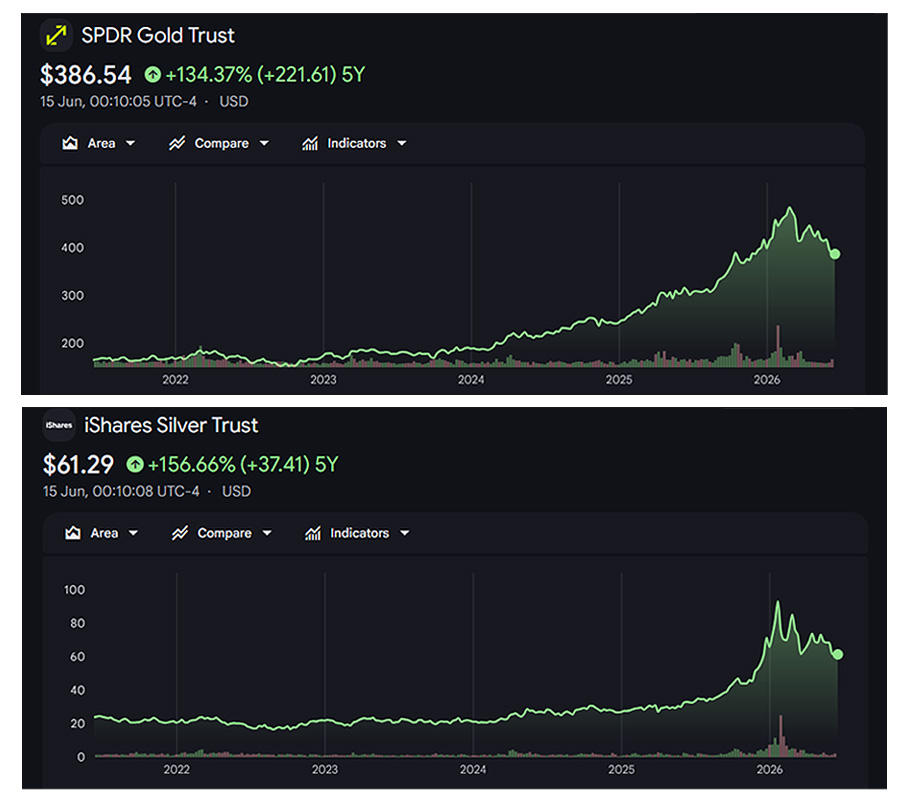
The two most widely held gold ETFs globally are the SPDR Gold Trust (GLD) and the iShares Gold Trust (IAU), both listed on US exchanges. GLD is the largest by assets under management; IAU carries a slightly lower expense ratio. For silver, the iShares Silver Trust (SLV) dominates by size. The Sprott Physical Silver Trust (PSLV) is popular among investors who want allocated physical holdings with a redemption option, making it the closest paper equivalent to direct ownership, though still not ownership itself.
Gold mining ETFs such as VanEck Gold Miners (GDX) and VanEck Junior Gold Miners (GDXJ) offer exposure to mining companies rather than the metal — a different proposition entirely, with company-specific and operational risks layered on top.
Gold and Silver ETFs in Singapore
Singapore investors have two main SGX-listed options: the LionGlobal Singapore Physical Gold ETF (GLS/GLU), backed by physical gold held in a Singapore vault, and the SPDR Gold Shares ETF (O87), a dual-listing of the global GLD fund. There is currently no SGX-listed silver ETF; investors seeking silver ETF exposure typically access US-listed SLV or PSLV through an international broker.
The Tax Case Against ETFs
For Singapore investors, the numbers make a clear argument for physical over ETFs. Investment Precious Metals are exempt from Singapore’s 9% GST. ETFs do not qualify. That’s a 9% cost disadvantage baked in from day one, before management fees are considered. Over a long holding period, with zero capital gains tax on physical bullion in Singapore, the structural advantage of physical gold and silver is significant.
Even outside Singapore, ETF management fees compound silently against returns. Physical bullion, once purchased, carries no ongoing management fee. Storage costs are typically modest and transparent.
ETFs have their place for investors who prefer exchange-traded liquidity. But for investors serious about precious metals as a long-term store of value, physical bullion is the more direct, more secure, and in most jurisdictions more tax-efficient route.
Gold and Silver Futures: High Risk, No Ownership
Gold and silver futures are contracts to buy or sell a fixed quantity of metal at a specified price on a future date. They are the primary tool of institutional traders, commodity producers, and professional speculators — not a route to precious metals ownership.
Futures allow investors to take long or short positions with significant leverage, controlling a large notional position with a relatively small margin deposit. That leverage is the central feature and the central danger: gains and losses are both amplified, and losses can exceed the initial amount invested. Margin calls — demands for additional funds when a position moves against you — can force liquidation at the worst possible moment.
In practice, very few futures contracts result in physical delivery. They are settled financially, which means the entire exercise is price speculation, not metal accumulation. For investors whose goal is to own gold or silver, to hold a real asset outside the financial system, futures are the wrong tool entirely.
For anyone considering futures as a way to gain directional exposure to precious metals prices, we’d suggest stepping back and asking what the underlying goal is. If it’s wealth preservation, a hedge against inflation or currency risk, or simply owning something tangible and enduring — physical bullion does all of that without the leverage, the margin calls, or the complexity. Our Bullion Savings Program offers a straightforward way to build a physical position incrementally, with none of the risks that come with leveraged instruments.
Futures remain useful for professional hedgers and institutional traders with dedicated risk management infrastructure. For everyone else, they are a source of unnecessary complexity and risk in a portfolio that could simply hold the metal itself.
Gold and Silver Mining Stocks: Exposure to the Industry, Not the Metal
Gold and silver mining stocks are often marketed as a leveraged play on precious metals prices. The logic is straightforward: when the gold price rises, mining margins expand faster than the metal price itself, amplifying returns. That’s true in the right conditions, but it’s worth being clear about what you’re actually buying.
A mining stock is a share in a company. You are not buying gold. You are buying exposure to management decisions, operational execution, energy costs, labour relations, regulatory risk, and the jurisdictional stability of wherever the mine happens to be. All of those factors can move independently of the gold price, and frequently do.
How Operating Leverage Works
The appeal of mining stocks rests on operating leverage. Mining companies carry relatively fixed costs, such as labour, energy, equipment, capital expenditure. When the gold price rises, revenues increase while costs stay broadly flat, causing profit margins to expand rapidly.
Example: a miner with all-in sustaining costs of $3,000/oz selling gold at $4,500/oz earns a margin of $1,500/oz. If gold rises 20% to $5,400/oz, that margin jumps to $2,400/oz — a 60% increase in profitability from a 20% move in the metal. The reverse applies with equal force: a falling gold price compresses margins far faster than the percentage decline in the metal itself.
Operating leverage is a double-edged instrument. It amplifies upside in bull markets and accelerates losses when prices fall or costs rise unexpectedly.
Senior Miners, Junior Miners and Royalty Companies
The gold mining universe spans a wide spectrum of risk:
- Senior miners — large established producers such as Newmont, Barrick Gold, and Agnico Eagle. More stable, often dividend-paying, but still subject to all the operational and jurisdictional risks of running large industrial operations.
- Junior miners — smaller, earlier-stage companies focused on exploration or early production. High failure rate; significant upside if a major deposit is confirmed, but most exploration programmes do not succeed.
- Royalty and streaming companies — firms such as Franco-Nevada, Wheaton Precious Metals, and Royal Gold that finance mining operations in exchange for a royalty on future production. Lower operational risk than direct miners, but still equity investments correlated to gold without the directness of owning the metal.

The Case for Physical Over Mining Stocks
For investors whose primary goal is exposure to gold and silver as stores of value, mining stocks introduce a layer of complexity and risk that physical bullion simply doesn’t carry. A gold bar doesn’t have a CEO, doesn’t operate in a politically unstable jurisdiction, and doesn’t report quarterly earnings that can disappoint the market. It holds its value because it is the metal itself.
Mining stocks have historically underperformed physical gold over long periods, despite their theoretical leverage. When you account for operational setbacks, dilutive capital raises, and management missteps, the amplified upside rarely arrives as cleanly as the thesis suggests. Physical bullion, by contrast, does exactly what it promises.
Silver Mining Stocks and ETFs
Silver is predominantly mined as a by-product of other metals, such as copper, zinc, and lead, rather than as a primary product. Pure-play silver miners include First Majestic Silver and Pan American Silver. For diversified exposure to silver producers, the Global X Silver Miners ETF (SIL) and the Amplify Junior Silver Miners ETF (SILJ) offer basket exposure to the sector. The same caveats apply as for gold miners: you are investing in businesses, not in silver.
Comparing Your Options: Physical Bullion vs. Paper Instruments
| Option | Key Benefits | Key Risks |
|---|---|---|
| Physical Bullion | Outright ownership; no counterparty risk; tax-efficient in many jurisdictions; holds value independently of any institution | Larger holdings have significant storage requirements |
| ETFs | Tracks metal price closely; trading-centric framework | No physical ownership; counterparty risk; management fees; typically no GST/tax exemption |
| Futures | Bidirectional trading; high leverage; used for price discovery | High loss potential including beyond initial investment; margin calls; unsuitable for most retail investors |
| Mining Stocks | Operating leverage on metal price; dividend potential from senior miners | Not directly tied to metal price; full company, operational, and jurisdictional risk |
| Royalty Cos. | Lower operational risk than direct miners; diversified revenue streams | Still equity risk; correlated to gold price but not a direct holding |
For investors whose goal is to own precious metals, rather than trade around their price, physical bullion is the only option in this table that actually delivers that. Everything else is a financial instrument built on top of the metal, with layers of cost, risk, and intermediaries between you and the underlying asset.
Tax Efficiency and Storage: The Structural Case for Physical Bullion
One of the most overlooked advantages of physical precious metals is their tax treatment. In a number of jurisdictions, investment-grade gold and silver qualify for meaningful tax exemptions that paper instruments do not. Buying physical bullion in the right jurisdiction, and storing it correctly, can make a material difference to long-term returns.
Tax Advantages for Physical Bullion
Tax treatment of precious metals varies by country, but physical bullion consistently fares better than paper alternatives across most major markets. In the United States, physical gold and silver are subject to capital gains tax, but no sales tax applies in many states on investment-grade bullion. In New Zealand, gold and silver bullion held as a long-term store of value is generally not subject to GST. In Singapore, the advantages are particularly strong.
Singapore: A Premier Jurisdiction for Bullion Investors
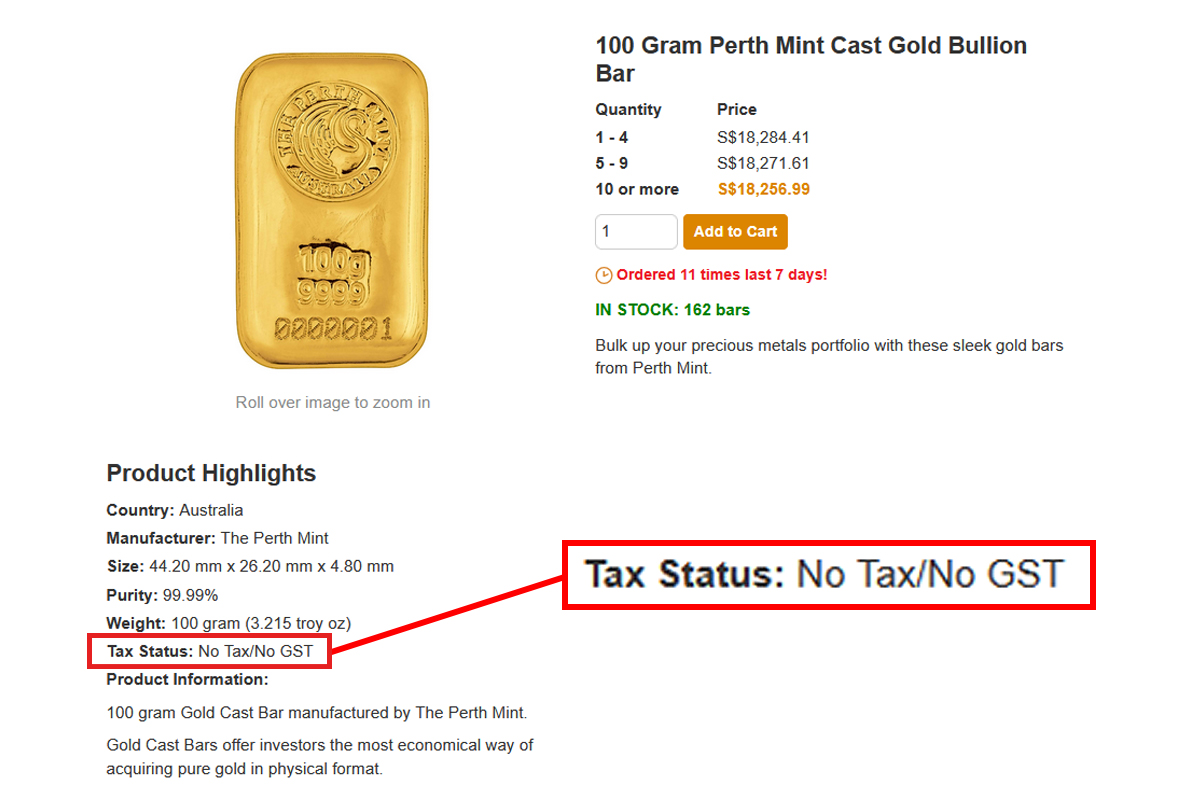
Singapore introduced the Investment Precious Metals (IPM) scheme in 2012, making qualifying gold and silver fully exempt from the standard 9% Goods and Services Tax. This is one of the most investor-friendly precious metals tax frameworks in the world, and it applies from the moment of purchase — a structural advantage that compounds significantly over time.
To qualify as IPM, products must meet specific purity thresholds:
- Gold bars and coins: minimum 99.5% purity. Coins must be legal tender and appear on the IRAS-approved list, including the American Buffalo, Britannia, Canadian Maple Leaf, and Australian Kangaroo.
- Silver bars and coins: minimum 99.9% purity, with the same coin approval framework.
- Platinum bars and coins: minimum 99% purity.
Not all gold or silver products qualify. Collector coins, numismatic pieces, and products below the purity thresholds are subject to the full 9% GST. At BullionStar, all qualifying IPM products are clearly identified so investors can buy GST-free with confidence.
Capital Gains
Singapore levies no capital gains tax on individual investors, meaning profits from buying and selling gold and silver are not taxed regardless of the size of the gain. Combined with the GST exemption on purchase, Singapore is structurally one of the most attractive jurisdictions in the world for physical bullion investing.
Investors based outside Singapore should note that profits realised here may still be reportable in their country of tax residence. Always seek local tax advice if investing from overseas.
Storage: Choosing How to Hold Your Metal
Owning physical bullion requires a storage decision. The right choice depends on the size of your holding, your appetite for direct access, and how seriously you take counterparty risk.
| Option | Security | Access | Insurance | Best For |
|---|---|---|---|---|
| Home Storage | Depends on setup | Immediate | Requires own policy | Small holdings; direct access preference |
| Bank Safe Deposit | Good | Bank hours only | Contents typically not insured | Convenience; small-to-mid holdings |
| BullionStar’s Vault Storage (Allocated) | Highest | Online 24/7 | Fully insured | Larger holdings; security-first investors |
Home storage gives direct control and immediate access, but introduces security and insurance considerations. Silver’s bulk is a potential issue for large holdings — the same dollar value of silver occupies many times the space of an equivalent dollar value of gold.
Bank safe deposit boxes offer a convenient option for smaller holdings, though contents are typically not insured by the bank and access is limited to branch hours.
Private vault storage such as BullionStar’s Vault Storage Solution which is fully allocated, is the preferred option for larger holdings. With allocated storage, specific bars are held in your name and do not form part of the storage provider’s balance sheet. This eliminates counterparty risk and ensures your metals are recoverable even in the event of the vault operator’s insolvency.
Allocated vs. Unallocated Storage: Why the Distinction Matters
For serious precious metals investors, the most important storage distinction is between allocated and unallocated:
Allocated storage means specific, identified bars or coins are held in your name. You are the legal owner of those exact items, fully insured and segregated from the vault operator’s own assets. In the event of the vault operator’s insolvency, your metal is recoverable — you are an owner, not a creditor.
Unallocated storage means you have a claim against the storage provider for a quantity of metal, but do not own specific bars. Often touted as “tokens" or “digital gold", unallocated storage introduces counterparty risk. If the provider becomes insolvent, you become an unsecured creditor. For long-term investors, this is a risk with no compensating benefit.
Allocated storage is almost always the appropriate choice for anyone holding physical bullion as a long-term asset.
BullionStar’s Storage Options in Singapore
BullionStar offers allocated gold and silver storage within our vaults at our Bullion Centre in Singapore and Le Freeport — a high-security, climate-controlled facility near Changi Airport, modelled on Geneva’s famous freeport and one of Asia’s premier precious metals vaulting destinations.
BullionStar’s storage solution provides 24/7 online account access for buying, selling, and withdrawing at any time, full insurance, photographic records of your specific bars, and complete transparency over your holdings.
International investors can hold metals in BullionStar’s Singapore vaults without taking physical delivery, benefiting from Singapore’s political stability, GST-free purchasing environment, and world-class security infrastructure.

Frequently Asked Questions
Is gold GST-free in Singapore?
Yes. Investment-grade gold qualifying as Investment Precious Metals (IPM) under IRAS rules has been GST-free in Singapore since 2012. Gold bars must be at least 99.5% pure and from an approved refiner. Gold coins must be 99.5% pure, legal tender, and on the IRAS-approved list. Non-qualifying gold products (such as most jewellery) are subject to the standard 9% GST.
Can I buy gold bars in Singapore without GST?
Yes, provided the bars qualify as IPM. BullionStar stocks a wide range of GST-free gold bars from approved refiners, available for home delivery or secure allocated storage within our vaults at our bullion centre and at Le Freeport.
What is the difference between paper gold and physical gold?
Physical gold is a tangible asset you own outright — a coin or bar that exists independently of any financial institution. Paper gold refers to financial instruments such as ETFs, futures, or mining stocks that track the gold price but do not give you ownership of physical metal. With physical gold, there is no counterparty risk. With paper gold, your return depends entirely on the continued solvency and integrity of those intermediaries. For investors who want gold’s protective qualities only physical bullion actually delivers them.
Is a gold ETF better than physical gold?
For most investors with a medium-to-long time horizon, no. ETFs carry counterparty risk, charge ongoing management fees, and in many jurisdictions do not qualify for the same tax exemptions as physical bullion. ETFs offer exchange-traded liquidity and low entry minimums, which suit some investors in some circumstances, but they are a financial product built on top of gold, not gold itself. If your goal is to own precious metals as a store of value, physical bullion is the more direct and structurally sounder route.
What is the difference between allocated and unallocated gold storage?
With allocated storage, specific bars are registered in your name. You are the legal owner of those exact items, fully insured and segregated from the vault operator’s assets. With unallocated storage, you have a claim against the storage provider for a quantity of metal but do not own specific bars. This introduces counterparty risk. For long-term investors, allocated storage is almost always the appropriate choice.
Own the Real Thing — Buy Physical Gold and Silver with BullionStar
Paper instruments can track the gold price. Only physical bullion lets you own it.
At BullionStar, we stock a full range of investment-grade gold and silver — bars and coins that qualify as GST-free Investment Precious Metals in Singapore, available for delivery or secure allocated storage. Our 24/7 online platform lets you buy, sell, and manage your holdings at any time, with full transparency over your specific bars and complete insurance cover.
Whether you are building a new position in physical precious metals or moving away from paper exposure toward direct ownership, we’re here to help.
Popular Blog Posts by Gold & Silver 101
 An Introduction to Gold & Silver Investing
 Should I Invest in Gold, Silver, or Platinum Bullion?
 Gold Coins vs Gold Bars: Which Is Better?
 How Is Gold Taxed in Singapore? The IPM GST Exemption Explained
 Storing Precious Metals, Gold, and Silver Bullion
 Gold & Silver Bullion Investing FAQs
 Karat vs Carat: What’s the Difference?
 Gold Purity: The Complete Guide
 How Much Gold Is There in the World?
 Junk Silver: What It Is and What It’s Worth